

Why are 27 kiosks in Hung Dung Market still closed?
(Baonghean)Since 2013, Hung Dung Market in Vinh City has been plagued by numerous controversies regarding the allocation of business spaces inside the market. In March 2014, through the Nghe An Newspaper hotline, several citizens continued to report on the problematic issues at Hung Dung Market, most notably the selection process for those receiving profitable business kiosks...
Information from many residents indicates that Hung Dung Market invested billions of dong in 27 kiosks since the end of 2012, but they have not yet been put into use. This delay has caused significant waste. The reason is the lack of transparency in the approval process. Most of those approved to receive kiosks are relatives of ward officials, while hundreds of policy beneficiaries, veterans, and farmers whose agricultural land was confiscated were excluded.
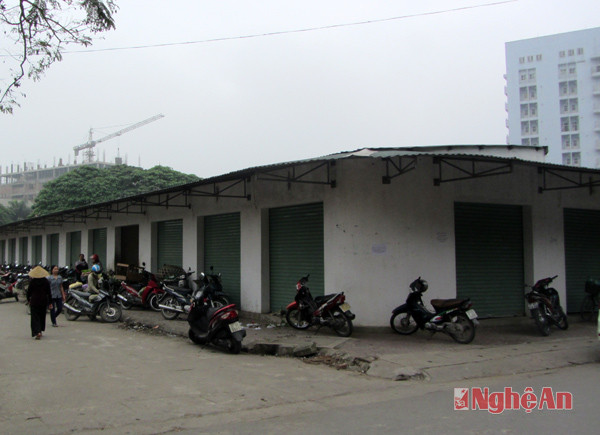 |
| 27 storefront kiosks at Hung Dung market have closed down. Photo: Nhat Lan |
Upon verification, the above information is credible, as to date, 27 kiosks in Hung Dung Market, located along the main road and in advantageous business locations, remain unused. According to our findings, since the end of March 2012, the People's Committee of Hung Dung Ward issued Decision No. 52/QD-UBND approving the economic and technical report for the upgrading project of Hung Dung Market; the total cost is nearly 5 billion VND; the funding comes from the ward's budget and contributions from the people. With this investment, in addition to constructing the following items: road system, drainage ditches, garage, water tank, and renovating toilets, the project also includes the construction of 3 new rows of 39 kiosks with an average area of 14.72 m2/kiosk along the main road; and 214 kiosks selling fish, meat, vegetables, and dry goods with dimensions of 1.25m + 1.68m2/kiosk inside the market. In early 2013, the market renovation was completed, but the number of stalls changed, with 27 stalls along the street front and 253 stalls inside the market.
In October 2012, the People's Committee of Hung Dung ward announced the planning for the investment and construction of kiosks and business premises for those who wished to register, with the following details: Registration for the use of premises for selling fish, meat, vegetables, and dried goods; Registration for auctioning the use of kiosks; Registration for the review of priority groups who needed kiosks but did not have business premises. A responsible official of Hung Dung ward (who requested anonymity) confirmed: Initially, the People's Committee of the ward decided to review 14 kiosks and auction 13 kiosks out of 27 kiosks located on the main street. The priority groups for kiosk allocation were defined in the following order: Policy beneficiaries who needed and were directly involved in business; Veterans who were directly involved in business in the kiosks previously occupied when the ward reclaimed the western area of the market; Agricultural cooperative members whose agricultural land was reclaimed; Employees who are currently working regularly at the agency (whose spouses are unemployed) are eligible. Applications will be accepted from October 5th, 2012 to October 15th, 2012.
There were approximately 130 applications, and although the priority groups were clearly defined, the review process was very difficult, dragging on until the end of 2013 when only 30 candidates were finalized for the Review Council to vote on, from which 14 would be selected. In early 2014, when the voting began, the Review Council was unable to complete it due to fierce competition. Therefore, the Ward People's Committee increased the number of kiosks under review to 21, leaving only 6 for auction. Also from this point, the number of candidates put up for voting by the Review Council increased further as some key officials added applications to request kiosks for their relatives. As a result of the voting, the majority of those who received kiosks were relatives of ward officials, including relatives of the Party Committee, the Fatherland Front, and the ward police.
According to Mr. Nguyen Ngoc Khanh, Vice Chairman of the People's Committee of Hung Dung Ward and Chairman of the Market Allocation Review Council, the upgrading of the market was completed in early 2013. The reason for the delay in putting the 27 kiosks into use was due to the complexities of the market's layout, resulting in numerous complaints and denunciations. The ward spent a considerable amount of time resolving these issues, leading to delays in the review and auction of the 27 kiosks. Regarding the kiosk allocation review, Mr. Khanh stated that to arrange the business area, the People's Committee of the ward established a review council consisting of 21 members representing various departments and heads of agencies within the ward. They widely publicized the process to allow those interested to apply; the review was conducted in a proper and objective manner; and those who met the requirements were selected through a voting process. The voting was successful and the results were publicly posted.
When asked: Why weren't the kiosks in the profitable locations auctioned off by the ward? Why was the number of kiosks approved increased from 14 to 21? According to Mr. Khanh, it was because the demand for kiosks for business from the people and the unemployed children of ward officials was too great. Regarding the question: According to the priority order stated in the kiosk registration notice, is it truly fair? Will those who were excluded be disadvantaged? Without directly answering the question, Mr. Khanh stated that officials whose relatives were on the list of approved candidates had worked for many years and made significant contributions, so they were chosen by the voting council...
On March 21, 2014, the People's Committee of Hung Dung Ward publicly posted a list of 21 individuals who were to receive business kiosks at Hung Dung Market at the community cultural centers in the wards and hamlets. Many residents and ward officials, upon viewing the posted list, clearly identified the relatives of ward leaders who were allocated kiosks and expressed their disapproval. According to Mr. Nguyen Khac Lien, head of Tan Lam ward, the list included individuals who had no need for business use, while those who submitted applications with genuine needs were excluded. Mr. Lien said: "Since 2013, the delay in putting the 27 kiosks into use has been mentioned at several briefing meetings. Looking back at the whole process, I think the People's Committee of the ward should have organized a bidding process for all 27 kiosks. In this case, the selection process should not have prioritized the children of officials, especially those without household registration in Hung Dung, let alone granting them kiosks..."
Mr. Tran Quoc Son, head of the Trung Tien block, also expressed concern about the negative rumors surrounding the list of individuals allocated kiosks that the ward had posted. According to Mr. Son, Hung Dung ward should not have prioritized the allocation of kiosks to the children of ward officials, as this creates favoritism, nepotism, and lacks transparency, while the needs of the people are much greater and more necessary. "Although I'm not originally from Hung Dung, I've lived here for several decades and understand the difficulties faced by those whose agricultural land has been confiscated. The ward shouldn't have prioritized the allocation of kiosks for these individuals, as this leads to unfairness. Instead, they should have organized a bidding process for all 27 kiosks for the people whose agricultural land has been confiscated..." Mr. Son stated.
Many others share similar opinions to Mr. Nguyen Khac Lien and Mr. Tran Quoc Son. For us, the process of prioritizing the allocation of storefront kiosks at Hung Dung Market is not transparent. These storefront kiosks should have been auctioned off to increase revenue for the budget. If prioritizing local residents is necessary, Hung Dung Ward should have organized a limited bidding process to restrict participation. The practice of prioritizing applicants has led to favoritism and favoritism, resulting in many kiosks being allocated to relatives of ward officials, including those who do not live in the area. Consequently, this has led to negative publicity, dissatisfaction among local officials, and resentment among the public. During our investigation into the 27 remaining closed kiosks, we also heard about many other irregularities at Hung Dung Market. These issues include the allocation of land inside the market hall, and the awarding of contracts for the parking area for cars and motorbikes north of the market... To resolve these problems, the Vinh City government needs to pay attention and direct Hung Dung ward to take corrective measures.
Reporters' Team