

It starts with raising public awareness.
(Baonghean) - On July 12, 2010, the Government issued Decree 75/2010/ND-CP on regulations for administrative penalties in cultural activities. Specifically, Point C, Article 18 stipulates a fine of 500,000 - 1,000,000 VND for the act of burning votive offerings at festivals, historical and cultural relics, and other public places. The Decree came into effect on September 1, 2010. After more than four years of implementing Decree 75, the burning of votive offerings still occurs frequently at temples and pagodas.
(Baonghean) - On July 12, 2010, the Government issued Decree 75/2010/ND-CP on regulations for administrative penalties in cultural activities. Specifically, Point C, Article 18 stipulates a fine of 500,000 - 1,000,000 VND for the act of burning votive offerings at festivals, historical and cultural relics, and other public places. The Decree came into effect on September 1, 2010. After more than four years of implementing Decree 75, the burning of votive offerings still occurs frequently at temples and pagodas.
Following the Lunar New Year of the Year of the Horse 2014, festivals take place. With over 1,000 historical and cultural relics, from communal houses, temples, pagodas, and shrines spread across the districts, cities, and towns of the province, and 25 regional festivals, not to mention village, commune, and clan festivals. In Vinh City alone, there are approximately 10 temples, pagodas, and shrines… The beginning of spring is also a time when families and individuals flock to temples and pagodas to pray for good fortune and peace.
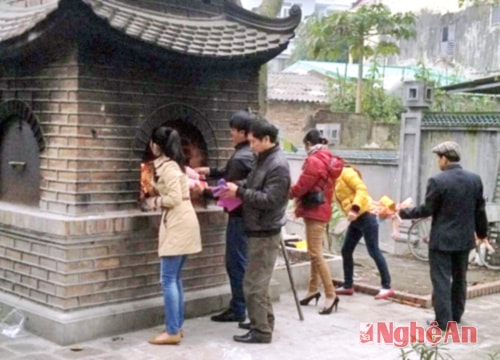 |
| Burning votive paper at Hong Son Temple (Vinh City). |
Walking around the famous and sacred temples and pagodas of the city and surrounding areas, such as Can Linh Pagoda, Hong Son Temple, Quang Trung Temple, An Hau Pagoda, and Ong Hoang Muoi Temple, one can see the bustling atmosphere, attracting visitors from both the North and South. The busiest and most vibrant is arguably Ong Hoang Muoi Temple – a renowned and sacred temple attracting many people from the northern provinces. Because of this, Ong Hoang Muoi Temple is the largest consumer of votive offerings among all temples and pagodas in the province and the city. Just the offerings for the New Year's rituals, prayers for the deceased, etc., in the various chambers of the temple require orders months in advance.
Visiting the Ông Hoàng Mười temple in early spring to offer incense and admire the scenery, one can truly appreciate the bustling crowds from all over the country who flock there to seek blessings and good fortune. It's known that to perform these rituals and pray for peace and prosperity at the temple, people must register in advance. Furthermore, if a family group of 10 or more people attends, a priest is usually present to perform the ceremony. However, the paper offerings are mostly purchased from manufacturers right next to the temple. Where there's demand, there's supply; around the temple alone, there are dozens of households specializing in selling paper offerings, primarily large, medium, and small horses, as well as human figures. A large horse costs 400,000 VND, a medium one 200,000 VND, and a small one 100,000 VND. A family wishing to perform these rituals for just four people would spend nearly 1 million VND on paper offerings.
Playing the role of a customer buying votive offerings for good luck, I was told by Ms. Hai – a producer of votive offerings at the Ong Hoang Muoi Temple in Hung Thinh, Hung Nguyen – that most customers ordering large horses are from Hanoi, Lang Son, Bac Ninh, Yen Bai… and there are also customers from within the province, but mostly business owners. They believe that Ong Hoang Muoi is a high-ranking official, and they come to the temple to pray for fame and fortune. Therefore, they often offer large horses to him so that he will bless their family with wealth, prosperity, and success. Especially this year, the Year of the Horse, almost everyone is ordering large horses. At the beginning of the year, my family couldn't produce enough to keep up with demand; we had to start making them before Tet (Lunar New Year) for customers who placed orders in advance. We know the government prohibits burning votive offerings at festivals, temples, and pagodas, but we have to make them when customers order them. We only stop producing when there are no more orders.”
Visiting Hong Son Temple in Vinh City on the afternoon of the 11th day of the lunar month in 2014, the temple's halls were crowded with families seeking to ward off bad luck and pray for good fortune at the beginning of the year. Ms. Thai Thi Van from Truong Thi Ward, Vinh City, said: “Every year, my family chooses Hong Son Temple to ward off bad luck at the beginning of the year. Besides offerings like fruits, cakes, and candies, we can't do without paper money. If we don't buy it, we feel something is missing and we're not at peace. Burning paper money has become a belief that no one can abandon, so we can only try to minimize it.” Ms. Hoang Thi Nga (Dong Vinh Ward, Vinh City) added: “The burning of paper money during Tet, the 15th and 1st days of the lunar month, or when going to temples to pray for peace and ward off bad luck has been around since ancient times. If the government is going to ban it, they should ban excessive amounts of paper money used in these rituals. I've witnessed families burning millions of dong worth of paper money and offerings, which is both wasteful and environmentally polluting. Every citizen should remember that when they burn paper money, they are burning their own hard-earned money.”
It's true that burning votive paper money during rituals to ward off bad luck, pray for good fortune, and visit temples at the beginning of the year has long become an indispensable habit for the vast majority of people. Some buy just a small amount of paper money, while others buy countless items (horses, houses, cars, boats, human figures, etc.) of all kinds. Depending on the client's needs for warding off bad luck, praying for good fortune, resolving grievances, or giving thanks, the ritual masters will specify the items to be purchased. For example, for a ritual to ward off bad luck at the beginning of the year, the client might need to buy: 10 bundles of paper money, human figures (one for each person), boats, horses, duck eggs, pork, fruits, cakes, and candies of all kinds…
According to the abbot of An Hau Pagoda in Nghi Duc commune (Vinh City): “The burning of votive paper has been deeply ingrained in the consciousness of Vietnamese people since ancient times, so it cannot be abandoned overnight. To ensure people comply with the decree, the State needs to implement practical measures. At An Hau Pagoda, 100% of Buddhists do not burn votive paper, even on major occasions throughout the year such as the full moon of the first, seventh, and eighth lunar months… From the pagoda's perspective, the government's issuance of this decree is very correct. Burning votive paper is not beneficial and also harms the environment and wastes a lot of people's money. However, on major holidays, according to tradition, the pagoda still has to arrange some places for Buddhists and people to burn votive paper. We do not encourage people to come to the pagoda to perform this ritual. Buddhist scriptures do not teach Buddhists to burn votive paper, but the custom of burning votive paper is the most common practice among Buddhists. Therefore, the Buddhist Association and pagodas need to provide guidance and explanations to prevent this practice.” Enlightened Buddhists recognize the harmful effects of this activity and will proceed to do better."
To effectively implement Decree 75, the Department of Culture, Sports and Tourism has recently sent official letters to the People's Committees of districts, cities, and towns, the Culture and Sports Departments, the Culture and Sports Centers, and temples and pagodas throughout the province. Training sessions have been organized on festival management, decrees and regulations on penalties for violations during festivals, especially the prohibition of burning votive paper at festivals and historical sites. Annually, during the Spring Festival and other festivals, the Department of Culture, Sports and Tourism organizes inspection teams to monitor festival preparations and superstitious activities, and will strictly penalize cases of burning large quantities of votive paper. However, to minimize this phenomenon, localities and temple/pagoda management boards need to strengthen public awareness campaigns to educate people about the wastefulness and environmental pollution caused by such practices.
Text and photos:Thanh Thuy