

Price caps on milk: Benefits for consumers.
Although there are still some concerns about the difficulty of the Ministry of Finance implementing a price ceiling on powdered milk products for children under 6 years old, most consumers and many economic experts have high hopes and confidence in the positive outcome of this plan.
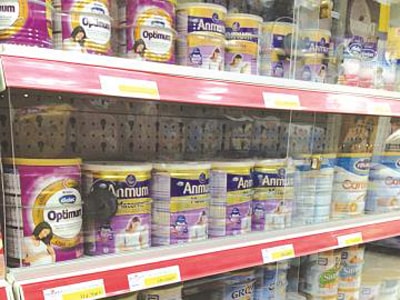 |
| Addressing the current milk price situation in our country requires a combination of measures, not just imposing a price ceiling. |
Hopeful
Recently, the Ministry of Finance proposed a plan to stabilize milk prices in accordance with the Price Law at the regular government meeting in April. This proposal was approved by the Prime Minister, and accordingly, businesses must register prices for milk products for children under 6 years old, with a registration period of 6 months. In addition, relevant agencies will regulate the maximum price for milk products for children under 6 years old, with a price ceiling period of 12 months. Therefore, when the official information was released, with calculations showing that, on average, each box of milk for children under 6 years old would be 50,000-70,000 VND cheaper under the price ceiling, many consumers expressed great enthusiasm.
Also discussing this issue, economist Dr. Ngo Tri Long believes that while many people expect the price ceiling on milk to stabilize the market, expectations shouldn't be too high because its feasibility requires a combination of other measures. A price ceiling will benefit consumers and force milk companies to constantly strive to reduce business and advertising costs to lower prices below the ceiling, thereby encouraging healthy competition. However, the downside is that if the price ceiling is incorrectly determined, unprofitable companies will have to cease production and business, leaving consumers without or no access to the product.
According to Mr. Vu Vinh Phu, Chairman of the Hanoi Supermarket Association, the recent inspection of five milk companies also uncovered issues related to taxes and pricing, but this must be done continuously. Focusing on key areas is essential to resolving fundamental problems. Using administrative measures to inspect milk prices is only a temporary solution. "When applying this measure, consumers may still benefit, but not in the long term," Mr. Vu Vinh Phu stated.
Blocking loopholes
According to a reporter's survey, information has emerged in the market about some milk products circumventing price caps by reducing the volume while maintaining the same price, or changing the packaging and adding certain substances to justify price increases. The owner of a milk distributor on Quan Nhan Street in Hanoi confirmed that he was aware of this information and anticipates changes around mid-May, such as reducing the 900g milk carton to 850g while keeping the price the same.
Regarding the issue of dairy companies "circumventing the law," Mr. Vu Vinh Phu stated: "Price increases don't necessarily mean blatant price hikes. Dairy producers and businesses have many ways to circumvent the law, such as changing packaging and designs, adding certain ingredients to formula milk, etc. With hundreds of types of milk, hundreds of formulas, and hundreds of suppliers, it's difficult for regulatory agencies to inspect them. This is a very complex issue."
To prevent these loopholes, according to Dr. Ngo Tri Long, price caps must be accompanied by regulations on product quality, not just vague statements. For infant formula, it must be clearly stipulated whether the product meets the required weight and micronutrient content. Therefore, milk producers and businesses will find it difficult to comply with this policy. The important thing is that the State must carefully consider the conditions and policies to ensure they are reasonable given the current diversity of this product.
According to Associate Professor Dr. Nguyen Van Nam - former Director of the Institute of Trade Research, the State must closely manage the market, understand the output, input, revenue, and profits of businesses in order to formulate timely adjustment strategies.
Arguing that price caps on milk haven't addressed the root cause of the current chaotic milk prices, Mr. Vu Vinh Phu proposed three issues that need to be resolved more than anything else. First, production needs to be boosted; domestic businesses should be encouraged to shift to the untapped market for powdered milk, guiding consumers toward domestically produced milk. A mismatch in production structure won't solve the fundamental problem. Second, the distribution system needs to be reorganized. Finally, the market must be controlled, and information gathered to handle situations where businesses overcharge or raise prices unreasonably. These three issues, combined with collaboration from the Tax Department, Customs, and the Ministry of Industry and Trade, are necessary to address the root of the problem.
Assoc. Prof. Dr. Nguyen Van Nam - Former Director of the Institute for Trade Research: Increased competition and stricter management. Price caps on milk may have some immediate effects, but foreign dairy companies are international-scale enterprises with years of experience, so they can easily find ways to circumvent them. These companies have very sharp claws, so the government needs to create a very thick barrier to prevent them from piercing through. Therefore, managing through economic rather than administrative measures is the most effective way to solve the problem. The government should learn from some countries around the world that have implemented price management measures by encouraging fair competition and breaking monopolies. To achieve this, the government must have policies to support domestic dairy businesses to become strong competitors. In addition, at the import stage, it is necessary to facilitate the entry of many businesses, preventing a few companies with large market shares from operating in a monopolistic manner, forming a "clique" to collectively raise prices. Crucially, the government must closely and thoroughly manage the market, understanding the input, output, revenue, and profits of businesses to develop timely adjustment strategies. Mr. Nguyen Manh Hung - General Secretary of the Vietnam Association for Standards and Consumer Protection (Vinastas): Consumers welcomed it. Recently, consumers have highly praised the actions of the State and relevant agencies in stabilizing milk prices. I believe that the price ceiling measure for milk proposed by the Ministry of Finance and approved by the Government will certainly have a positive and long-lasting impact on the market and consumers. The important issue is how it will be implemented. The State must use all means to manage the market and cannot allow it to fluctuate with unreasonably high milk prices. I believe that if this measure fails, the State will use other measures. Consumers can exercise their right to choose to boycott milk products that engage in "circumventing the law." Mr. Pham Van Nhan - Deputy General Director of Moc Chau Dairy Cattle Breeding Joint Stock Company: Nothing is specific yet. The new milk price ceiling only applies to powdered milk products for children under 6 years old, so the company's products are not affected. However, if regulations on milk price caps are also applied to liquid milk products, businesses will certainly comply, as these are government regulations based on market research and consumer feedback. Currently, nothing is concrete, so businesses must wait for the results before formulating appropriate business plans. Furthermore, the milk price cap will mainly affect large businesses, while small businesses with low production volumes will not be a concern. |
According to the Customs newspaper.