

Measles - Unpredictable complications
(Baonghean)In folk belief, measles is considered a self-limiting disease and not considered dangerous. However, the current situation with measles is unpredictable: the number of children with complications is increasing, and in the North alone, as of April 17th, 111 children have died.
Use caution when taking medication.
For over three months straight, Dr. Nguyen Van Son, Head of the Infectious Diseases Department at Nghe An Obstetrics and Pediatrics Hospital, and his colleagues have been battling measles patients, leaving them exhausted. He himself cannot fully explain the complexity of this year's measles outbreak, especially with cases of complications. More than 10 critically ill children have had to be transferred to higher-level hospitals for treatment. At this point, the health sector cannot confirm whether any of the 110 patients who died at the National Children's Hospital were transferred from Nghe An.
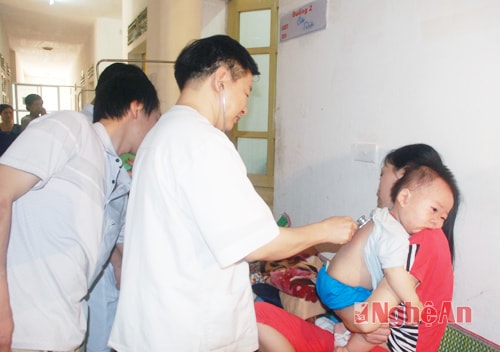 |
| Checking the health of children with measles at the Infectious Diseases Department, Nghe An Obstetrics and Pediatrics Hospital. Photo: Thuy Hien |
Following the case of Ngo Ba L (Dien Hoa, Dien Chau), who was transferred to a central hospital on the morning of April 16th in a serious condition with slow progression, shows how unpredictable measles can be. L was admitted to the hospital on April 6th with common symptoms such as fever, cough, and runny nose. After two days, red blisters appeared on the outer surface of his leg, and his lower leg swelled. Initially, doctors diagnosed him with upper respiratory tract infection and inflammation of the right lower leg, suspected to be caused by an insect bite. However, after six days of treatment, L's condition did not improve, and he developed symptoms such as high fever, multiple rashes, and prolonged fever. At this point, it was discovered that L had severe pneumonia due to measles. His condition improved slowly after being transferred to the infectious disease ward. On the morning of April 16th, after 10 days at the Obstetrics and Pediatrics Hospital, at the family's request and based on L's health condition, he was transferred to the National Children's Hospital…
With over 20 years of experience, Dr. Nguyen Van Son believes that measles is a difficult disease to diagnose, with only about 67% of cases being diagnosed initially. Therefore, many pediatric patients are transferred to the infectious disease department for measles treatment from other departments or medical facilities, often due to severe pneumonia developing into measles. Because of this difficulty in diagnosis, many medical facilities and doctors prescribe corticosteroids such as Hydrocortisone, Prednisone, Betamethasone, Dexamethasone, Prednisolone, and Salumodin during treatment. These drugs are widely used, even considered a "miracle cure" at one time because they can treat almost any ailment and provide quick relief. They are also frequently used to combat critical situations such as pain, infection, or inflammation in the early stages, as well as skin allergies, respiratory allergies, and severe asthma.
However, corticosteroids also have many harmful effects if used long-term. Specifically for children with measles, the drug weakens the immune system, preventing the measles rash from erupting and worsening the disease. Dr. Tran Van Son added: Up to 30% of children with severe measles have a history of corticosteroid use. He himself has advised many families, attended numerous conferences, and even consulted colleagues, but the misuse of the drug remains widespread. This is extremely dangerous.
Before measles appears, children usually only have common symptoms such as mild fever, dry cough (without phlegm), runny nose, red eyes, headache, sore throat... According to Dr. Nguyen Van Son's advice, it is best to treat symptoms only when the cause is not yet known, such as fever with antipyretics, cough medicine with antitussives, and antibiotics to detect signs of infection, but absolutely not to use medications containing corticosteroids. Don't be overly worried and rush your child to medical facilities for treatment when they only have a mild fever; in many cases, they are prescribed corticosteroids, which can suppress the measles eruption and lead to complications. In reality, measles can resolve on its own after 7-10 days if the child does not have other unusual symptoms such as: fever not decreasing with antipyretics, lethargy, difficulty waking up, seizures, or continued fever even after the measles rash disappears.
Monitoring of cases under treatment shows that the majority of children with measles had not been vaccinated previously, and even those who had only received one dose had a relatively high chance of contracting measles.
Increase vaccination rates.
There are many reasons why many children have not been vaccinated, including against measles. Ms. Le Thi Lien, from Nghi Huong ward, Cua Lo town, whose daughter is over 3 years old and is being treated in the infectious disease ward, said: "Previously, every time we prepared for vaccinations, my daughter would get a fever, so we kept delaying the vaccination." Conversely, many families, worried about complications after vaccination, do not take their children for vaccinations. This inadvertently makes children more susceptible to diseases, especially infectious diseases. Measles is a highly contagious disease, mainly transmitted through the respiratory tract, so it easily spreads widely if there are no timely preventive measures. Dr. Tran Dinh Can - Head of the Health Station of Ha Huy Tap ward, said: "In 2013, partly because vaccination was suspended for a long time, and partly because of concerns, the vaccination rate for children was only about 50%." According to an investigation by the Center for Preventive Medicine, the province currently has approximately 13,969 children aged 9-24 months who need the first dose of measles vaccine and 19,582 children aged 18-24 months who need the second dose of measles vaccine.
Following Decision No. 601/QD-BYT dated February 20, 2014, of the Ministry of Health, and the directive from the Provincial People's Committee on "measles vaccination and catch-up measles vaccination," the campaign to encourage people to bring their children for vaccination has begun in localities over the past month. According to the plan, this supplementary measles vaccination will be completed by the end of April 2014. Mr. Nguyen Dinh Thanh, Director of the Preventive Medicine Center of Hung Nguyen District, said: While the district survey only shows 1,032 children receiving the first and second doses, an additional 79 children from outlying areas have also registered to receive the full number of doses.
On the morning of April 17th, the Yen Thanh District Health Center administered 810 doses of measles vaccine to children aged 9-24 months. To ensure this measles vaccination campaign achieved its target, the District Health Center directed each vaccination site to ensure safe vaccination conditions, including: facilities, equipment, medicines, and emergency vehicles as prescribed by the Ministry of Health; and to assign at least two trained and certified staff members. Simultaneously, it instructed communes and towns to focus on identifying children aged 9-24 months who had not yet received the measles vaccine; children aged 18-24 months who had not been vaccinated or had received one dose of the measles vaccine more than one month prior to the vaccination campaign; and to coordinate with village heads to compile a list of transient individuals to be included in the vaccination list, striving for 100% vaccination coverage for children in the target age group.
Mr. Phan Nguyen Truyen, Deputy Head of the Medical Operations Department of the Department of Health, affirmed: "We will create the best possible conditions to ensure safe vaccination. The department has also prepared sufficient vaccines, needles, and syringes. Previously, an inspection of the conditions to ensure safe vaccination facilities was conducted throughout the province. Health stations that did not meet the requirements were reminded and promptly rectified. If necessary, mobile vaccination points can be organized outside the health stations."
- According to data to date, 111 children have died from measles. Concerned about the spread of measles, on April 16th, Prime Minister Nguyen Tan Dung issued a directive requesting ministries, agencies, and localities to focus on measles prevention and control, proactively preventing the spread of the disease, and minimizing the number of cases and deaths. The Chairmen of the People's Committees of provinces and cities are to coordinate with the Ministry of Health to direct the vigorous implementation of emergency care and effective treatment of patients, contain outbreaks, and thoroughly address the situation to prevent further spread. According to statistics from the Department of Preventive Medicine, 80% of measles patients recorded nationwide were unvaccinated. According to Vietnam's Expanded Immunization Program, children are recommended to receive their first measles vaccine dose at 9 months of age. A booster dose is given after 12 months of age. In some other countries, children begin measles vaccination at 12 months of age. According to health experts, besides the risk of measles infection due to lack of vaccination, it is also possible that individuals who have received all necessary vaccinations may still contract measles, as no vaccine provides 100% immunity. |
My Ha