
Bach Ma Temple: An attractive cultural and spiritual tourist destination.
(Baonghean) - In folk beliefs, Bach Ma Temple in Vo Liet commune, Thanh Chuong district, is one of the four temples with historical, cultural, and sacred value in the Nghe Tinh region: "First Corn, second Qua, third Bach Ma, fourth Chieu Trung". And today, Bach Ma Temple also holds a special place in the cultural, spiritual, and religious life of the local people and visitors from all over who come annually to admire the temple and pray for good fortune, especially during the annual festival held on the 9th and 10th of the 2nd lunar month.
(Baonghean) - In folk beliefs, Bach Ma Temple in Vo Liet commune, Thanh Chuong district, is one of the four temples with historical, cultural, and sacred value in the Nghe Tinh region: "First Corn, second Qua, third Bach Ma, fourth Chieu Trung". And today, Bach Ma Temple also holds a special place in the cultural, spiritual, and religious life of the local people and visitors from all over who come annually to admire the temple and pray for good fortune, especially during the annual festival held on the 9th and 10th of the 2nd lunar month.
From the Bạch Mã Temple relic
According to many historical records, the Bach Ma Temple was built during the Le Dynasty to worship Phan Da (the White Horse God) - a talented general who made great contributions to the war against the Ming invaders in the 15th century. According to folk legends and historical records preserved at the temple, General Phan Da was born in the early 15th century into a family of fishermen living along the Lam River, in Chi Linh village, Vo Liet commune, Tho Du district (now Khai Tien village, Vo Liet commune, Thanh Chuong district).
Phan Đà was orphaned at a young age and taken in by a blacksmith in the village. As a young boy, Phan Đà was intelligent, handsome, and skilled in martial arts and archery, earning him the nickname "prodigy." When foreign invaders attacked, Phan Đà gathered his troops and trained them day and night. In 1418, Lê Lợi raised the banner of the Lam Sơn rebellion in Thanh Hóa, and later established a base in Nghệ An to fight against the Ming invaders. General Phan Đà joined the Lam Sơn rebels with his forces and, along with the militia of Võ Liệt village, enthusiastically participated in many battles to defeat the enemy.
Phan Đà was a resourceful and courageous general who "charged into battle as if it were an empty space," striking fear into the enemy on many occasions. During one mission to gather intelligence on the enemy while disguised, Phan Đà visited a village festival and was discovered. He single-handedly fought the enemy and was severely wounded. Knowing his master was in danger, his loyal warhorse, in a frenzy, broke through the encirclement and swam back to their base. Upon arriving, Phan Đà breathed his last. In 1428, when Lê Lợi ascended the throne, recognizing Phan Đà's great service, he bestowed upon him the title of "Great Emperor Bạch Mã Thưởng đẳng phúc thần" (Great White Horse God of Heavenly Fortune), and provided funds to local officials to build a magnificent temple, which is now known as the Bạch Mã Temple (White Horse Temple).
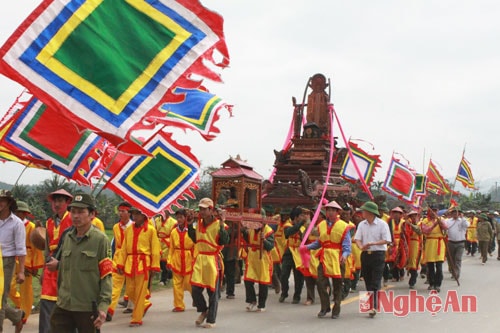 |
| Procession at Bach Ma Temple. Photo: Duy Hung |
According to historical records and legends, since his sacrifice, the spirit of the brave general Phan Đà has repeatedly manifested itself, saving the people from natural disasters and epidemics, and also protecting the kings and generals in defeating their enemies. In the 6th year of Quang Thuận (1465), King Lê Thánh Tông, on his way to conquer the South, visited Bạch Mã Temple and performed a prayer ceremony there. After returning victorious from battle, the king ordered additional offerings and worshippers to be provided to the temple. Subsequently, in the 3rd year of Cảnh Hưng (1770), Duke Bùi Thế Đạt, leading his army to fight the enemy in Trấn Ninh, also visited the temple to perform a prayer ceremony. After a great victory, he petitioned the king to bestow upon the temple the title of "Thượng đẳng tối linh mỹ từ," meaning the most sacred temple.
This temple also recorded many important historical events and milestones during the nation's revolutionary struggle. During the Nghe Tinh Soviet movement of 1930-1931, Bach Ma Temple became a location closely associated with many struggles of the people of Thanh Chuong. On April 13, 1930, on the day of the festival, the people of Vo Liet gathered at the temple to fight, forcing the local officials to allocate 41 acres of land to the poor. Terrified by the people's spirit, the officials were forced to concede. The people of Thanh Chuong achieved a decisive victory in the demonstration on September 1, 1930, establishing the first Soviet government in the two provinces of Nghe An and Ha Tinh. Along with Vo Liet communal house and many other locations, Bach Ma Temple became a place for organizing many secret activities of the Thanh Chuong peasant organization. In 1945, the people of Vo Liet commune again chose Bach Ma Temple as a gathering place to fight for the return of land to the farmers…
Today, Bach Ma Temple is still preserved on the exact site where it was built centuries ago, in Vo Liet commune, Thanh Chuong district. From Vinh City, following National Highway 46 through Hung Nguyen and Nam Dan, Bach Ma Temple is located right on the road connecting National Highway 46 with the Ho Chi Minh Trail, about 3 km from Ro Bridge. Situated on an area of about 5,000 square meters, although weathered by time, the temple still retains its majestic and solemn appearance in a rare tranquil and peaceful setting compared to other temples. This is the main attraction of Bach Ma Temple, drawing many locals and tourists from near and far to come here for contemplation and to enjoy the scenery. Especially on the first day of the Lunar New Year and on the first and fifteenth days of each lunar month, the temple always attracts a large number of people from the surrounding area to light incense and pray for peace and good fortune, becoming a spiritual cultural tradition of the people here.
Mr. Tran Van Huu, Head of the Bach Ma Temple Management Board, said: Bach Ma Temple consists of the triple gate, ceremonial gate, upper hall, middle hall, lower hall, left wing, and right wing. It is a beautiful and unique architectural work with a harmonious layout and many exquisitely carved details. The hall also preserves many rare documents, artifacts, and ritual objects, adding to the historical and spiritual value of the temple. With its immense historical, cultural, scientific, and artistic value, Bach Ma Temple was classified as a national historical monument by the Ministry of Culture and Information (now the Ministry of Culture, Sports and Tourism) in 1994.
In recent times, Thanh Chuong district has focused on attracting capital from various sources to invest in the restoration of the historical site, including building a stadium to host activities at the temple; constructing a fence, access road to the site, and some ritual objects within the temple... Currently, the Bach Ma Temple has been approved by the Provincial People's Committee for restoration, repair, and construction with a total investment of up to 27 billion VND. The remaining issue is to expedite the process to secure funding so that this project can be implemented soon, befitting its grandeur and status as one of the "four sacred temples" of Nghe An province.
Attend the Bach Ma Temple Festival
Historical records show that the rituals at Bach Ma Temple were organized very seriously and on a large scale from the Le Dynasty to the Nguyen Dynasty. The rituals at Bach Ma Temple are considered "national" in nature. According to the book "Do Thien Dai De Linh Tu Van" by author Hoang Ba Dat, the rituals at Bach Ma Temple were previously held twice a year. The national ritual was held in February, and the joint ritual (worshiping all the gods in the region) in March of the lunar calendar. Since ancient times, the rituals at Bach Ma Temple have always been meticulously and seriously organized with many rich activities: the ritual of worshiping the gods, the procession of the ancestral tablets from the maternal hometown of General Phan Da to the temple; folk games such as swinging, cockfighting, wrestling, boat racing, etc.
According to Mr. Tran Duy Hung, Director of the Thanh Chuong District Cultural and Information Center: The Bach Ma Temple Festival was revived in Thanh Chuong district in 2001 and has been held annually since then, on the 9th and 10th of the second lunar month, on a district-wide scale. The annual Bach Ma Temple Festival aims to commemorate the merits of General Phan Da and other ancestors who contributed to building and protecting the nation, demonstrating the traditional Vietnamese principle of "drinking water, remembering the source"; and at the same time, contributing to the preservation and promotion of the cultural and spiritual values of the people through the ceremonial and festive activities.
The festival also serves as an opportunity to strengthen cultural, artistic, and sporting exchanges; to enhance solidarity and build a vibrant competitive spirit among all segments of the population to successfully accomplish the local tasks in 2014. Mr. Tran Duy Hung also added: The 2014 Bach Ma Temple Festival will be organized with both ceremonial and festive parts. The ceremonial part includes the opening ceremony, the incense offering ceremony at the tomb of General Phan Da and the incense offering ceremony at Phu Ngoai, the procession, the announcement ceremony, the worship ceremony, and the thanksgiving ceremony. The festive part includes traditional cultural and sporting activities such as wrestling, traditional wrestling, card games, cockfighting, pot smashing, tug-of-war, combined with modern cultural and sporting activities such as football and volleyball matches, as well as poetry recitation, poetry recitation and painting, artistic exchanges, and beauty contests…
In addition, the district also coordinated with the Soviet-Nghe Tinh Museum to display an exhibition on the revolutionary movement of 1930-1931 and organized propaganda film screenings. This is one of the very practical activities to give the people and the younger generation of Thanh Chuong the opportunity to learn about the fine traditions of their homeland. The festival organizing committee also set very high requirements for ensuring the safety of people and tourists participating in the festival, so it assigned the District Police and volunteer youth teams to protect security, order and traffic safety during the festival; established a food safety inspection team to inspect food and beverage businesses serving tourists... Strictly implementing the festival regulations, resolutely preventing any distortions such as: disguised gambling games, indiscriminate burning of votive paper, superstitious activities...
With noble intentions, meticulous and elaborate preparation, and solemn and respectful organization, the annual Bach Ma Temple Festival is always an ideal destination for tourists at the beginning of spring, a place where people come to worship and express their reverence and gratitude to the ancestors who contributed to protecting and building the country. Mr. Vo Van Tien, Vice Chairman of the Thanh Chuong District People's Committee, shared: The Provincial People's Committee's approval of the project to restore, renovate, and build the Bach Ma Temple relic with a total investment of 27 billion VND has affirmed the position and immense historical and cultural values of this temple.
This will also be an opportunity for Thanh Chuong district to proactively develop Bach Ma Temple into an attractive cultural and spiritual tourism destination; linking the formation of historical and cultural tourism tours, given that Thanh Chuong currently has hundreds of relics and scenic spots, including over 30 classified relics; and focusing on developing sightseeing and resort tourism along the Ho Chi Minh Highway, especially when the Thanh Thuy Border Gate becomes operational in the near future. According to Mr. Vo Van Tien, the Bach Ma Temple Festival, held annually, attracts tens of thousands of participants each year, becoming an indispensable traditional cultural activity for the people. Therefore, in the future, it is hoped that the Bach Ma Temple Festival will be upgraded to a regional-level event within the province.
Minh Chi