

The saying "ginger is spicy, salt is salty" weighs heavily on my mind.
(Baonghean)“My dear… Salt remains salty even after three years, ginger remains spicy even after nine months. But our love is deep and strong, even if we are separated, thirty-six thousand days… will not be far.” That folk song, from childhood, haunted the farmer from the rice-growing region of Yen Thanh, so much so that, as he said, “I followed folk songs for a lifetime, yet I never fully understood a single verse.”
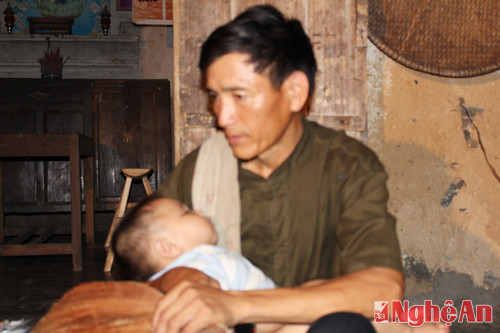 |
| Artist Nguyen Canh Son in a scene from the lullaby "Ten Virtues of Parents". |
The small house of folk artist Nguyen Canh Son is nestled in the middle of the village, with vast fields in front and on either side, and pine hills behind, where the wind whistles year-round. Inviting us in, his wife, Mrs. Hoi, eagerly recounted: “He just came back from practicing singing with the children at the school; I heard the village's cultural unit is preparing to welcome us.” She said we were lucky to be home earlier than usual, because “every day he goes out from morning until noon, then out again until evening. Since he started teaching folk songs at the school, he’s been constantly on the go. He’s always out, and when he gets home, he sings…”
The story of Mr. Son's passion for singing is well-known throughout Dong Thanh commune. People in Dong Xuan hamlet recount that from a young age, Son would toddle along with his mother to watch and listen to singing. By the age of six or seven, he insisted on joining the village's aunts and uncles in singing folk songs on moonlit nights. Once, he skipped school to watch a performance, and even after being punished by his parents, he didn't stop. Then, Nguyen Canh Son began his singing career right in the fields, on the village stage… and that became his lifelong stage.
Mrs. Hoi told us that the song was truly a blessing, a destiny that gave her a complete family. She was captivated by her husband's singing, angry at him because he loved singing so much, and quickly forgot her anger because... listening to him sing made amends. Sometimes he would sing lullabies to her grandchildren, other times he would sing for both her and her grandchildren. He was away all day, and when she came home angry, she would see him smile and sing: "Our love is deep and strong / Even if we are far apart, thirty-six thousand days will not be far." She said, hearing that, who could still be angry? She added that something even more special about her family was that both her husband, Mr. Son, and her mother-in-law were recognized as folk artists on the same occasion. Mrs. Hoi's mother, artist Tran Thi Nhu, is nearly 100 years old and still loves singing, participating in the Dong Thanh Commune Folk Song Club with her son-in-law.
Nguyen Canh Son admitted that he was just an "ugly guy" but "had a voice that could redeem him." We jokingly said he was "like Truong Chi," and he smiled brightly, nodded, and began to sing. While singing, he enthusiastically told us about each genre, explaining what "vi do dua" (boatman's song), "vi dong truong" (field song), "vi do dua ngui" (boatman's song against the current), "vi leo mountain" (mountain climbing song), "dam Duc Son," "dam ve," "dam cua quan," "dam narrated," "dam noi," "dam noi" (connecting song), "dam xam" (blind minstrel's song)... He sang as if a silkworm were tearing itself out, as if he wanted to convey to us the depth and affection of the song... We sat silently listening to him sing, and it was as if we could see before our eyes the village of yesteryear... Those moonlit nights, by the fields or under the pine hills, people irrigating the fields, gathering pine needles, and singing. A song that made us forget poverty, a song that made us forget hunger, a song that brought love, a song that multiplied our love for our homeland and our country.
Mr. Son recounted that, for reasons unknown, that proverb had captivated him, leaving him utterly enchanted for a lifetime. Perhaps it was from the cradle, when he heard his mother sing, "Salt that's been salted for three years is still salty..." Therefore, from the moment he learned to sing clearly, young Canh Son hummed the bitter, spicy, salty verses. The profoundness, the "love" of the land and people of Nghe An, "contained in a single song, yet enough to last a lifetime." He remembered his childhood, clinging to his mother's clothes to go listen to singing. Sometimes, when his mother wasn't there, he'd fall asleep in a corner of the yard listening to performances. Whenever there was a cultural performance in the district, he'd beg his parents to let him ride his bike there every day. The family only had one old bicycle, and the chain often came off. Every time he came home, his face was covered in dirt, and even though he'd get spanked, he'd still find ways to go. Despite the spanking, deep down, his parents still loved and indulged him. Whenever he liked a song, his father would go searching for it, copying it by hand for him to practice. And so, the boy's audience was sometimes his family, sometimes the pine forest during harvest season, sometimes the endless rustling cornfields, sometimes the night sky with its thousands of twinkling stars… Once, in the middle of the night, his father woke up and couldn't find his son. He frantically searched and found him sitting quietly in the pine forest behind the house…singing. Another time, Dong Thanh commune organized a cultural performance, and the boy insisted that his mother register him for a performance. Seeing her son's fervent desire, the mother, having just returned from the fields, her feet muddy and her trousers uneven, ran to the commune office to ask for permission for her son to sing. That night, Canh Son stood on a crowded stage for the first time and sang a folk song he had learned from the women, and everyone praised it. Canh Son heard the thunderous applause from below, and his heart felt like it was going to leap out of his chest. His joy wasn't simply about expressing himself, but about sharing, about seeing his own joys and sorrows spreading...
However, the "stage" he remembers most vividly in his life is the battlefield. Those were the years he served in the military (1979 to 1985) on the northern border. While enemy artillery shells echoed from the other side, he continued to sing. Songs like "Borderland Evening" (Tran Chung), "Artillery Pulling Chant" (Hoang Van), and "Eastern Truong Son" were performed."Western Trường Sơn" (Hoàng Hiệp), "The sound of gunfire has echoed across the border sky" (Phạm Tuyên)... On rainy nights, with rumbling stomachs, the soldiers in the unit only had a little dried rations left, sharing each piece of bread, looking at each other with overflowing love as they sang, "Oh, my dear, the border evening / Is there any place higher / Like the head of the river, the head of the stream / Like the head of the clouds, the head of the wind / Like the sky of our border homeland…". His performing arts group sang day and night for the soldiers, tirelessly. He recounted that in the group there was Huy from Quỳnh Lưu, who had a high fever in the afternoon, his body freezing cold. The soldiers in the unit took turns warming him up, yet when enemy artillery flared on the other side of the border, he jumped up and sang loudly: "The sound of gunfire has echoed across the border sky…". The songs were sung without music, using the clapping of his comrades to create high and low tones, yet he sang with such devotion.
After leaving the army and returning to his hometown, Nguyen Canh Son joined the cooperative's performing arts group. His voice once again resonated on the village stage. He also acted as the master of ceremonies at engagement and wedding ceremonies. People in the village whispered that he had a Midas touch; any couple he organized for a wedding would be happy. When there was a funeral, he would come and play the trumpet. Thus, in both joyful and sorrowful times, the people of Dong Thanh became accustomed to his presence… He considered it his “mission.” He was always ready to sing for anyone who wanted to hear him sing, and wholeheartedly taught anyone who wanted to learn about folk songs. He himself also diligently sought out and “taught” many more songs. He learned from his mother-in-law, artisan Tran Thi Nhu, and from respected teachers and artists such as Mr. Phan The Phiệt (formerly a district cultural officer), Meritorious Artist Dinh Bao, Meritorious Artist Duc Duy, Meritorious Artist Danh Cach, Meritorious Artist Tien Dung… And his method of learning, when he couldn't meet his "teachers" in person, was through… tapes and discs, and on mass media.
Farming was a busy job, but fatigue never made him forget to sing. Whenever he had free time, he would enthusiastically participate in community and village affairs. For the past two decades, he has always been an active member of the Dong Thanh Performing Arts Team, participating in the Village Lotus Singing Festival. Then came the festivals and competitions: the Central Coastal Folk Song Festival, the Nghe An Ethnic Groups' Cultural and Arts Festival, the Central-Central Highlands Folk Song Festival, the Farmers' Folk Song Festival, the "Connecting the Folk Songs" Folk Song Festival, the Nghe An Folk Song Festival... Songs like "The Silk Thread on the Mother's Side," "Girls from Mai Village, Boys from Thuong Village," "Deep Father-Son Love"... from Nghe An folk songs brought him a Silver Medal at the "Central-Central Highlands Folk Song Festival" (held in Hue in 1998), a Gold Medal at the "Farmers' Folk Song Festival" (held in Quang Ngai in 2000), and the A prize at the provincial level at the Nghe An Folk Song Festival (2011)... Since the policy of introducing folk songs into schools was implemented, Nguyen Canh Son has been invited to teach at schools in the district, and for him, "that is a great joy." He said, "Folk songs will never disappear; they are inherent in the blood and flesh of every Vietnamese person. I understand this even more deeply when teaching folk songs to young children..."
He also spoke of his own emotions, as a farmer whose whole life has been intertwined with fields and forests, each time he stood in the sunny schoolyard, watching his homeland change day by day and listening to the children singing folk songs in the classroom. Then he confided about the anxieties of the people in his hometown regarding China's illegal placement of the Haiyang 981 oil rig in Vietnam's continental shelf. In his small house filled with wind and the scent of pine needles, he began to sing, a song he once sang in the border region: "Truong Sa is so close" by composer Hinh Phuoc Long, as a heartfelt expression of a son of his homeland's love for the islands...
“I will continue singing until the last day of my life,” said Nguyen Canh Son, a 55-year-old farmer, “I’m sure of it” as he bid us farewell. He believes that his country will overcome all hardships, and he trusts in the traditions and spirit of the Vietnamese people, for those traditions and spirit shine brightly in the saying, “ginger is spicy, salt is salty.”
An Ngoc - Thuy Vinh