

The Echoes of Dien Bien Phu: A nation cannot be defeated!
The victory at Dien Bien Phu was the most intense sprint, the most fierce battle of wits and strength between the Vietnamese people and the invading French colonialists, the first victory of the East over the West, contributing to making the 20th century the "Century of Disarmament of Colonialism".
That is the opinion of historian Tran Thai Binh, a veteran who directly participated in the Dien Bien Phu campaign.
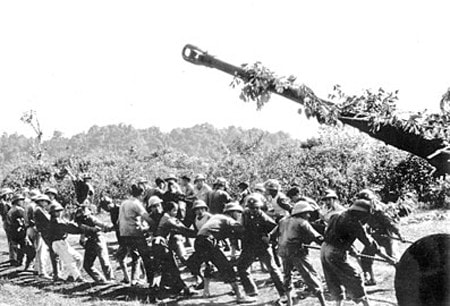 |
| Without the wise and courageous decision to postpone the planned campaign and change the tactics from "quick attack, quick victory" to "steady attack, steady advance," the complete victory of the Vietnam People's Army on May 7, 1954, would not have been possible. |
Victory for Peace, Independence, and Freedom
Mr. Tran Thai Binh stated that at Dien Bien Phu, we annihilated and captured more than 16,200 enemy troops, including the entire command structure of the fortified complex, a general (De Castries), along with 16 colonels, and 1,749 officers and non-commissioned officers. The enemy forces destroyed included 17 elite infantry battalions (including 7 paratrooper battalions), 3 artillery battalions, and nearly 1 engineering battalion. In total, 21 battalions were destroyed.
In terms of air power, the French suffered extremely heavy losses during this period. The number of bomber, fighter, and transport aircraft (including American B24 bombers and C129 heavy transport aircraft) shot down and destroyed on the ground at Dien Bien Phu was 62, and if all battlefields nationwide are included, the total is 177.
However, in addition to the 62 aircraft destroyed at Dien Bien Phu, 167 more were damaged in the valley airspace, including aircraft flying in from aircraft carriers docked offshore.
France lost one-third of its troops in the Battle of Dien Bien Phu, including some of its most elite units. This devastating defeat forced France to agree to sit with the delegation of the Democratic Republic of Vietnam at the Geneva Conference to negotiate an end to the war and the restoration of peace in Indochina.
According to researcher Tran Thai Binh, the defeat at Dien Bien Phu was a defeat for colonialism. The victory at Dien Bien Phu was a victory for peace, independence, and freedom.
The first prisoner of war we released was Genevieve, a nurse who was on her way to Dien Bien Phu to transport the wounded but her plane broke down, forcing her to stay behind and be captured by our troops. By special order from President Ho Chi Minh, she was released on May 24, 1954, just 17 days after our army's complete victory.
The prisoner of war who attracted much attention, released on September 3, 1954, was Lieutenant Colonel Marcel Bigeard, commander of the 6th Parachute Battalion eBPC, who fiercely resisted until the very last day of the French stronghold. Bigeard later ended his military career with the rank of general. After several visits to Vietnam to revisit the old battlefields, in 1993, in an interview with a foreign cameraman, Bigeard made a meaningful statement: "If I were Vietnamese, I would also become a Viet Minh."
The complete defeat of the French Allied forces at Dien Bien Phu, as well as in other coordinated battlefields, dealt a fatal blow to the morale and will of the reactionary French colonialists. It forced those who had waged this war to seriously and objectively reflect and draw profound lessons.
The commander-in-chief of the Dien Bien Phu fortified complex, General De Castries, upon his return to France after the defeat, confessed to the French Ministry of Defense's Investigation Committee: "One can defeat an army, but one cannot defeat a nation."
That is the spirit of the masses, the creativity of the masses, in solving the difficulties of the situation. That is the strength of a people's war launched and led in a brilliant and skillful manner.
Researcher Tran Thai Binh quotes the French author Jules Roy: "France was defeated, not by means, but by the intelligence and will to win of its opponent."
Indeed, courage alone is not enough to achieve victory. Among French commentators, some lamented: If General Giap had not changed his tactics at the last minute, the Dien Bien Phu trap would certainly have crushed the Viet Minh forces, and Dien Bien Phu would have been a defeat for Vietnam, not a victory. Without the wise and courageous decision to postpone the planned offensive on January 25, 1954, and change the tactics from "quick attack, quick victory" to "steady attack, steady advance," the complete victory of the Vietnam People's Army on May 7, 1954, would not have been possible.
The contribution of the General-Commander-in-Chief in commanding the campaign is truly an achievement that will be etched in history. This is affirmed by both our side and the enemy's.
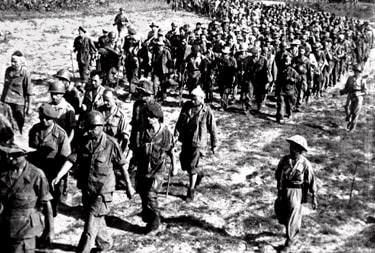 |
| Over 10,000 French prisoners of war at Dien Bien Phu were released by our forces. |
A beautiful epilogue
Among the more than ten thousand prisoners of war at Dien Bien Phu, there were many people of different nationalities. Coming from diverse backgrounds, they were part of units known as the Foreign Legion, including soldiers, officers, or non-commissioned officers from North Africa, Central Africa, and Central Europe (Germany, Austria, etc.).
Researcher Tran Thai Binh recalled that, under the Northwest sky, as the smoke from gunfire and bombs gradually cleared, groups of prisoners of war, either on foot or in vehicles, were led through the forest to prisoner-of-war camps. There, they were not subjected to the brutal beatings or mistreatment they had feared, but instead witnessed and heard new things that changed their souls and consciousness.
During free discussions and exchanges in the prisoner-of-war camps, soldiers from across the continents were often asked: You are excellent warriors, why are you fighting as mercenaries for the colonialists? Why don't you fight for yourselves, so that your country belongs to you?
Researcher Tran Thai Binh vividly remembers the image of prisoner Slimane Hoffman, an Algerian lieutenant who asked to join the Viet Minh ranks, but was advised: "We have done our duty for our country. You also have a homeland; do your duty for your country."
Released from prison, Slimane Hoffman returned to his homeland. Years later, he joined the Algerian National Liberation Front, fought, and rose to the rank of colonel. He orchestrated a Dien Bien Phu-style victory in his own country.
Researcher Tran Thai Binh commented: Vietnam's victory at Dien Bien Phu was like a thunderclap resounding throughout the world. It's no surprise that after Dien Bien Phu, many Africans in colonies also rose up to fight for independence with powerful shouts: Ho! Ho! Ho Chi Minh! Giap! Giap! Dien Bien Phu.
According to chinhphu.vn