
Pay the "fee" for poor households!
(Baonghean) - This is a sad story that took place in TB hamlet, M commune, T district, as presented by a reader in a letter sent to Nghe An Newspaper on April 25, 2014. According to verification, it is true that poor households in this area have to pay a percentage of their allocated funds to the hamlet, even though hamlet officials defend this by claiming it was voluntary on the part of the poor households...
(Baonghean) - This is a sad story that took place in TB hamlet, M commune, T district, as presented by a reader in a letter sent to Nghe An Newspaper on April 25, 2014. According to verification, it is true that poor households in this area have to pay a percentage of their allocated funds to the hamlet, even though hamlet officials defend this by claiming it was voluntary on the part of the poor households...
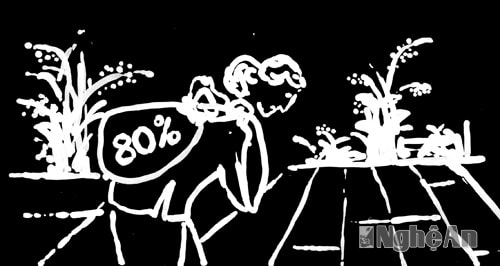
The reader's petition reads as follows: In December 2012, the TB hamlet held a meeting to review the poverty status for 2013. Twenty-eight households were classified as poor, but divided into two categories: Category 1 included 12 households entitled to all poverty benefits; Category 2 included 16 households required to return 80% of their benefits to the hamlet's fund. Ms. H's family was among the 16 households required to return 80%, and was asked to pay Mr. D (the meeting secretary), otherwise they would not be recognized as a poor household the following year. Due to her family's even more difficult circumstances than the 12 Category 1 households – her husband suffers from dementia, and her two children have chronic illnesses requiring treatment at both provincial and central hospitals – Ms. H requested permission from the hamlet to receive all poverty benefits. However, the hamlet's leadership committee did not accept her request.
Due to her husband and children's chronic illnesses, Ms. H received all the poverty alleviation funds she was entitled to in 2013 but did not return a percentage to the village fund. Therefore, in November 2012, her family was granted land conversion for rice and other crops according to their land use rights certificate, but the village's land conversion committee subsequently reclaimed approximately 1,300 square meters of land. In 2013, Ms. H hired people to plow and fertilize these plots of land twice, but then others used them...
 |
| Illustration: Huu Tuan. |
Outraged, Ms. H repeatedly wrote complaint letters to the People's Committee of the commune, but they were not resolved according to the facts. Furthermore, the TB hamlet committee accused Ms. H of defamation...
It was learned that M commune in T district is a semi-mountainous area with barren fields, underdeveloped economy, and impoverished, backward living conditions for its people. Ms. H's family has three-quarters of its members suffering from chronic illnesses, placing them among the poorest of the poor. Her husband, formerly healthy and a village official, unfortunately developed brain atrophy and memory loss. Their two children suffer from various ailments: the eldest has glomerulonephritis, and the second has an eye disease with a risk of blindness. All three are constantly in and out of the hospital. When asked about their situation, a villager remarked, "Ms. H's family is suffering immensely."
"It's true that poor households in Commune M have to pay a percentage. I also attended the meeting and know this clearly. Because of the issue of poor households and land, they're frantically filing complaints everywhere..." According to Mr. T, who confirmed Ms. H's application, in 2013, due to a relapse of an old illness and having two children attending school, his family was classified as a poor household by the commune to receive health insurance and tuition fee exemptions. "I don't really like the title of poor household. But being classified as a poor household helps a lot. I didn't attend the meeting to select poor households in the hamlet, but I heard they said we had to pay 80% of the money that poor households are entitled to for the hamlet fund, so I paid. However, a few days ago, the person I paid the money to returned it, and then I saw some commune officials come to check if I had received my refund..."
When asked about the "fee" for poor households, the Party Secretary of TB hamlet claimed that the forced payment was a fabrication by a few frustrated households and not true: "The Party branch did not direct or authorize this, and the hamlet's leadership committee was not involved. The records and documents of the Party branch and the hamlet are still there, clearly showing this...". When the reporter mentioned that Mr. T had his money returned and the commune had sent officials to investigate, the Party Secretary said: "The collection of money was voluntary on the part of the poor households, based on their understanding, not forced by the hamlet. And they paid Mr. D, also a poor household, not the hamlet officials..."
Visiting Mr. D's house, one could see that his family, while not wealthy, wasn't poor either. They had a two-story house, brick walls, a paved yard, a motorbike, and a readily available workforce... not to mention spacious livestock pens with two buffaloes and one healthy calf. Regarding the percentage of the fee that poor households pay to the neighborhood, Mr. D awkwardly admitted to being the one collecting the money, explaining: "Everyone voluntarily comes to pay. I'm just collecting it to use as a neighborhood fund later..." When asked: Only families truly in difficult circumstances are included in the poor household category so that the government can provide some assistance. Even if it's a voluntary contribution, doesn't he see the irrationality in collecting the money? Mr. D awkwardly explained, "I've suffered a lot because of this. Including my family, there are 13 households that have paid. And even then, it's not even 80% paid. Each family only paid between 300,000 and 400,000 dong. Recently, the commune instructed the village to remind me to pay back the rest..."
The issue of paying "fees" for being classified as a poor household only became clear when we questioned the head of TB hamlet: Given Mr. D's family circumstances, why was he classified as a poor household? The head of the hamlet explained: "In 2013, our hamlet had 28 poor households, of which 13 met the criteria, and 15 slightly exceeded them. Mr. D was classified as a poor household because his family was large, so the average income, when assessed by the hamlet, was very close to the standard. Because they didn't meet the standard but were included in the poor household category, they voluntarily paid the money to the hamlet..."
Continuing our conversation, the village head's wife explained: "Every village in this commune is in the same situation. Some villages designated as 'cultural villages' have over 30 poor households. The poorest village in the commune, TB, receives fewer votes, and the villagers say, 'The village officials are blind, they don't care about the people.' So, they just pick those that are close to the standard..." Why aren't they classified as near-poor? According to the village head, besides the 28 poor households, TB village had over 20 near-poor households in 2013. In 2014, the village had 22 poor households and 25 near-poor households, and his family was among them. "Around 2010-2011, the village had a policy of collecting 50% of the funds from poor households. After some objections, it was returned. In 2013, the village didn't have this policy, but some poor households voluntarily contributed money. We are at fault for knowing about it but not preventing it..."
Regarding Ms. H's claim that a portion of her farmland was taken away by the village, the village headman stated that the land previously allocated to her family was improperly used for cultivation and farming. Furthermore, due to a conflict, her mother-in-law reclaimed a portion of the land, thus justifying the reduction in her land area. These explanations are unacceptable. Ms. H's family's right to use their farmland and cultivated land is clearly stated in the Land Use Right Certificate issued by the T district government. If the village headman's explanation is accurate, then the matter should be handled according to proper procedures. The village and commune arbitrarily reclaiming the land and allocating it to others is against the law.
While paying the "fee" for poor households may be considered voluntary, the practice of "rescuing" poor households and making them "voluntarily" pay the "fee" is against regulations, shameful, and must be stopped.
Nhat Lan