

Pù Huống Journey
(Baonghean) - The Pu Huong Nature Reserve is located within the administrative boundaries of 12 communes in 5 districts: Que Phong, Quy Hop, Quy Chau, Con Cuong, and Tuong Duong. Of these, the two communes of Nga My and Xieng My occupy the largest area, with over 15,000 hectares. We embarked on a journey into the core of Pu Huong to experience the arduous yet fascinating challenges of this nature reserve in western Nghe An province.
The arduous journey to Pu Huong
We began our journey in early July. It was only early morning, but the scorching sun's rays piercing through the trees along the roadside signaled a harsh day ahead in the western part of Nghe An province. Accompanying us on our journey up into the core of Pu Huong National Park was Mr. Nguyen Que Hai, a forest ranger from the Pu Huong Forest Ranger Station. Worried that the visitors might be unfamiliar with the route, he frequently stopped the car to wait. We stopped at the edge of the forest, where there were several makeshift shelters belonging to the people of Pieng O village who were working in their fields. Here, we planned our trip in detail. According to the plan, we would enter the core of Pu Huong with the guidance and support of Mr. Nguyen Que Hai and two local people. Before setting off, we were offered a drink that, according to the locals, was a blood tonic and a fatigue reliever...
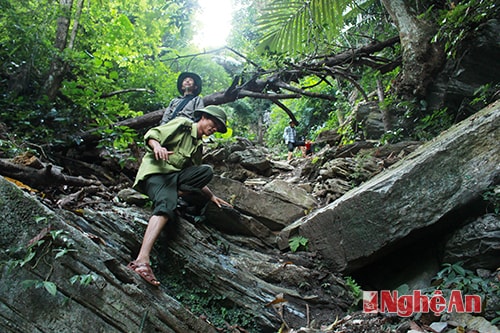 |
| The path was treacherous, but the timber still managed to get out of the forest. (Large image) |
At 7:30 AM, the journey began. By this time, the motorbikes had been left behind, and walking was the only way to reach the core of Pu Huong. Following the directions of the guides, we walked along the Hang stream. This is one of the main streams that flows through the Pu Huong forest, collecting water from many tributaries before flowing into the Nam Non stream and merging with the Ca River. After nearly 30 minutes, we reached a fork in the road, and the guides stopped to decide whether to go straight or take a detour. The detour would take longer but would avoid the dangerous rock climbing. Everyone decided to take the detour, a little longer but safer. It was then that I noticed that almost all the guides, besides their belt knives, also carried a small vial...
Before we could even ask, we soon learned about the purpose of the small bottle everyone hung next to the knife... The bottle contained a mixture of liquid that forest dwellers used to "eliminate" slugs and leeches. This area was a damp forest, so there were many leeches. They crawled on the ground and scurried around on the branches. These tiny mollusks always gave many people a terrifying, goosebumps-inducing feeling. Therefore, those who frequently went into the forest had "created" a mixture of kerosene, soot, lime, soap... to combat slugs and leeches.
Returning to our journey, our purpose this time was to learn about and explore the Pu Huong Nature Reserve – the center of the Western Nghe An Biosphere Reserve. More importantly, through this trip, we also wanted to understand how the protection of this special-use forest has been and is being carried out. After following the Hang stream, we ventured deep into the forest. The sun was still blazing. We moved low beneath the bamboo canopy. At times, it felt like we were walking through a tunnel. The space was enveloped in high humidity, making it incredibly stuffy and uncomfortable.
Seemingly understanding everyone's restlessness, and since the group had already been traveling for about an hour, Mr. Nguyen Que Hai proactively stopped. During the break, I had the opportunity to carefully observe the two local guides. The first was Lo Van Toan, 31 years old, who had previously worked in the South. Returning home disappointed with what he had never experienced, he decided to start over by raising livestock and farming. Currently, Toan raises 20 goats, in addition to several dozen chickens and pigs. The second was Mong Van Pho, originally from Xieng My, living in Binh Chuan commune (Quy Hop district), who had only returned to his hometown a little over a year ago. Both Lo Van Toan and Mong Van Pho are members of the forest protection contract force in Pieng O village, Xieng My commune, Tuong Duong district.
It should also be added that currently, in the Pù Huống Nature Reserve, there are 486 households from 6 villages and 2 communes, Nga My and Xiêng My (Tương Dương), who have been contracted to protect the forest. The total area contracted to these households for protection is 7,758 hectares. Of these, the Piêng Ồ village alone has 85 households contracted to protect the forest. While everyone sat down on the decaying leaves in the forest, gasping for breath, Lô Văn Toán pulled out his Mẹo knife and quickly grabbed a bamboo stick. Then, with the razor-sharp knife, in just a few movements, Toán completed a long pipe. It was the first time I had seen such a long pipe, about 1.2 meters long. Actually, with his years of experience in the forest, the fresh bamboo in Toán's hand wasn't just for satisfying his tobacco addiction.
The bamboo stalk has three sections; the top section is used to make a pipe, and the two lower sections are hollowed out to become containers for drinking water. The entire section of bamboo also serves as a walking stick to aid in climbing the slope. While meticulously carving a section of bamboo to make the pipe stem, Toán grinned, revealing his yellowed teeth: “What do I know how to do with it! Everything is difficult for the people up here! I go on patrol every month.” As if suddenly remembering something, Toán glanced quickly towards the vast forest and frowned seriously: “There’s a three-legged creature in this forest!!!” Toán lowered his voice, almost whispering: “It’s a tiger! It only has three legs, but it’s very clever…” The others with him also chimed in, making the story of the three-legged “tiger” incredibly intriguing in the deep, dark forest. Finally, Toán concluded with a completely irrelevant statement: "But from childhood until now, I've never seen one in Pù Huống. I've only seen them in Đầm Sen in 'Saigon'." According to research by scientists, the Pù Huống Nature Reserve has 461 animal species belonging to 99 families and 28 orders. Among them are 66 rare species such as: the black gibbon with silver cheeks, the gray langur, the peacock pheasant, the white partridge, and of course, the tiger.
Magnificent Pu Huong
Everyone resumed the journey. The deeper we went into the core area, the steeper the slope became. There were sections with steep inclines and no low branches to hold onto, forcing us to almost bury our faces in the mountainside, using our hands to scrape against the soil and rocks to inch forward. Every 10 minutes or so, we had to stop to catch our breath. Nguyen Que Hai and Lo Van Toan took turns leading, with the two reporters in the middle and Mong Van Pho at the rear. Occasionally, we found a relatively flat spot to balance our feet. At those times, Hai and Toan would look at us and smile broadly: "We've only covered one-third of the way." It was around 10 a.m. We were standing amidst the vast expanse of the primeval forest – the heart of the Western Nghe An Biosphere Reserve, recognized by UNESCO as a World Biosphere Reserve in September 2007.
According to surveys by domestic and foreign scientists, Pu Huong has 1,137 plant species belonging to 585 genera and 116 families. The Pu Huong Nature Reserve is home to rare and valuable trees such as the cypress, the oil palm, and most abundantly, the fragrant jasmine, and the teak. We observed that the large trees were spaced about 10 meters apart. Some trees had trunks so large that it would take several people to encircle them. I noticed that occasionally, Pho would bend down to pick something up, quickly rub it on his shirt, and then chew it. It turned out to be sour plums. Sour plums were scattered along the path. Giving me a few unripe ones, Pho said innocently, "The birds ate all the ripe ones, only these green ones are left. They help quench thirst a lot."
So, not in Hanoi, but right here in this primeval forest, I got to gaze up at the towering ancient sấu trees and savor their refreshing, slightly sour taste, which helped soothe my dry mouth and almost parched throat. When I asked Mộng Văn Phở about his life and livelihood, he replied kindly: “It’s nothing much, just protecting the forest! We get three million dong and two hundred kilograms of rice a year. The government says so, and we just do it!” It is known that, according to regulations, each household receives 200,000 dong per year from the government for each hectare of forest they are contracted to protect. On average, each household in Nga My and Xiêng My (Tương Dương) protects 10 hectares, with the largest only protecting 30 hectares. Meanwhile, the Pù Huống Nature Reserve has a total area of over 92,009.8 hectares, of which the core area of the special-use zone is 40,127.7 hectares. Pù Huống is located within the administrative boundaries of 12 communes in 5 districts: Quế Phong, Quỳ Hợp, Quỳ Châu, Con Cuông, and Tương Dương. Of these, the two communes of Nga My and Xiêng My occupy the largest area, exceeding 15,000 hectares. Therefore, the protection of this special-use forest is of paramount importance for scientific research, biodiversity conservation, and as a biosphere reserve for humanity. It is also a decisive factor in maintaining the ecological balance of the upstream area.
 |
 |
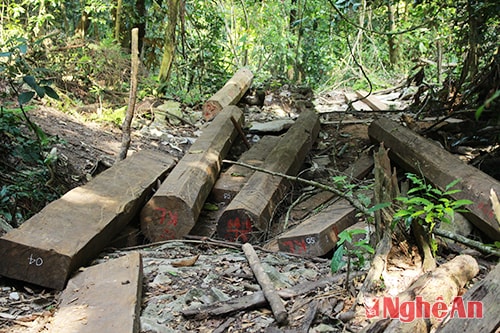 |
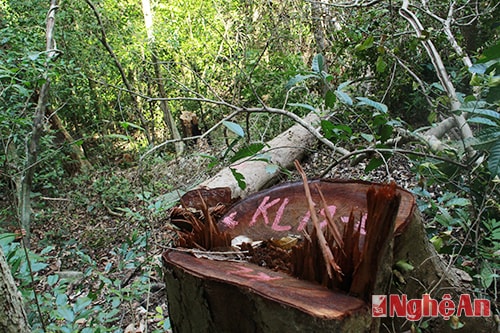
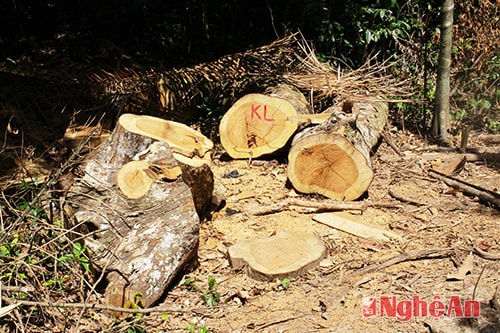
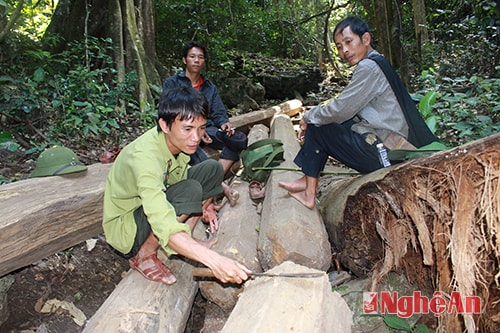
Illegal logging is taking place on the summit of Bu Cop (Pu Huong). |
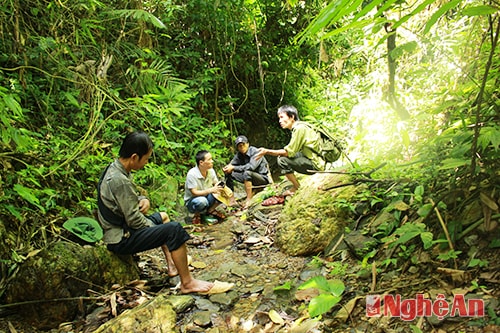 |
| A moment of rest at the summit of Bu Cop (Pu Huong). |
The plight of the Conservation Area
It took the whole group four hours to reach the middle of Bua Cop peak. Nguyen Que Hai pulled out the specialized GPS device used by the forest rangers and started typing: “We are currently at an altitude of 725m. To reach the summit of Bua Cop, we have to climb another 400m.” The terrain where we stopped was gently sloping. At this point, I saw long, concave lines running along the mountainside. These were log tracks created by buffaloes pulling logs. In some sections, the cliffs were steep, and people had used stakes driven into the ground or wooden planks to create troughs along the mountainside to prevent the logs from falling into the ravine when the buffaloes pulled them. Many large tree stumps lay scattered throughout the forest. Many other tree stumps had been felled with chainsaws, cut into sections, and sawn into planks. Occasionally, Mong Van Pho would stop, carve a piece of wood with a knife, and bring it to his nose, saying: “trai,” “da huong,” “trai,” “da huong,” “lat.” Some felled tree trunks lay upside down on the cliff face, impossible for the illegal loggers to retrieve, exposed to the elements. There were also some fragrant trees, their stumps oozing sap that had dried and turned a blood-red color. I saw the letters "KL" written in red paint on the round logs and planks. Some planks bore dates, such as: "June 14, 2014, June 19, 2014, July 2, 2014". According to Mr. Nguyen Que Hai, a forest ranger at the Nga My Forest Management and Protection Station - Pu Huong Forest Ranger District, this is how forest rangers and forest protection forces mark the locations whenever they discover illegally felled timber. This is the only method the forest rangers can use during patrols. “Even if they were cutting down trees while we were climbing up, we couldn’t catch them. We’d only encounter fallen trees, not people. They have information here. If they spot forest rangers outside the ravine, they’ll know inside. The biggest problem here is that we can’t seize or transport the evidence. Our only options are to mark the area, report it, and plant informants so we can ambush them when they come down to the ravine.”
We continued climbing back up to the summit of Bua Cop. I was truly shocked by the number of trees felled by illegal loggers. In the shallow stream bed at the summit of Bua Cop, at an altitude of about 1000m, dozens of sawn timber planks lay scattered. Most of the planks were over 3m long, 50-60cm wide, and 20-30cm high. Along the stream bed, about 20m down, was a collection point for more than 10 logs. These were mainly valuable timber species such as teak, rosewood, and ironwood. From observation, it was clear that the illegal loggers had selected and sawn the trees around Bua Cop, then used buffaloes to drag them to one place, waiting for an opportunity to smuggle them out of the forest. Remarkably, besides the logs and planks marked with red paint by the forest rangers, the majority of the timber stockpiled at the summit of Bua Cop bore the inscription in white (using correction fluid): "CSMT 27/6/2014". In reality, this timber was discovered and seized by the Environmental Police of Nghe An province after months of surveillance. According to initial information, the amount of timber illegally felled and transported out of the forest was approximately 20 cubic meters. The investigation is still ongoing, and the ringleader has been identified as an individual from another area who hired local people to illegally exploit the timber in Tuong Duong. Significantly, the evidence suggests that the timber had been cut down in scattered locations over several months prior, but it wasn't until the Environmental Police, working tirelessly through the forest on the night of June 26th to 27th, that they were caught red-handed and seized. Later, upon returning from the forest, I met and spoke with Mr. Vo Minh Son, Deputy Head of the Pu Huong Forest Ranger Station. He explained that the Nga My Forest Ranger Station is responsible for managing and protecting a large area of the Pu Huong Nature Reserve, but due to a small force of only six people, carrying out their duties is very difficult. Furthermore, identifying violators is impossible. The forest rangers also lack sufficient means and personnel to transport the timber and confiscated items out of the forest.
We sat on a pile of logs in the middle of the Pù Huống forest, feeling utterly disheartened. Nguyễn Quế Hải explained that it would take about a month and a half to transport this much wood to the edge of the ravine and the forest. “The most difficult thing is hiring locals to pull it; they never dare. A buffalo used for pulling wouldn’t last more than a month…” Hải said. Mộng Văn Phở added: “The locals here don’t dare confront us. Sometimes when I’m patrolling and discover felled logs, I tell them, but they say it’s government wood, not yours… Sometimes they even threaten us.”
After 1.5 hours of documenting, filming, and photographing the timber yard on the summit of Bu Cop, we began our return. This time, instead of following the old path, we followed the steep slopes – the route used by illegal loggers for transporting timber. Mr. Nguyen Que Hai explained that this was the only way to get timber out of the core area. So, how many cubic meters of timber were discovered and seized by the Pu Huong forest rangers? What was the ratio of confiscated timber to the amount discovered and marked? These were questions no one could easily answer.
At 2 PM on a sweltering summer day, with cicadas chirping loudly, we sat on the slopes of Bu Cop mountain, eating sticky rice, dried rations, and drinking stream water. No one spoke a word. The sticky rice got stuck in our throats, accompanied by sighs. Our hearts were heavy. Pu Huong remained majestic and full of mysteries.
Dao Tuan - Ho Quy