

The Resilience of the Trường Sơn Soldiers
(Baonghean) - Nearly 40 years have passed since the war ended, but the memories of that time of "fire and fire" still live on in the heart of veteran Le Thanh Hai (Hong Linh hamlet, Van Dien commune, Nam Dan district). He was a truck driver on the Truong Son trail, living and fighting in the heroic resistance war for the liberation of South Vietnam. Returning after the war, this soldier, who endured the rain of bombs and bullets, still upholds the qualities of a true soldier of Uncle Ho, becoming a shining example of successful production and business in his village.
The era of "fire and flowers"
“No windshield, not because the vehicle didn't have one / Bombs shook and rattled, shattering the glass / We sit calmly in the driver's cabin / Looking at the land, the sky, looking straight ahead…,” that was the mission of us Trường Sơn truck drivers back then, traveling through bomb rain and bullets, but our hearts were always full of determination. Because behind us were weapons, ammunition, and food waiting to be supplied to our comrades on the battlefield. And as if touching a region of memories full of recollections, emotions suddenly welled up in him… as he recounted the years of war.
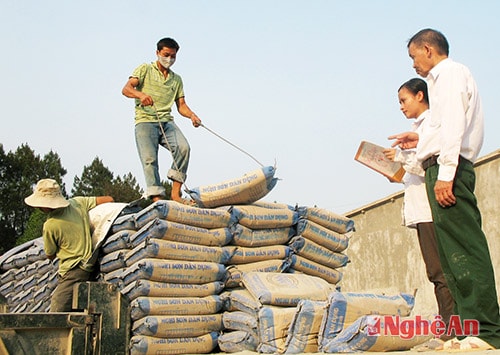 |
| Veteran Le Thanh Hai (far right). |
In early 1972, Le Thanh Hai was only 18 years old. He was called upon to enlist in the army and go to the Southern battlefield in response to the sacred call of the Fatherland. Thanks to his tall and strong physique, he was accepted into the 559th Brigade, a renowned brigade in the Truong Son Mountains during the years of the war against the US. After a period of training as a driver transporting supplies to the battlefield, in 1973, he was transferred to the 80th Battalion, 50th Regiment, Eastern South Vietnam Logistics Department to prepare for the historic Ho Chi Minh Campaign. During that period, his battalion was tasked with transporting supplies from the Truong Son Mountains, Laos, and Cambodia to the Eastern South Vietnam battlefield. Some shipments from Quang Binh, or from the Indochina crossroads to the Southern battlefield, took months to complete. “Our convoy traveled through vast forests and mountains in the dark of night, often stopping during the day to avoid aircraft. I remember most vividly the times the squad members set up makeshift camps to cook meals, constantly keeping an eye out for planes. Then there were the nights our convoy crossed the ‘silver tunnel,’ everyone in the convoy strained their eyes, concentrating on the road, their minds focused on the steering wheel, controlling the vehicles according to the soldiers’ instructions.”
However, there were battles where we couldn't escape the enemy's VO10 aircraft. It was 1973, when we were marching through military outpost 15. During our lunch break, the drivers crawled under the vehicles to rest and regain their strength for the next leg of the journey. An enemy aircraft spotted us, and one of the vehicles carrying weapons was hit and burst into flames. My comrade was killed. Other vehicles were buried under mud, and we were knocked unconscious by the blast pressure. "But when the comrades woke up, they only rested for a short while before setting off again together." His voice suddenly softened as he mentioned his fallen comrades. There were marches where a convoy of 10 vehicles would only return with 5. Some convoys not only carried weapons and food but also transported wounded soldiers and fallen comrades. He knew that during those times of intense fighting, life and death were separated by only a hair's breadth. Yet, each time he witnessed a comrade's death, it was a gnawing feeling, forging a fighting spirit in the Trường Sơn truck drivers.
In 1974, his battalion was assigned to support key battles in Dong Xoai, Tay Ninh, and Loc Ninh. “That year, we received continuous news of victories from the battlefield, and our convoy was even more eager, moving faster. During the March 1975 operation to liberate Xuan Loc, many members of my unit were killed. But we successfully completed our mission of providing weapons and food supplies to our troops, contributing to the victory. And the unforgettable moment was at 10:00 AM on April 30, 1975, when our battalion received orders to march into Saigon. The South was completely liberated after so many years of waiting. The soldiers cheered, laughed, and hugged each other, crying with overwhelming joy. That historic moment is still vividly etched in my memory.”
The diligent worker bee
Returning home after the war, his health was affected (he was a disabled veteran with a 2/3 disability rating), so he began a life of hard work in the fields. Burdened with the responsibility of providing for his six young children, he had to take on various jobs to support his family. Besides cultivating 7-8 acres of rice paddies, he also worked in milling and livestock farming. Even when his livestock crops were completely lost, he didn't lose heart. He shifted his focus to trading fertilizers and buying agricultural products, starting with an old motorbike which he sold for over ten million dong. Thanks to his reputation, his shop became a trusted source for local farmers. Quick-witted and resourceful, he gradually expanded his market.
At each stage, he skillfully seized opportunities to diversify his business. From selling fertilizers and purchasing agricultural products, he transitioned to trading furniture and building materials. He accumulated capital to expand production, invested in trucks, and by 2012, he had established the Lan Hai Transport Cooperative. Currently, his family's cooperative, specializing in supplying building materials, provides regular employment for 20 workers with salaries of 2.5-3 million VND per person per month. From the early days of struggling to find delivery contacts on his own, the Lan Hai Cooperative has now become a major supplier for rural transportation projects in the district; and has expanded to neighboring districts such as Do Luong and Thanh Chuong… Thanks to this, the cooperative, under his ownership, earns nearly 150 million VND in profit per month.
For him, achieving the success he has today is always thanks to the arduous training he endured on the battlefield. “During the war, we did everything ourselves, from cooking rice without smoke to avoiding the enemy; building shelters and camps with just a small knife; and navigating through ‘silver tunnels’ in the dark of night… I learned that you must always be courageous and independent to overcome all difficulties, and nothing is impossible, as long as you always strive and are determined.”
And the soldierly qualities that remained intact in him were taught and instilled in his children, shaping them into responsible adults. Now, all six of his children have grown up: two work at the Da Nang Department of Justice; one is a lecturer at the Ho Chi Minh City University of Medicine and Pharmacy; one is an officer in the vehicle team serving airports in Central Vietnam; and the remaining two work for him at the transport cooperative. The old veteran now smiles contentedly, having fulfilled his dream of providing his children with a good education.
In his small office at the Lan Hai Transport Cooperative, the medals and decorations from the resistance war are still proudly displayed on the wall. He proudly showed me the First Class Resistance Medal, the Liberation Fighter Medal, and the Glorious Medal awarded by the State for his wartime achievements. He explained that he had dedicated his youth to the country and was fortunate enough to return to his family and hometown.
Because of these feelings of empathy, veteran Le Thanh Hai always cherishes his comrades and the families of those who unfortunately perished on the battlefield. He often shares and supports the veterans' associations in the villages of the commune on holidays and anniversaries. Recently, he donated 20 million VND to build the Van Dien Commune Cultural Center… And for him: “As long as I have the strength to work, I will continue to dedicate money to charitable activities.” This stems from the belief that “during the war, we soldiers always fought and sacrificed for the country; now, living in peace, I feel fortunate to be able to contribute to building the nation.”
Dinh Nguyet