

Tho Hop (Quy Hop): The worry of the river "swallowing" the village.
(Baonghean) - The Dinh River flows through Son Tien hamlet, dividing it into two parts: Soi village on the left bank and Dua village on the right bank. These two villages are connected by a rickety bamboo bridge, only wide enough for one person to walk across while pushing a motorbike. Of particular concern is that Dua village is facing daily erosion from the river water.
The river "swallows" the village.
Meeting us at the edge of the village, the village elder Truong Van Mien, who has been associated with Dua village (Son Tien hamlet, Tho Hop commune, Quy Hop district) for over 60 years, bitterly remarked: "Dua village used to be round and full like a full moon, but now the Dinh River has eroded it, making it crescent-shaped. Seeing the river encroaching deeper and deeper into the village makes me worried."
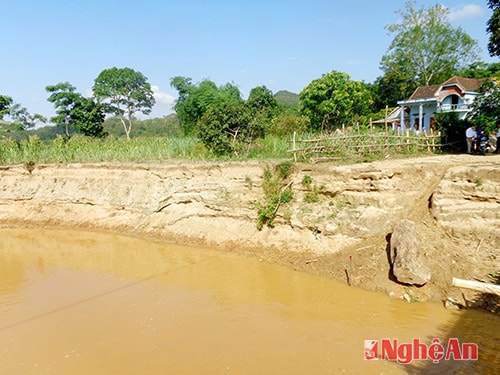 |
| The section of the Dinh River that collapsed passes through Dua village. |
Upon arriving at Son Tien hamlet, our first impression was the clear demarcation between the eroding and depositing sides. Standing in Soi village – on the depositing side – and looking across at Dua village – on the eroding side – we couldn't help but feel concerned. The Dinh River has carved deep into Dua village, forming a deep, concave arc. Because Dua village is located at a bend in the river, and its soil is mainly composed of loose sand and alluvial soil, it erodes quickly when waterlogged. During heavy rains and floods, the fierce currents erode deeply, creating cavities. Therefore, the 57 households, nearly 270 people in Dua village, live in constant worry, especially the 6 households right on the riverbank that are slated for relocation.
Mr. Truong Van Thiem, head of Dua village, said: "For about 3-4 years now, the river has been eroding the villagers' residential land by about 7-8 meters each year, extending along a bend of about 300 meters. This means that every year, Dua village loses about 2,250 square meters of residential land. Just since 2009, the Dinh River section passing through Son Tien hamlet has changed course, encroaching about 35-40 meters into the villagers' residential land." Mr. Truong Van Mien, a household owner along the river who had to relocate in 2012, confided: "We had no choice but to relocate. All the hard work and savings we put into building our house, we could only take a few tools with us when we moved. The houses in this area are mainly built of stone and brick; we can't use much of what we've unloaded." "Relocating meant leaving everything behind and starting over... That year, floods came, the land collapsed quickly, and our family only had time to 'flee for our lives.' Luckily, we weren't swept away by the water. Although it was very difficult, thinking about that near-death experience, in 2012 my family decided to relocate to a new place."
Mr. Nguyen Van Trung, Chairman of the Thọ Hợp Commune People's Committee, said: During heavy rains and floods, the Dũa village is cut off and isolated from the commune and district centers on the left bank by the Dinh River. High school students have to cycle around to the bridge downstream and then back up, a distance of about 15-17 km to school. Families with children attending primary or secondary school have to send their children to school on the other side of the river for convenience. As for preschool children, they need someone at home to look after them because they cannot leave them with anyone else, and it is impossible to take them to and from school every day with the roundabout route of tens of kilometers.
According to village head Truong Van Thiem, the households in Dua village do not own any land for rice cultivation. Their main economic activities are livestock farming and growing crops such as sugarcane, corn, beans, and peanuts. Therefore, the daily lives of the people in Dua village depend heavily on trade and commerce with the outside world. On sunny days, crossing the Dinh River via the small bamboo bridge is already difficult; during the rainy season, the bridge is submerged, making travel very dangerous.
This needs to be rectified soon.
To prevent landslides and the dangers they cause, every year the Son Tien hamlet mobilizes residents of Soi and Dua villages to contribute bamboo stakes and labor to build embankments themselves. According to village head Truong Van Thiem, the bamboo stake embankments clearly help to deposit some sediment at the base of the embankment, somewhat limiting the landslides. However, these bamboo embankments are only temporary solutions, mainly preventing landslides when the water level is low. When the rainy season arrives, the bamboo embankments built by the people of Son Tien themselves are not strong enough to withstand the powerful currents. To cope with this year's rainy season, the village mobilized each household to contribute three bamboo poles and has built a section of embankment at the beginning of the village. Nevertheless, these are commendable local efforts, especially in the absence of financial or material support from relevant agencies and levels of government to address the landslide problem.
Recognizing the need to relocate households along the Dinh River to ensure the safety of lives and property, local authorities surveyed and assisted six households in relocating and stabilizing their lives starting in 2012. Currently, 17 households remain under warning for potential landslides, including six households that registered for relocation in 2014 but lack the necessary funding. These households urgently need support to escape the threat of landslides endangering their lives and property.
Delving deeper into the village, we realized this concern wasn't limited to the households along the riverbanks. With the current rate of erosion continuing year after year, if no preventative measures are taken, the villagers of Dũa may have to keep relocating indefinitely. And if the erosion continues at the same rate as the past four years, in just about 10 years, the entire village of Dũa will be... washed away by the alluvial soil…
To overcome the isolation, local authorities have included the construction of a sturdy bridge across the village in their planning, hoping to expedite the survey and implementation process so that the lives of the people in Dua village can soon be improved. Along with this, it is necessary to leverage the local people's resources, along with support from the commune, district, and various levels and sectors, to implement measures to build a sturdy embankment to save Dua village from being "swallowed by the river."
Duc Duong