

Part 1: Heavy rain, devastating floods
(Baonghean.vn) -With 14 storms, dozens of torrential rains, historic floods, intensified cold fronts, tropical depressions... 2013 was a year in which Nghe An province in particular, and the whole country in general, suffered many natural disasters.Nevertheless, thanks to effective and coordinated leadership and implementation of disaster response measures, damage to the people has been somewhat minimized. There have been many irreparable sacrifices and losses after each major flood and storm, but amidst the storms, the spirit of humanity and the solidarity between the military and the people shines brightly.
Heavy rain, torrential floods.
Located in the heart of the North Central region, with the largest land area in the country and complex terrain, Nghe An has always been a harsh land, prone to heavy rain and storms. By the end of July, five major storms had already appeared in the East Sea. In early August 2013, while tourists were enjoying the beauty of Cua Lo beach resort under the bright sunshine, Typhoon No. 6 appeared in the East Sea. Although the typhoon did not make landfall, it swept along the coast of Nghe An, causing severe consequences: two fishing boats were sunk, and 16 fishermen fell into the sea, one of whom is missing.
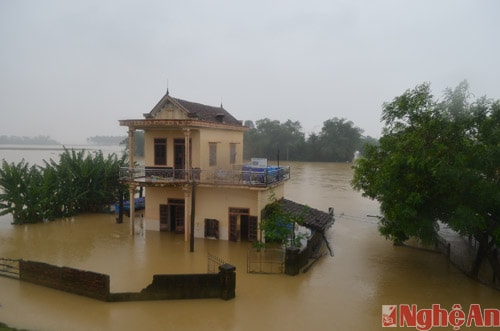 |
| Floods have cut off many communes in Hung Nguyen district. |
A few weeks later, people had to continue preparing for Typhoon No. 7 and especially the remnants of Typhoon No. 8, which caused heavy rains over a wide area, resulting in 13 deaths, 4 houses collapsing, 962 houses flooded, 2 schools and 15 classrooms affected. 1,491.6 hectares of rice were damaged, with 70% of the area completely destroyed, along with 5,108.5 hectares of corn and other crops, 549.7 hectares of industrial crops and perennial fruit trees damaged, 8.45 hectares of cultivated land eroded, over 495 hectares of aquaculture completely destroyed, and nearly 3,400 livestock, poultry, and cattle killed by floodwaters. Before people could recover, while floodwaters were still inundating the fields, heavy rains continued, typhoons followed typhoons, and floods followed floods.
Typhoon No. 10 continued to bring heavy rain, up to 500 mm, to the Quynh Luu area and Hoang Mai town, causing the water level in Vuc Mau reservoir to reach an alarming level, requiring emergency flood release. The consequences were devastating; the entire town of Hoang Mai was submerged in water. Water flooded rooftops, submerged national highways, swept away billion-dollar shrimp ponds that were just days away from harvest, destroyed vulnerable sections of sea dykes, turning coastal villages in Quynh Di and Quynh Phuong districts of Hoang Mai town into open seas, destroyed ships, and instantly turned seafood warehouses prepared for Tet into foul-smelling mud.
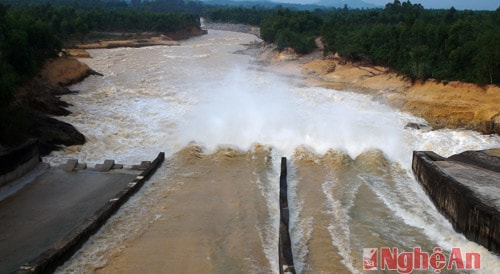 |
| The Vuc Mau reservoir released floodwaters, causing a historic flood in Hoang Mai town. |
While the phrase "Hoang Mai flood" is being mentioned most frequently on social media and in the mass media, people in Thanh Chuong, Nam Dan, and Hung Nguyen districts continue to live through successive floods. The excessive rainfall from Ha Tinh province caused all large and small irrigation dams in Thanh Chuong and Nam Dan districts to overflow by several meters, and two small reservoirs in Thanh Chuong district broke, causing localized flooding and isolating many areas. For nearly a week, people in the Bich Hao cluster of communes including Thanh Tung, Thanh Ha, Thanh Giang, Thanh Xuan, Thanh Mai, and Thanh Lam in Thanh Chuong district, the Chin Nam area of Nam Dan district, and the area outside the Ta Lam dike in Hung Nguyen district have had to live with the raging, muddy floodwaters. Many heartbreaking deaths have occurred due to the floods...
In November, as people in the flooded areas were struggling to recover, returning to the fields to resume farming in time for the season and salvaging what little remained after successive storms and floods, Super Typhoon No. 14 (internationally known as Super Typhoon Hayan) appeared. Before heading straight towards central Vietnam, this typhoon flattened the entire city of Tacloban, Philippines, killing nearly 10,000 people. The typhoon's power, considered unprecedented on Earth, caused widespread anxiety and fear among the population, prompting them to seek ways to protect themselves and find shelter.
Timely response to natural disasters.
Immediately after Super Typhoon No. 14 passed through the Philippines, the Prime Minister directly chaired an online meeting with 63 provinces and cities nationwide to discuss measures to respond to the super typhoon. At the Nghe An branch, Mr. Nguyen Xuan Duong, Deputy Secretary of the Provincial Party Committee and Chairman of the Provincial People's Committee, along with the Vice Chairmen of the Provincial People's Committee, the Provincial Steering Committee for Flood and Storm Control and Search and Rescue, and leaders of various departments and agencies, attended the meeting and fully absorbed the directives from the Central Government. Immediately afterwards, implementation throughout the province began with an online meeting between the Chairman of the Provincial People's Committee and various departments, districts, and towns. Mr. Nguyen Xuan Duong personally inspected vulnerable areas, and members of the Provincial Party Standing Committee were also present in their respective localities to direct the government and people to urgently combat the typhoon. The atmosphere was tense, with provincial leaders closely monitoring every subtle change in the storm on satellite maps while simultaneously shuttling between areas such as Cua Lo, Hoang Mai, Dien Chau, Quynh Luu, Vuc Mau Lake, and Song Sao Lake to inspect storm response efforts.
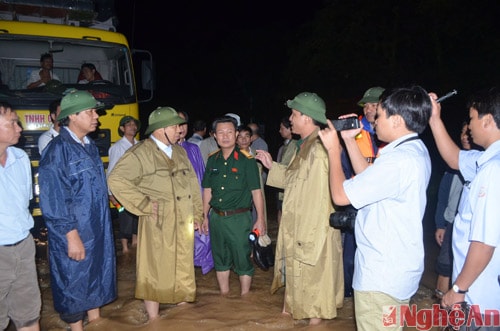 |
| Comrade Nguyen Xuan Duong inspected the flooded area of Hoang Mai at 2:00 AM on October 2, 2013. |
Meanwhile, local authorities in districts and communes, as well as people throughout the province, were worried, reinforcing houses and boats, and cutting down trees around their homes to prevent them from falling due to the storm. People in coastal areas, from Rong hamlet in Nghi Thiet commune (Nghi Loc district), Nghi Tan fishing village (Cua Lo district) to low-lying communes such as Dien Hai, Dien Bich (Dien Chau district), Son Hai, Tien Thuy (Quynh Luu district), Quynh Lap, Quynh Di, and Quynh Phuong (Hoang Mai town), were also urgently evacuating their belongings and valuable assets to escape the storm. Some households in Rong village, Nghi Thiet, for various reasons, refused to evacuate, forcing local authorities to use coercive measures. Fortunately, just before making landfall, the super typhoon weakened and changed direction, moving along the coast before making landfall in Hai Phong and Quang Ninh provinces and then into China, causing less damage to people and property than predicted.
Immediately after the super typhoon did not make landfall, the Chairman of the Provincial People's Committee, Nguyen Xuan Duong, affirmed that although the typhoon did not cause much impact on Nghe An, the officials, soldiers, and people of the province had demonstrated a very good spirit of proactive storm prevention and control. It can be affirmed that this was a comprehensive rehearsal for responding to natural disasters in the context of increasingly complex climate change.
Not only during Super Typhoon No. 14, but even before that, the direction and response to natural disasters were very well done by agencies, departments, and local people. Before each typhoon and flood, the provincial leaders and the Provincial Flood and Storm Control and Search and Rescue Command issued urgent telegrams to the local government, people, and relevant agencies to implement flood and storm prevention and control measures. In addition, provincial leaders and leaders of provincial departments and agencies were also present at critical points, standing side by side with the people during the most difficult times. By mid-December 2013, the Provincial Flood and Storm Control Command had sent a total of 18 telegrams on flood and storm prevention to districts, cities, and relevant agencies, and 58 quick reports on the flood and storm situation were sent to the Central Flood and Storm Control Steering Committee and central ministries and agencies to update the flood and storm situation in Nghe An...
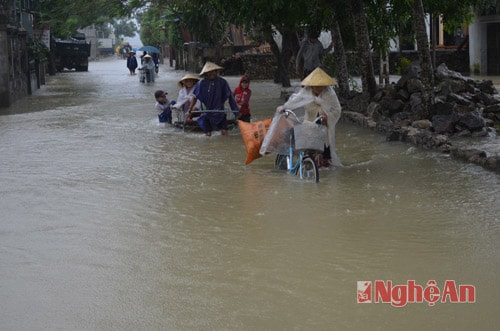 |
| Heavy rains caused flooding in Quynh Luu district. |
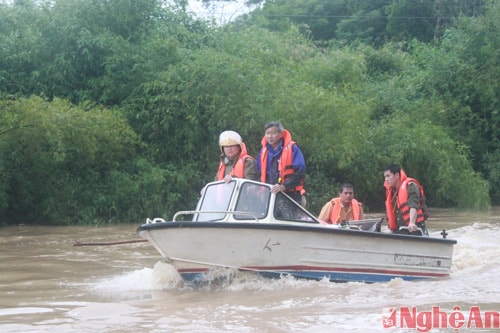 |
| Police and military forces are participating in rescue and relief efforts in Khe Ang, Nghia Hong commune, Nghia Dan district. |
At its peak, the entire province mobilized more than 1,000 officers and soldiers from the army, police, departments, agencies, and local people, along with the best available equipment and machinery, to participate in rescue and relief efforts in the Khe Ang area, Nghia Hong commune, Nghia Dan district, and to help people escape the floods in Hoang Mai town as well as Thanh Chuong, Nam Dan, and Hung Nguyen districts. Furthermore, at 10 PM on October 1, 2013, Mr. Dinh Viet Hong, Vice Chairman of the Provincial People's Committee, even convened an emergency meeting and decided to establish a forward command post for flood control in Hoang Mai town.
* Next Episode:Lessons are never superfluous.
Nguyen Khoa