

Drug prevention, maintaining peace in border areas.
(Baonghean)Along with intensifying the fight against drug trafficking, transportation, and storage, the Nghe An Border Guard Force organized a high-intensity campaign to educate and encourage ethnic minority communities in the border areas of Que Phong district to stay away from drugs and build peaceful villages. Therefore, these days, in the highlands, border guard officers and soldiers are even more actively moving forward alongside the local people.
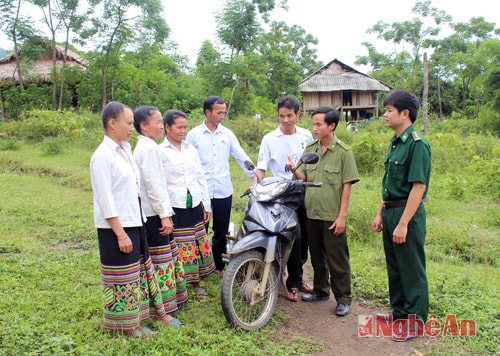 |
| Officers and soldiers of the Tri Le Border Guard Station, in coordination with various organizations and associations, are conducting awareness campaigns among the local people on drug prevention and control. |
In mid-June, 14 officers and soldiers from the Cultural and Artistic Propaganda Team of the Provincial Border Guard Command set off for the western part of Nghe An province. The journey to the mountains under the scorching sun, with temperatures exceeding 37 degrees Celsius, in a vehicle without air conditioning, was met with optimism and enthusiasm from all members of the delegation as they set out to visit the people in the border region of Que Phong. Occasionally, they would sing songs, seemingly dispelling the fatigue of the winding road. Captain Pham Anh Tuan, Deputy Head of the Propaganda Team, said: “This trip will last over a month. We will visit 13 villages in 6 communes of Que Phong district to propagate and mobilize the Thai, Mong, Kho Mu, Kinh ethnic groups… to not participate in the trading, transporting, storing, or using of addictive substances. To prepare for this long mission, we spent two months practicing songs and plays in the ethnic languages that clarify the harmful effects of drugs and the message we want to convey to the people: stay away from drugs and contribute to building a peaceful and progressive life…”
The first destination on the Border Guard's cultural and artistic propaganda team's journey was Tri Le commune, a key area with complex drug-related issues for many years. Therefore, officers and soldiers of the Tri Le Border Guard Post actively participated in the propaganda team's activities. Lieutenant Colonel Luong Van At, the Border Guard Post Commander, quickly provided the following information: “In recent years, to combat the ‘white death’ (drug addiction), the Post has strengthened its personnel and coordinated with the police, militia, and people from all walks of life to organize drug crime crackdowns. From the beginning of the year until now, the Tri Le Border Guard Post has detected 13 drug trafficking cases, arrested 15 suspects, and handed them over to relevant agencies for legal processing. However, to date, there are still 4 complex drug hotspots in the area, with 62 drug addicts. We are closely coordinating with all forces and the people to gradually push back the drug problem and clean up the area. Strengthening the propaganda campaign is one of the important factors in achieving that goal.”
As soon as they got off the bus, the officers and soldiers of the Border Guard's Cultural and Artistic Propaganda Team immediately got to work, transporting speakers, musical instruments, costumes, etc., to Na Lit village – a location 5 km from the commune center. The stage was the village's volleyball court. The stage was quickly erected using bamboo poles and a white backdrop. The sound of the engine echoed as the team tested the four mobile lighting fixtures; the village management announced the evening's cultural program to the villagers… all creating an atmosphere of excitement in the village. Today, all the families held dinner earlier than usual, hundreds of people, young and old, men and women, each brought a rattan chair to the volleyball court to watch the performance. Many young mothers carrying their babies arrived from dusk. It had been a long time since the village had had a "cultural troupe" perform. Following captivating song and dance performances, the Border Guard Propaganda Team performed the play "New Sunshine in the Border Region," reflecting the difficult lives of highland villages facing the infiltration of drugs. The play clearly illustrates the harmful effects of drugs: When "the addictive substance" enters the village, many young people and even the elderly are drawn into the vicious cycle; some become greedy and engage in drug trafficking, others fall into addiction; the village is no longer peaceful, theft occurs, and the good cultural and moral values of the villagers are at risk of being eroded… Faced with this situation, the Border Guard actively intervened, coordinating with the Party committee, village leaders, village elders, influential people, and the Youth Union to actively propagate and encourage those who have gone astray to reform, focus on economic development, and build a peaceful village. The play ended, but the applause of the villagers continued to resound. Many children, delighted, quickly picked wildflowers to give to the actors and actresses.
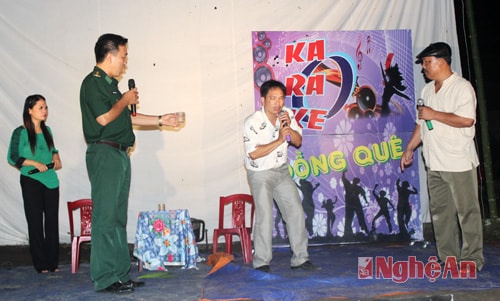 |
| A short propaganda play on drug prevention and control, produced by the Border Guard of the province. |
Following the success of the performance, the next morning, the Political Department of the Provincial Border Guard Command, in coordination with the Party Committee, the local government, and the Party branch and village committee of Na Lit, organized a "meeting" of the villagers; meeting with, persuading, and educating individuals involved in drug-related activities; bringing those who had previously committed crimes of drug trafficking, transportation, storage, and use, as well as other related individuals, to be reprimanded and made to sign commitments not to re-offend before the villagers. Vi Van Hoa, a former drug addict and drug trafficker who was arrested by authorities, after serving his sentence and returning to his village, bravely stood before the villagers and visitors and said: “I made mistakes in the past, got involved with drugs, was arrested, and underwent rehabilitation. During that period, my whole family lived in shame. I feel ashamed of that and strive to live a better life. Back in the village, my family and I are trying to develop livestock farming and production, and focus on raising our children. Every day, I talk to my children about my shameful mistakes to keep them away from drugs. The villagers have also seen the harmful effects of drugs. Addicts get sick, families fall into hardship, and traffickers are punished by the law. I hope that no one else in our village will get involved with drugs…”
At the end of the meeting, all households in the village signed a commitment not to possess or use drugs, and not to abet or conceal drug trafficking crimes. Mr. Ha Van Hoa, Secretary of the Na Lit village Party branch, said: “The village still has 5 drug addicts and 12 others suspected of addiction. There are currently 2 drug trafficking points in the village. We, as well as other functional forces, are monitoring and have plans to eliminate drugs from the area. As for the children, the Party branch and the village committee regularly remind them not to associate with bad people, to avoid getting involved with drugs and social evils. With the coordination of the Tri Le Border Guard Post and the Provincial Border Guard, this time, the village organized a public review of individuals involved in drug-related activities. The villagers wholeheartedly support this and are working together to prevent drug abuse and maintain political security and social order in the area.”
Bidding farewell to Na Lit, the Border Guard delegation arrived at Muong Long village in Tri Le. The single-track road, traversing four mountain slopes and five streams, was only passable by motorbike in the dry season and on foot in the rainy season, making the 20-kilometer distance from the commune center to the village seem insignificant. However, fulfilling their assigned responsibilities, and with the assistance of officers and soldiers from the Tri Le Border Guard Post, the Border Guard's cultural and artistic propaganda team arrived at the village on schedule to meet with the Mong people. To transport the loudspeakers and props to the village, the delegation had to hire skilled motorbike taxi drivers in the commune. The 20-kilometer journey, despite its complexity and difficulty, cost 300,000 dong per motorbike ride in the dry season. "We only charge that price out of respect for the soldiers. Otherwise, the price should be 400,000 dong. During the rainy season, if many customers offer over 500,000 dong, we're hesitant to take them," a motorbike taxi driver said.
The stage for the cultural performance promoting drug prevention and control in Muong Long village only had two battery-powered compact fluorescent lamps. Yet, over 600 villagers gathered, applauding enthusiastically for the performances, which alternated between Vietnamese and Hmong languages. Mr. Tho Thong Ly, the Party Secretary, said: “For decades, since the village was established, this is the first time the Hmong people here have seen such a professional cultural program…” Perhaps that’s why, the very next morning, at the village meeting to sign the commitment to drug prevention and control, all households were present; not a single family was absent.
Leaving Muong Long village in Tri Le commune, the provincial Border Guard Command's working group continued its mission to other border villages in Thong Thu, Hanh Dich, Nam Giai communes and two inland communes, Chau Kim and Chau Thon, to raise awareness and mobilize the entire population in drug prevention and control. This task is being carried out according to Plan No. 678 of the Provincial Border Guard Command and Que Phong district on resolving the complex drug situation along the border. Although Border Guard officers and soldiers have intensified their operational work and combat drug crimes, Que Phong remains a complex area. In the first six months of the year, the Border Guard Command arrested 20 cases of drug trafficking involving 28 individuals, seizing over 21 kg of heroin (equivalent to 60 blocks of heroin) and over 3,100 synthetic drug pills. To date, the district still has 8 complex drug hotspots and 94 drug retail points with 765 addicts and 1,104 people infected with HIV. These are the numbers recorded in the management, monitoring, and combat operations, but the actual number may be much higher. This situation raises many issues that need to be addressed. According to Lieutenant Colonel Le Nhu Cuong, Deputy Head of Political Affairs, besides intensifying the fight against drug crimes, an equally important and decisive task is raising awareness of the harmful effects and prevention of drug abuse among ethnic minority communities. Therefore, the Border Guard's mission to educate and persuade ethnic minorities to stay away from drugs, focus on production, develop socio-economic activities, and preserve ethnic cultural identity plays a crucial role in promoting the mass movement to report crimes and rehabilitate offenders within families and communities. Through cultural and artistic programs and public reviews of individuals involved in drug-related activities, the Border Guard Command of the province, together with the local Party committee and government in Que Phuong, implemented the motto: prioritizing education and persuasion, encouraging the public to report violators, and strengthening solidarity among villages, clans, and ethnic communities. This contributed to the most effective prevention and control of drug abuse and other social evils.
Nguyen Son