
20 years of "living in the forest"
(Baonghean) - In Tam Quang commune, if you ask about Ms. Nghi's house in Bai Xa village (Tuong Duong district), everyone knows her. It's a stilt house in the ancient Thai architectural style, with massive pillars, beams, and rafters, and a slanted staircase. Ms. Nghi came down the stairs, greeted us warmly, poured us water, and then told us the story of how she and her husband became rich on the top of Khe Mat stream...
(Baonghean) - In Tam Quang commune, if you ask about Ms. Nghi's house in Bai Xa village (Tuong Duong district), everyone knows her. It's a stilt house in the ancient Thai architectural style, with massive pillars, beams, and rafters, and a slanted staircase. Ms. Nghi came down the stairs, greeted us warmly, poured us water, and then told us the story of how she and her husband became rich on the top of Khe Mat stream...
In 1991, after they got married, their first son was born. The family had many siblings, and while they had fields and gardens, the land was small and farming techniques were poor. Just providing three meals a day was exhausting for the family. There were days when the wife had to carry her newborn child to neighbors to beg for salt or sticky rice, hoping to have enough milk for her baby.
In that situation, she discussed with her husband the idea of clearing land in the forest to cultivate a field. Her husband (Vi Van Thuyet) agreed. Then, the couple carried rice and knives to the top of Khe Mat stream to build a hut, clear the forest, and sow seeds. In their first cropping season, they sowed over 100 kg of seeds. The rice grew well, lush and green, spreading across the hilltop; looking at the field was heartwarming. However, when the rice started to flower, a drought struck, and the entire field, which had been green just moments before, turned white. Their more than 100 kg of seeds were lost. Looking at the rice field, her heart ached.
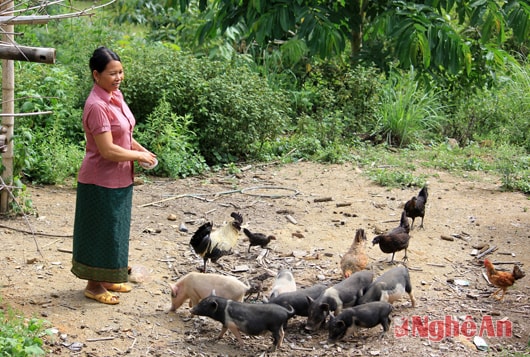 |
| Ms. Lo Thi Nghi is taking care of her chickens and pigs. |
Realizing that rice farming was inefficient and heavily dependent on the weather, leading to an unstable livelihood, she discussed with her husband the possibility of switching to livestock farming. Recognizing the favorable conditions at the top of Khe Mat stream for animal husbandry, with abundant feed suitable for various animals like buffaloes, cows, goats, and pigs, the couple decided to borrow money from the bank to buy livestock. They started with a few of each, initially buying two buffaloes, two cows, and two goats to try raising them. Just over a year later, they were all thriving. In just a few years, at one point, Ms. Nghi's herd of buffaloes, cows, and goats numbered in the dozens.
As the economy began to improve, Mr. Thuyet was trusted by the villagers and elected to the village management board. His work often required him to be away from the village. Ms. Nghi had no choice but to stay in the hut to look after the family's livestock. Surrounded by mountains and forests, she initially had to stay up all night tending the fire because she was afraid. On some stormy nights, when the buffaloes returned in the rain, she would brave the elements alone in the forest to herd them into the hut.
In 2009, her family also bought black pigs and black chickens from the Nam Can border gate to raise, which proved profitable. Besides livestock farming, her family also planted several economically valuable trees such as acacia and mahogany. To date, Ms. Nghi's family owns 10 buffaloes, 6 cows, 6 goats, 10 breeding pigs, nearly 200 chickens, over 3 hectares of acacia trees ready for harvesting, and over 1 hectare of mahogany. Each year, the family earns over 50 million VND from the profits of their livestock farming.
Despite being busy with economic development, Ms. Nghi still fully and actively participates in the activities organized by the Women's Association of her village, as well as many activities of the Women's Association of the commune. In 2012, she received a commendation from the Central Women's Association for achieving the title of outstanding individual for six consecutive years.
Ms. Kha Thi Hien, Vice Chairman of Tam Quang commune, acknowledged: Ms. Lo Thi Nghi is a person with strong willpower in life, a role model of successful businesswoman in Tam Quang commune, and is praised by many. In 2014, she was one of two delegates from the commune to attend the Conference of Reputable Representatives of Ethnic Minority Communities in the province.
Ho Phuong