

The rural revolution
(Baonghean)Time flies, and a year has passed. On our reporting journeys, whether in the plains or the high mountains of Nghe An province, we have all felt the vibrant and enthusiastic atmosphere. Under the guidance of the Resolutions of the Party Congress at all levels, the government and people of the province are striving to accelerate progress, contributing to the fulfillment of the targets set forth in the Resolution of the 17th Provincial Party Congress and the goals of the grassroots Party committees...
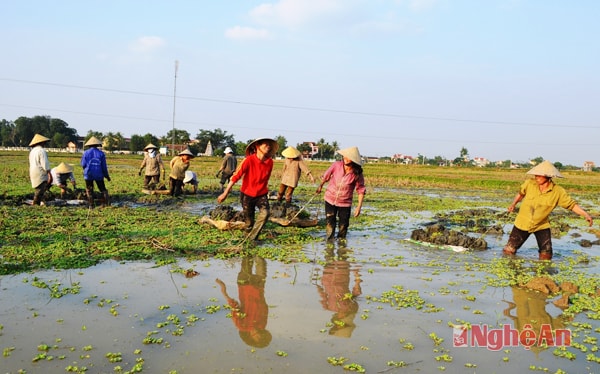 |
| Farmers in Dien Nguyen commune leveled their fields after land consolidation and reallocation. |
Dien Nguyen commune is divided into 7 hamlets, with 1447 households and 7200 inhabitants. Farming remains the main occupation of the farmers in this area. Unfortunately, despite hard work and diligence, the economic efficiency of farming is not high due to fragmented fields and small-scale production, lacking a commercial scale. Comrade Dam Van Hien - Deputy Secretary of the Party Committee of Dien Nguyen commune (Dien Chau district), also an experienced farmer, expressed his concern: “Our commune has 370 hectares of rice paddies, with two harvests per year. In the past, that was enough to live on, even with a surplus. But nowadays, to practice commercial agriculture, each household having only five or seven small plots of land is unsustainable and cannot keep up with the trend. During planting or harvesting, we can't even hire enough workers. The fields are so small, how can we introduce machinery to replace human labor? Building high-income fields is also difficult. The low economic efficiency is partly due to this.”
The concerns of the leaders of Dien Nguyen commune are also the sentiments of farmers in many localities. Like "rain after a drought," farmers throughout the province welcomed Directive 08 of the Provincial Party Committee on promoting the "land consolidation and exchange" campaign and "encouraging land accumulation to develop large-scale agricultural production" with immense enthusiasm. The Directive served as both a guiding principle and a driving force, creating political determination among all levels and sectors to implement what farmers liken to a "rural revolution." The correctness and timeliness of Directive 08 have created a turning point in the rural areas of the province.
In December, despite the persistent rain and biting cold, farmers across Dien Nguyen commune enthusiastically mobilized to prepare their fields, carrying out land consolidation and exchange to ensure timely planting for the winter-spring crop. In the fields of Hamlet 2 (Tan Phong), for over a week now, the villagers have been meeting and voluntarily dividing into several labor groups, working together to level the fields after hiring machinery to build embankments and irrigation systems as part of the land consolidation and exchange program. Their hands and feet are covered in mud, and they are wading through mud up to their knees, but when asked about the effectiveness of the land consolidation and exchange program, the rural women of Tan Phong unanimously replied: "It's tiring in the short term, but the long-term benefits are great!"
Ms. Le Thi Te's family in Tan Phong hamlet owned 5 sao (approximately 0.5 hectares) of rice fields scattered across 8 plots. Each planting and harvesting season, they had to rush to hire laborers to ensure timely completion. However, after land consolidation, the family's entire area is now reduced to just two large plots surrounded by wide embankments, making planting and harvesting much easier. She shared: "Because we're short on manpower, harvesting was incredibly hard before. But after land consolidation, we farmers will definitely have an easier time next season, and we'll be able to care for our crops more easily because we have machinery to replace manual labor and oxen. It might cost a little more in the short term, but thinking about the long-term benefits, everyone is enthusiastic and willing to work together according to the plan of the commune and hamlet. Land consolidation is truly a revolution in the countryside."
Meanwhile, in Tan Ninh hamlet (hamlet 5), the land consolidation and reallocation of 5 hectares of farmland has also progressed smoothly with the unanimous support of the people. This result was achieved thanks to the maximum implementation of grassroots democracy. The people were directly involved from beginning to end. “As soon as we received the directive from the higher authorities, the hamlet's Party committee and Party branch discussed and developed a plan for redistributing the land. Then, the hamlet continued to gather opinions from the people to adjust the plan accordingly. Once the plan was agreed upon, the Land Steering Committee proceeded to divide into teams to survey, assess, classify the land, and calculate the land coefficient. The Party branch also emphasized that the people should receive their land first, followed by cadres and Party members, so the people were very supportive,” said Comrade Nguyen Van Nam, Deputy Secretary of the Party branch and Head of Tan Ninh hamlet.
The directive was well-received by the people, and the implementation process maximized grassroots democracy. By the end of 2013, Dien Nguyen commune had completed land consolidation and exchange, with each household receiving an average of only two plots of land. This also served as a foundation for the Dien Nguyen Party Committee and government to begin implementing the restructuring of agricultural production towards specialized cultivation of cash crops, increasing economic value per unit area in accordance with the spirit of Directive 08 of the Provincial Party Committee. “The commune Party Committee is developing a high-quality agricultural production project. We are cooperating with Vinh Hoa Company to introduce rice varieties that meet export quality standards and have high economic value for large-scale cultivation in the commune. The company will handle the market for the products,” said Comrade Dam Van Hien.
Looking at the broader picture at the district level, over the two years of implementing Directive 08 of the Provincial Party Committee, Dien Chau district has achieved outstanding results. Mr. Le Van Thuan - Head of the Department of Natural Resources and Environment, Deputy Head of the Standing Committee of the Steering Committee for land consolidation and exchange in Dien Chau district, said: “By the end of 2013, 100% of the communes in the district (except for Dien Chau town and Dien Bich commune which have no rice fields) had completed land consolidation and exchange, ensuring the following objectives: each household only has 1-2 plots of land for production; ensuring the implementation of the internal irrigation planning, model field planning, and rice seedling land planning… ensuring production can begin in the next season.”
While land consolidation and reallocation are creating momentum for lowland districts with large rice paddies, in the highlands of Que Phong, agriculture is also making promising breakthroughs. We visited Nam Nhoong commune to see a model of "mac tanh" melon – a traditional local crop of the ethnic minorities in the highlands. For a long time, the Thai and Mong people have planted it from April to August of the lunar calendar and harvested it only for daily use. But in recent years, this fruit has been considered a specialty and has found a stable market. In the village, we saw groups of traders waiting at the entrance to buy mac tanh melon harvested by the villagers. Mr. Ha Van Thao from Na Hoc 2 village, Nam Nhoong commune, said: “In the past, we planted it alongside upland rice and used it for family consumption. About four years ago, traders started buying it in the village at the highest price of around 10,000 VND/kg. My family planted about 20 acres, and this year we earned about 15 million VND.”
With such economic benefits, in early 2013, Que Phong district directed the Agricultural Extension Center to pilot a 2-hectare melon cultivation project in Na Khich village, Nam Nhoong commune, with 21 participating households. Initially, each hectare yielded an income of up to hundreds of millions of VND. Mr. Hoang Dinh Nghia, Head of the Que Phong District Agricultural Extension Center, said: “The district's future orientation is to bring melons into commercial production; register, build a brand, and introduce them to supermarkets and trading centers in Vinh City to increase economic value and alleviate poverty for the people.” Not only melons, in recent years, implementing Resolution 20 of the Que Phong District Party Committee on strengthening the application of science and technology and innovating agricultural extension work, and strengthening the leadership of the Party Committee and government, the District Party Committee has focused on directing the application of new technologies and new varieties, selecting some plant and animal varieties with local characteristics to create a competitive advantage in the market.
In addition, the district has proactively integrated government programs such as 30a, 135… and projects from non-governmental organizations to utilize capital, technology, and experience from these resources to promote poverty reduction. As a result of three years of implementation, the district has developed 9 crop farming models such as: Japanese sweet potatoes, safe vegetables, Japonica cold-resistant rice… 8 livestock farming models such as: raising Quy ducks, black chickens, striped pigs… 7 forestry models: cardamom, bo bo, rattan… Among these, some models have been highly successful, such as the passion fruit cultivation model, which was continuously implemented for three years from 2010 to 2012 in Tri Le commune. Based on the overall assessment, after deducting costs, the average profit per hectare was 300-400 million VND or more. Participating households have seen increased income, with the lowest income being 20 million VND, and higher incomes ranging from 40 to 100 million VND, such as the households of Mr. Vi Van Xuan, Vi Van Nhan, and Ha Van Trung… in Yen Trung village, Tri Le commune.
Evaluating the effectiveness of the resolution, Comrade Kha Van Tam – Standing Deputy Secretary of the Que Phong District Party Committee – said: “For mountainous districts, building economic models plays a very important role in guiding people to develop their economy. Over the past half term of the District Party Committee, the Standing Committee has focused on directing the construction of many highly effective models, contributing to accelerating poverty reduction and improving the lives of the people. By the end of 2013, the poverty rate in the entire district was 41.18%, a decrease of 3.21% compared to 2012.”
As the old year passes and the new year arrives, bringing with it many opportunities and challenges, 2014 is a crucial year before the end of the term of the Provincial Party Congress and other levels. The achievements made serve as a foundation and driving force for further successes in the cause of national construction and defense. Along this path, the resolutions of the Party Congresses at all levels are the guiding principle, bringing faith and hope for change in all aspects…
Thanh Duy