

The National Assembly discusses the Law on Inland Waterway Traffic.
Continuing the session's agenda, on the morning of May 21st, National Assembly delegates worked in the Assembly Hall to discuss several remaining points of disagreement in the draft Law amending and supplementing a number of articles of the Law on Inland Waterway Traffic.
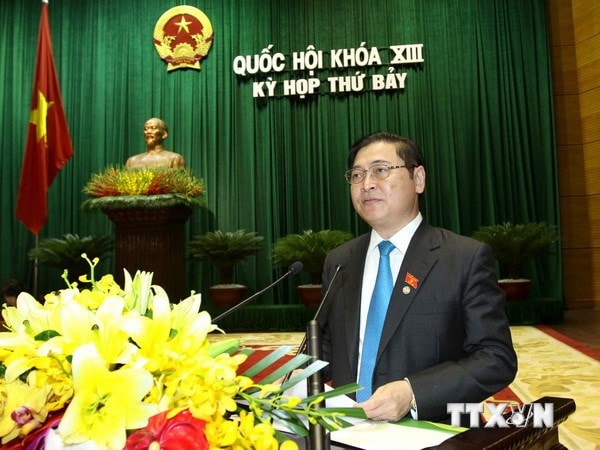 |
| Chairman of the National Assembly's Committee on Science, Technology and Environment, Phan Xuan Dung, presents the Report on the Law on Inland Waterway Traffic. Photo: VNA. |
| RELATED NEWS |
|---|
Some argue that instead of adding legal regulations for certain inland waterway traffic activities in areas not classified as "inland waterways" to the "scope of regulation," the "application of law" to non-inland waterway areas should be stipulated in an Article in Chapter IX of the 2004 Inland Waterway Traffic Law to ensure legal consistency.
The delegates analyzed the characteristics of Vietnam's natural conditions, noting that inland waterway transport activities are still taking place in waters from "the edge of the channel to the edge of the natural bank and on rivers, canals, and streams that have not been officially designated for transport exploitation" (water areas not yet managed or exploited for transport).
Navigation in these waterways poses numerous traffic safety risks. Therefore, to ensure traffic safety for vessels operating outside the designated channels in cases of force majeure and in unregulated waterways, and to define the responsibilities of People's Committees at all levels in ensuring traffic safety in general, especially in warning about dangerous areas for inland waterway traffic, the addition of provisions in Article 101a applying the law to certain activities of inland waterway vessels outside the designated channels and in unregulated waterways is reasonable.
Specifically: “The operation of vessels outside the designated channels and in waters not yet organized and managed for transportation must comply with the provisions of this Law regarding inland waterway vessels; crew members and vessel operators; traffic rules and vessel signals; inland waterway transport; inland waterway traffic accidents and inland waterway search and rescue; and other relevant legal provisions. People's Committees at all levels are responsible for organizing signaling in areas dangerous for the operation of vessels outside the designated channels and in waters not yet organized and managed for transportation.”
According to the draft law, an inland waterway terminal is a small-scale, independent structure comprising land and water areas in front of the terminal for vessels to anchor, dock, load and unload goods, pick up and drop off passengers, and provide other support services. Inland waterway terminals include cargo terminals, passenger terminals, general cargo terminals, cross-river passenger terminals, specialized terminals, and community terminals.
Organizations and individuals constructing inland waterway ports and wharves must obtain written approval from the competent state management agency for inland waterway transport.
According to delegate Truong Minh Hoang (Ca Mau), such a regulation is inappropriate because requiring written approval from a state management agency for public wharves "makes things difficult" for the people.
The delegate cited the example of the Mekong Delta region, specifically Ca Mau province, where 50-60% of the population lives on the waterways, and these people's houses all have wharves for daily life. Now, requiring permits will create difficulties for the people and hinder the implementation by government agencies.
Regarding Article 98e, inland waterway traffic rescue, Clause 3 stipulates: "The rescued vessel, ship, or fishing vessel may be seized, detained, or auctioned off by the rescue party to ensure payment of rescue fees." Some opinions express concern that this regulation could be exploited, and valuable assets could be intentionally seized or auctioned off.
Some have suggested adding a regulation that only allows the property to be seized and auctioned off if the rescued party is unable to pay, in order to prevent loopholes and profiteering.
During the discussion session, delegate Nguyen Ngoc Phuong (Quang Binh) proposed including provisions in the law for managing floating houses and vehicles used for both transporting and fishing aquatic products.
Representative Pham Thi My Ngoc (Ninh Binh) proposed an absolute ban on the use of alcohol by those operating inland waterway vessels.
National Assembly delegates discussed and provided specific feedback on the contents of inland waterway development planning; waterway and route management; registration of inland waterway vessels; and inspection of inland waterway vessels...
For the remainder of the morning, National Assembly delegates worked in their respective delegations, discussing the situation in the East Sea, China's illegal placement of the Haiyang Shiyou-981 oil rig in Vietnam's exclusive economic zone and continental shelf; and Vietnam's policies and solutions.
In the afternoon, the National Assembly held group discussions on the proposed legislative and ordinance drafting program for 2015, adjustments to the legislative and ordinance drafting program of the 13th National Assembly and for 2014; and the draft Law amending and supplementing a number of articles of the Law on Civil Aviation of Vietnam.
According to Vietnam+