

Mountain and forest specialties
(Baonghean)In the culinary culture of the people of Western Nghe An province, dried beef, smoked sausages, and fermented pork have long been indispensable dishes for festivals, celebrations, or when entertaining honored guests. On the market, they have become famous specialties, memorable delicacies. In the spring, venturing into the forests and mountains to learn about the origins and taste these dishes is incredibly meaningful...
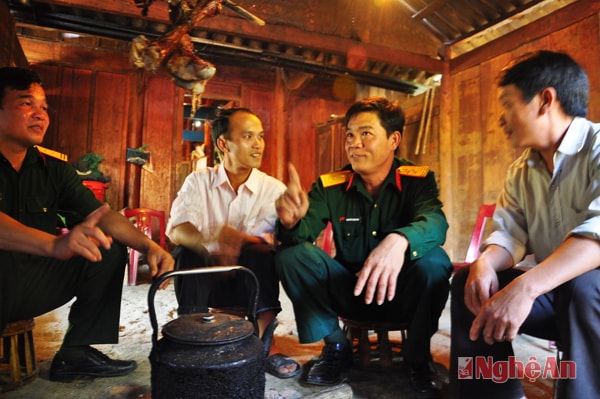 |
| By the family fireplace of Mr. Vu Va Tu (Muong Long commune, Ky Son district) |
The word "giàng" in Thai means smoked meat; while in the Hmong language, "giàng" means sky. Sitting around the fireplace of a Hmong family in Muong Long commune, Ky Son district, the host, Vu Va Tu, explained to us the very serendipitous origin of the current specialty, smoked beef. He recounted a time when fire had been discovered, but people still lived in caves, primarily subsisting on hunting and gathering. To keep the fire burning, their ancestors kept the hearth burning year-round. One day, in a certain village, the villagers hunted a large animal, and each family received a share of meat and bones. Some families, after eating their fill, threw away some of the meat and bones right next to the fireplace. A famine and cold weather arrived. The entire family had nothing to eat, and they gathered sadly around the fire. A child found a small piece of meat still clinging to a rolling bone and tried eating it. In times of scarcity and hardship, our ancestors would hang or store leftover bones and meat above the fire to keep them clean. This is how the dish called "thịt giàng" (shrimp jerky) was born. Over time, as society developed, they discovered that salted meat tasted better and could be preserved longer. To offer a change of taste from these stored food items, sausages and fermented meat were also created.
Clearly, the traditionally prepared dried beef at Mr. Vu Va Tu's house had a much inferior color and flavor compared to the widely sold dried beef from Ky Son that we had previously tasted. Mr. Tu explained: Ky Son dried beef tastes better because it's a commercial product… We returned to Muong Xen town, where there are more than 10 production facilities that have built the "Ky Son Dried Beef" brand. The dried beef here is all made using traditional methods, but each household has its own secret recipe. Among them, the Hau Que facility in Block 5 of the town is the oldest and most famous. Visiting the Hau Que facility, we witnessed the stages of making dried beef. Without hiding his trade secrets, the owner, Mr. Nguyen Lam Hau, demonstrated and explained each step: To make exceptionally delicious dried beef, attention to every small detail is crucial.
First, choose the meat – it absolutely must be lean meat from the two front legs and two hind legs of the cow. This cut of meat is both chewy and has long fibers. The meat needs to be fresh to ensure the flavor of the roasted beef and the reddish-pink color. The meat needs to be washed clean, cut into long pieces along the grain, and marinated with spices such as salt, MSG, chili, ginger, sugar, and pepper for about 30 minutes. Next, these pieces of meat are skewered onto bamboo sticks and hung on a system of racks about 1 meter high above a fire. A moderate fire of firewood is burned underneath. A little smoke combined with the heat from the embers will cook the meat in 2 days and 2 nights. Importantly, the firewood used must be from the roots of the Săng Lẻ tree. This type of wood burns very well, produces little smoke, and the smoke is non-toxic. Showing us a mountain of Săng Lẻ firewood used for making roasted beef this Tet, Mr. Hậu revealed: "The firewood alone cost 20 million dong." It takes 3.5 kg of fresh beef to make 1 kg of dried beef. The price of dried beef increases proportionally with the price of fresh beef. Each Tet holiday, his business sells around 600-700 kg of dried beef. The current price is 900,000 VND per kg.
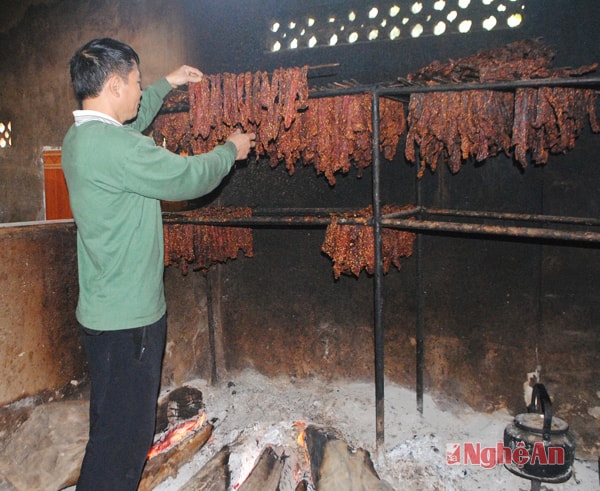 |
| Mr. Nguyen Lam Hau, owner of Hau Que establishment, is inspecting a batch of dried beef he just processed. |
Offering guests a few freshly grilled beef strips, Mr. Hau quickly cooks them over hot coals, then uses a pestle to pound and shred them. The dry, hard beef strips, glistening reddish-brown, quickly char and crumble, then are placed on a plate, squeezed with a little lemon juice, releasing an alluring aroma. Chewing each strand of beef carefully, one finds it not crispy but rather chewy and tender, infused with a rich, sweet flavor. To achieve the desired taste, further preparation is possible depending on preference: wrapping in fresh banana leaves and burying in hot coals for 1-2 minutes, grilling on a gas stove, microwave, or alcohol burner, frying in oil, or even steaming in hot rice. But perhaps the most delicious way is still grilling over hot coals… From the still-hot strips of meat, the aroma emanating is not just the intoxicating scent of beef, but also the rich, captivating fragrance of thin smoke. The smoke permeates each fiber of the meat, just enough to bring out the pristine flavor of the mountains and forests. Mr. Hau said: "Both my wife and I are border guards, and we've been working in Ky Son for nearly 20 years. During our time living with the locals, we've learned and made quite a few special local dishes. Ky Son beef jerky is made by the Mong, Thai, and Kinh people alike; it's not a dish exclusive to any one ethnic group. However, the Thai people make the smoked sausages the best."
Unlike dried beef, which can be preserved for months in the attic or freezer, smoked sausages can only be kept in their original state for about 15-20 days. It's not until mid-December that the people of Ky Son prepare smoked sausages for Tet (Lunar New Year). Perhaps due to personal preference, I was particularly impressed with the sausages made by the Thai people in Tuong Duong. To learn the original way this dish is made, we traveled by boat to the Ban Ve hydroelectric reservoir – where the houses of Thai people still stand along the Nam Non River. Mr. Luong Khac Phung, an elder in Cha Coong village, explained: While dried meat and fermented meat can be stored for a long time, smoked sausages and cured meats must be consumed within a month or they will spoil. This type of food is made from meat using the stuffing method. To make delicious smoked sausages, you must use the meat and offal of free-range black pigs raised by the locals in the forest, which only reach 15-17 kg a year, resulting in firm, flavorful meat with little water. The meat used for sausages is loin or rump, and the offal must be young intestines. The meat is cleaned, minced according to a ratio of 4 parts lean to 1 part fat, and mixed with spices and salt for a rich flavor. The young intestines are cleaned, and all the mucous membranes and fat are removed from the inside to make them as thin and transparent as possible. Then, the minced meat is tightly stuffed into the intestines, both ends are tied tightly, and they are hung over a fire so that the smoke and heat cook and dry the sausages.
When guests arrive, the host will bring out the sausages, grill or fry them in sections, and then slice them up. When grilling or frying, the cook doesn't need to add any extra oil or fat; the fat itself will melt. The melted fat coats the sausages, sizzling and crackling over the fire, creating a delightful sound and a fragrant aroma. Thai smoked sausages have a rich, indescribable flavor; you can eat a lot without getting tired of it. This is because the sausages have a special sour taste, created by additives, primarily due to the soaking time of the pork intestines in water – the longer the soaking time, the more sour the flavor becomes. Smoked sausages are easy to make, so recently, restaurants in Hoa Binh town, Tuong Duong district, have started making them themselves, adding this dish to their menus, which is very well received by diners. Similar to Ky Son beef, Thai smoked sausages from Nghe An have become popular and in high demand in Hanoi and Ho Chi Minh City. Currently, smoked sausages are sold by production facilities in Ky Son and Tuong Duong at a price of 400-450 thousand VND/kg; while in major cities, the price ranges from 650-700 thousand VND/kg.
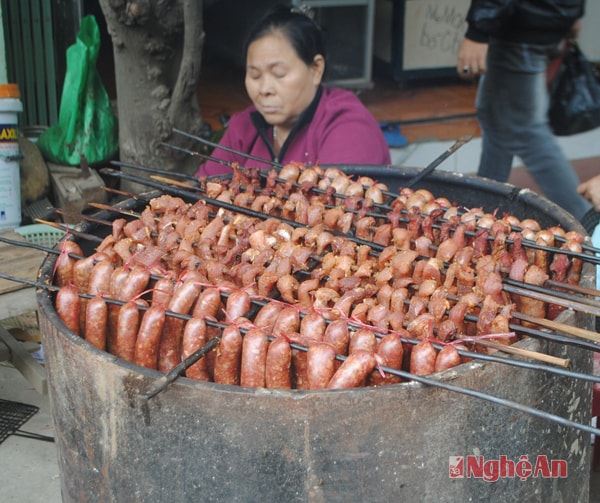 |
| People in Hoa Binh town are making smoked sausages in preparation for Tet (Vietnamese New Year). |
During our work trips, traveling back and forth within the province, we once had the opportunity to attend the Hang Bua Festival in Quy Chau district. This festival, held at the beginning of the year, features many competitions, including a Thai culinary contest. We had heard much about Chin Xom (Thai sour meat), but it was our first time tasting it. For the Thai women of Thuy Son, just like rice wine and brocade weaving, making sour meat is an art. This is because making sour meat is not easy; if not done skillfully, the meat can easily spoil and become inedible. Mrs. Sam Thi Lan, 60 years old, from Hoa Tien ancient Thai village, Chau Tien commune, enthusiastically greeted us while explaining how to make this delicious dish: The meat used for Chin Xom can be beef, buffalo, or pork, but it must be lean meat without fat.
The meat is washed and sliced by hand. It is blanched in boiling water for about 30-45 seconds to sear the outer surface, then removed, drained, and sliced across the grain into large pieces. Next, it is marinated with white salt; the amount of salt must be just right, as too much or too little salt, or impure salt, will spoil the meat. After marinating for about an hour, take some cooked rice, let it cool completely, and mix it with the meat, the amount of rice being about one-third the amount of meat. The next step is to put the meat and rice mixture into a fresh bamboo tube, compress it to a moderate level, seal it with a banana leaf or dong leaf, tie the mouth of the tube tightly, and place the tube of meat at an angle above the kitchen stove to absorb the heat.
In an anaerobic environment at high temperatures, the meat ferments, developing a sour taste and gradually ripening. The bamboo tube containing the meat is left in the attic for about three days before being taken down, the stopper opened, and the meat poured out. The prepared roasted rice flour is then added and mixed well for fragrance. The meat is then put back into the bamboo tube, tied shut, and placed back in the attic as before. These steps must be done quickly to prevent the meat from becoming soggy and fishy. The sour meat is then ready to eat after another three days in the attic. The meat, still reddish-pink, is cooked through the fermentation process. It tastes sour, savory, spicy, and fatty, not greasy, and melts in your mouth with a very distinctive and delicious flavor…
On a beautiful spring day, with a slightly chilly weather and a light drizzle, all family members reunite and enjoy the Tet flowers, savoring some Ky Son dried beef, smoked sausages, Thai-style fermented pork, and a small glass of wine. Only then can one truly appreciate the essence of these ancient dishes. It reminds everyone of past hardships, fosters contentment with present happiness, and inspires determination to build a better life in the future…
Thanh Chung