

Kim Lien Street - Potential for a New Urban Area
(Baonghean)The road hasn't yet become bustling with streets and doesn't evoke the feeling of a long, vital thoroughfare. But upon reading the name, travelers, both familiar and unfamiliar, are sure to want to experience the scenery along this road. It is Kim Lien Road in Vinh City…
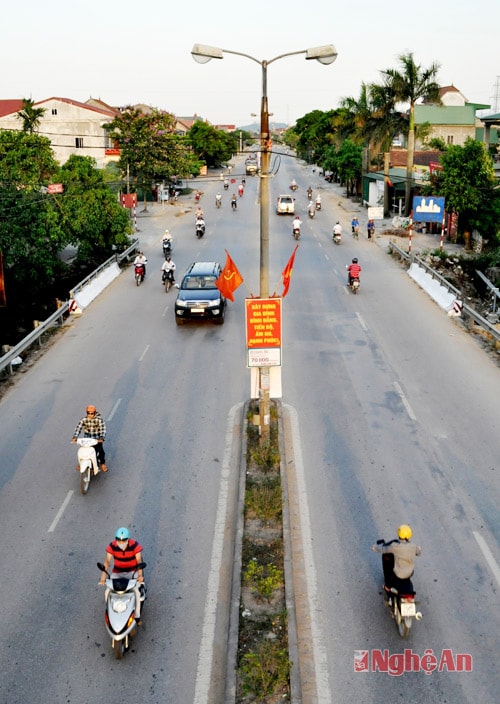 |
| Kim Lien Street (Vinh City). |
Approximately one kilometer long, Kim Lien Road is located entirely within Hung Chinh commune, a suburban area of Vinh City, connecting Nguyen Sinh Sac Road from Duoc Bridge to Ma Bridge, marking the border with Hung Nguyen district. Since the French colonialists paved Highway 49 to serve their second phase of Indochina colonial exploitation (1914), the road has been adjusted twice by the Vietnamese government to achieve its current design. The first adjustment was in 1990, when the road was completely rerouted from its original axis and inaugurated to celebrate the 100th anniversary of President Ho Chi Minh's birth. The second adjustment was in 2000, expanding the road to four lanes, creating a suburban traffic artery (at that time, Hung Chinh was still part of Hung Nguyen district), marking the beginning of National Highway 46 connecting Vinh City with the Ho Chi Minh Highway in southwestern Nghe An province. The installation of a two-way median, streetlights, and street planning dates back to when Hung Chinh was incorporated into Vinh City. Vinh (2008) and the Kim Lien street sign was only put up a few years ago when the urban planning agency decided to segment Nguyen Sinh Sac street.
When I say travelers passing through here will inevitably become "curious" upon reading the street name, it's primarily because the street bears the name of President Ho Chi Minh's hometown (Kim Lien - Sen Village), and secondly, because of what the cultural officer from Hung Chinh commune said: that this street will soon become a "transit" service street for the Vinh - Kim Lien tourist route. With the urban planning and structure still somewhat hesitant, this street will certainly have the opportunity to replace and flourish services catering to tourists staying in Vinh who travel to Kim Lien or from Kim Lien back to Vinh. This means developing specialized food stalls for breakfast and dinner, and souvenir shops to create a suburban shopping space, for example... There are now restaurants selling porridge and eel soup for breakfast, with unique preparation and serving methods that attract discerning diners from all over Vinh. In particular, the restaurant has gained a reputation, attracting many tourists from across the country staying in Vinh.
My "curious" wanderings led me to the home of 84-year-old Mr. Nguyen Van Quy in Hamlet 3, Hung Chinh – the only living source of information about the revolutionary periods that took place along this road. He was born when the drums of the five-drum assembly urged the farmers of Hung Nguyen to march to the district capital to fight in the revolutionary movement of September 12, 1930. At the age of 11, he was orphaned, losing both his father and mother. Unable to bear the constant scolding from his uncle, he left and built a small thatched hut on four bamboo poles, living right next to the Huong Nguyen district capital's residence in the poor hamlet of Chinh Duc (now Hamlets 3 and 4 of Hung Chinh). That orphaned child, who wore tattered, patched clothes year-round, earned a living by carrying loads and gleaning potatoes to stave off hunger. Gradually, he learned to read and write, grew up to join the revolution, became the chief accountant of the commune for many years, and participated in many local policy decisions during the Hung Chinh period, like many other communes in the North, which served as a major rear base against the Americans. According to Mr. Quy, the Hung Nguyen district office was located right on what is now the new Duoc market. During the August Revolution, the area around the district office was teeming with Japanese soldiers and then the defeated "Chinese soldiers" (Chiang Kai-shek's army wearing baggy pants and leggings) who had fled. These "Chinese soldiers" were a motley crew; without food supplies, they were starving and resorted to theft and robbery. Many died of starvation and were hastily buried by their accomplices under the bamboo thickets at the edge of the village and along the Duoc River...
The Hung Nguyen district headquarters, with its rows of buildings, has survived many upheavals, leaving only the district well located in the back of the communal house at Duoc Market. The well has been covered with a concrete lid and fitted with a small pump for the women selling meat to use. But according to Mr. Quy, he doesn't regret the loss of the district headquarters, but only the loss of the sacred communal houses, temples, and pagodas, which, although renovated, have lost their spiritual essence in the hearts of the people and the land. The Duoc Market communal house, famous for its large and beautiful architecture, used to be located right next to the south side of what is now Kim Lien Street, and was the place of worship for the village's guardian deity, Chinh Duc. The communal house no longer exists, but the influence of its culture is still seen in the daily lives of some of the "original" residents on both sides of the street. Also on the south side, there is the Kim Ma Temple, once associated with a very lively festival dedicated to two saints of the Vo family and a princess (whose full name is unknown, but her tomb is still in Xuan Hoa commune - Nam Dan district). Many people still preserve the royal decrees of this temple. The temple was demolished, but the triple gate remains, along with the spiritual stories that are still passed down...
Yen Lac Pagoda (also known as Duoc Temple) is located right on the northern edge of Kim Lien road. It was once an ancient pagoda situated in a spacious compound planted with many old banyan trees, a place where Mr. Quy and his friends often gathered to play and have fun in their youth. Built over 200 years ago, initially as a thatched hut, it was gradually renovated and improved by local people through donations, resulting in its present magnificent structure. Local people regularly visit the pagoda to offer incense and express their spiritual beliefs on the first and fifteenth days of the lunar month.
The Kim Lien road now has a curved section starting from Duoc Market. This is because, in the past, when the French were building the road through Hung Nguyen district, they encountered the ancestral temple and property of Mr. Cai Nha, a landlord. They couldn't "clear the land" because Mr. Nha offered too much bribe, so they deliberately shifted the road to the south. Later, as the population grew, the road could only be straightened to its current "straight" state. Mr. Cai Nha was a descendant of Mr. Nguyen Dinh Lam – the son of Cuong Quoc Cong Nguyen Xi – and was sent to reclaim land and establish a settlement here. The ancestral temple, several hundred years old, is still respectfully preserved by his descendants right next to Kim Lien road. And Mr. Quy, although his branch changed to Nguyen Van, was actually a direct descendant of the Nguyen Dinh lineage in Hung Chinh…
Although it lacks the bustling atmosphere of a modern street, Kim Lien Street is gradually attracting people from other areas who rent kiosks and storefronts to expand and introduce services and businesses, including high-end fine art woodworking, sophisticated mechanics, and modern electronics and information technology products.
Visiting the rich historical sites of the Yen Do district, near the ancient Yen Truong district of Vinh, such as the Nghè (a place of worship), the Đước (a shrine dedicated to a meritorious official of the early Le Trung Hung dynasty), the Thần Nông Temple, the Yen Lac Pagoda, the Kẻ Tráo Temple, Kim Mã… one can imagine how interesting it would be if the skilled craftsmen in those carpentry, mechanics, and electronics workshops could one day become souvenir shop owners with exquisite products reflecting the culture of Nghe An, attracting tourists; contributing to the creation of Kim Lien Street as a "transit" service for the Vinh – Kim Lien, Nam Dan tourist route, the birthplace of President Ho Chi Minh. Yes, who knows!
Kim Lien is the name of a lowland commune in Nam Dan district; it has a natural area of 1,522 hectares, a population of 3,200 households and 13,000 people. Kim Lien commune was selected by Nam Dan district as one of three pilot communes for building new rural areas, and is expected to be the first commune in the district to complete the new rural area criteria (phase 1) in 2014. During the feudal period, the Kim Lien area basically belonged to Chung Cu commune of Lam Thinh district. The name of the present-day Kim Lien commune is derived from the name of Kim Lien village (which is Sen village on President Ho Chi Minh's maternal side). Currently, Kim Lien commune is well-known for its historical sites and the Ho Chi Minh Memorial House, which is the focal point of the Kim Lien Historical Site Complex, and has been included by the Prime Minister in the list of 23 special national historical sites. Vinh City is the first locality in the country to name a street after Kim Lien commune. |
Dinh Sam