
Actions to prevent sea level rise
(Baonghean) - Climate change is a global issue of concern to countries and territories worldwide. The theme of "World Environment Day 2014" is: "Act to prevent sea level rise." Baonghean newspaper interviewed Mr. Vo Van Ngoc, Deputy Director of the Department of Natural Resources and Environment, on several related issues.
(Baonghean) - Climate change is a global issue of concern to countries and territories worldwide. The theme of "World Environment Day 2014" is: "Act to prevent sea level rise." Baonghean newspaper interviewed Mr. Vo Van Ngoc, Deputy Director of the Department of Natural Resources and Environment, on several related issues.
Reporter:Sir, rising sea levels and their consequences are a major concern for many countries. Could you please tell us about the risks, challenges, and impacts of climate change on the globe in general, and on Vietnam, especially Nghe An province?
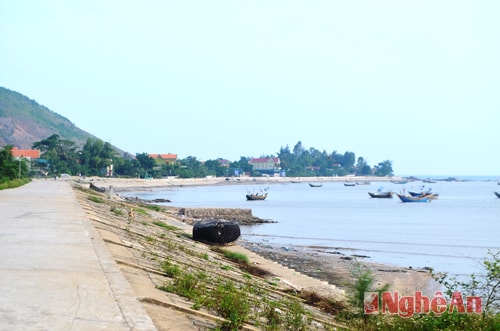 |
| The breakwater runs through Quynh Long commune, Quynh Luu district. Photo: Thanh Duy |
Mr. Vo Van Ngoc:According to the United Nations Framework Convention on Climate Change (UNFCCC), "Climate change is the alteration of the climate resulting directly or indirectly from human activities that leads to changes in the global atmospheric composition, observed over a long period of time." The main cause of global climate change is the increase in human activities that lead to excessive emissions of greenhouse gases into the atmosphere, and the overexploitation of greenhouse gas sinks and reservoirs such as biomass, forests, and other marine, coastal, and terrestrial ecosystems.
These changes have had and continue to have a direct impact on global socio-economic life and the environment. In recent years, many parts of the world have suffered from dangerous natural disasters such as major storms, prolonged heatwaves, floods, droughts, earthquakes, tsunamis, and extreme weather events, causing significant damage to human lives and property.
Vietnam is a country vulnerable to the impacts of climate change. According to the 2012 climate change scenario, by the end of the 21st century, temperatures could rise by 2.5-3,700°C, and sea levels could rise by about 1 meter. Consequently, approximately 39% of the Mekong Delta, over 10% of the Red River Delta and Quang Ninh, over 2.5% of the coastal provinces of Central Vietnam, and over 20% of Ho Chi Minh City's land area would be submerged. However, in reality, climate change, especially sea level rise, is occurring faster than predicted. We can see that in recent times, natural disasters such as typhoons, floods, flash floods, landslides, waterlogging, droughts, and saltwater intrusion have caused significant damage to people and property, resulting in over 9,500 deaths and disappearances, with estimated property damage accounting for about 1.5% of GDP per year.
Nghe An is one of the provinces considered to be most affected by global climate change.
According to the Ministry of Natural Resources and Environment's B2 average emission scenario, Nghe An province is significantly affected by climate change and sea level rise, such as: coastal erosion, loss of agricultural and residential land in coastal areas, landslides and damage to irrigation works and coastal transportation infrastructure... In the short term, this is evident in the increased saltwater intrusion into rivers during the dry season and the significant impact of saltwater intrusion on land use in coastal areas. According to calculations by the Ministry of Natural Resources and Environment, the 4‰ salinity threshold in the Lam River could reach over 30 km inland by 2020, and in the Mo, Thai, and Bung rivers it could reach 6-7 km. Several communes in Quynh Luu district, including Quynh Minh, Quynh Luong, Son Hai, Quynh Nghia, Tien Thuy, Quynh Thuan, and Quynh Long; and Dien Thanh, Dien Trung, Dien Hung, Dien Kim, Dien Bich, and Dien Hai communes in Dien Chau district, are also affected. Phuc Tho, Nghi Tien, and Nghi Thiet communes in Nghi Loc district are at very high risk of salinity exceeding 4‰. Therefore, we must "Act to prevent sea level rise" now.
Reporter:Amidst the numerous challenges facing the province recently, what actions has Nghe An province taken to proactively combat and adapt to climate change?
Mr. Vo Van Ngoc:Over the past period, the Department of Natural Resources and Environment has advised the Provincial People's Committee to direct the implementation of many measures to proactively respond to climate change as follows:
Firstly, the plan involves advising on the development of an action plan to respond to climate change in Nghe An province up to 2015 and extending to 2020. It also requests the Provincial People's Committee to direct relevant departments and agencies to implement these plans, focusing primarily on tasks such as: raising community awareness and enhancing the capacity of management officials to meet the objectives set out in the Prime Minister's National Target Program on Climate Change Response and the Politburo's Resolution 24/NQ/TƯ on Proactive Climate Change Response, Strengthening Resource Management and Environmental Protection; integrating climate change response objectives into the planning and implementation of socio-economic development plans and the development of various sectors and fields within Nghe An province; and promoting the implementation of the national target program on energy conservation and efficiency in the province.
Furthermore, it is known that the province has been focusing on directing the construction of projects to respond to climate change, combat storms, floods, and sea level rise; and upgrading the sea dike system in Nghe An. According to the national program, Nghe An has received investment to upgrade approximately 42 km of sea dikes, and is currently upgrading the Ta Lam dike along the Ca River, in the Nam Dan, Hung Nguyen, and Vinh sections. We are also proceeding with procedures to propose the construction of a saltwater intrusion prevention sluice gate across the Lam River at Ben Thuy and upgrading the irrigation system of the Hoang Mai River…
Reporter:To continue implementing the action plan for responding to and adapting to climate change and sea level rise, what solutions does Nghe An province need for the coming period, sir?
Mr. Vo Van Ngoc:Based on the Climate Change Response Plan approved by the Provincial People's Committee in Decision No. 1395/QD-UBND.DC dated April 27, 2011, the Department of Natural Resources and Environment and related agencies are currently reviewing, updating, adjusting, and supplementing the strategies and action programs of the sector and localities, taking into account climate change factors, to suit the natural conditions and socio-economic development of the province, for the period 2014-2020.
The Department of Natural Resources and Environment has advised the Provincial People's Committee to review short-term, medium-term, and long-term solutions and plans to identify priority areas for implementation. This includes focusing on key tasks such as: strengthening community awareness of climate change; organizing water management, especially in coastal areas; upgrading and repairing dike and seawall systems, constructing new sluice gates to prevent saltwater intrusion and retain freshwater; adjusting crop structures and agricultural production seasons; protecting and developing forests of all types; implementing pollution control and environmental improvement measures; and promoting communication and awareness campaigns on preventing and adapting to climate change and implementing programs and projects to proactively respond to climate change and sea level rise. From there, it aims to mobilize all levels, sectors, and segments of the population to work together. Simultaneously, the province continues to mobilize resources from the central government budget, preferential loans, support from the World Bank, the German Reconstruction Bank, and non-governmental organizations to implement key investment projects aimed at mitigating the impacts of climate change and sea level rise.
Reporter: Thank you, sir!
PV