

Duong Huy, a poet for children.
(Baonghean) - For the children he had to carry around while feeding them along Phong Dinh Cang street in Vinh city, Duong Huy was a "peculiar old man" who always knew how to entertain them so they would "open their mouths wide" and "swallow quickly." To the neighbors around house number 196, Duong Huy was a simple, somewhat unpretentious, but witty "walking old man." For us, the journalists of Nghe An, Duong Huy was a close and dear colleague, father, and uncle. He was not only one of the first generation of journalists at Nghe An newspaper but also a renowned poet who wrote for children.
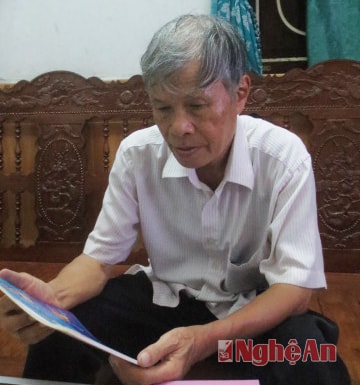 |
| Poet Duong Huy |
Duong Huy, a 76-year-old poet, may still browse the internet daily and have a computer, but he still prefers to handwrite articles and poems to send to news outlets. For the past few years, he's completely abandoned his bicycle to become a "walking old man" on the sidewalks of Vinh City. One might think he's slow and leisurely, yet he keeps up with domestic and international news, and his satirical essays and poems are highly topical…
And talking with him, I realized that hidden deep within that thin, quiet man was so much youthfulness and playfulness. "How could I write for the world of children without being mischievous?" he said with a chuckle, then recited an illustrative poem, a poem that many children enjoy and know by heart: "In the sequence of natural numbers / The number 0 is inherently mischievous / He's chubby and round / But poor and has nothing / Adding a tail makes him fat / The number 0 becomes the number 9 / Hanging it upside down to count / The number 9 loses three / Playing stacking buds and flowers / Two zeros become 8 / Leaning on a cane to visit a friend / The number 0 becomes the number 10."
Duong Huy said he has many "titles" and "positions," and if he were to receive commemorative medals, he would have quite a few: founding member of the Provincial Association of Literature and Arts, member of the first Executive Committee of the Association, one of the first generation of the Nghe Tinh Newspaper, the first Secretary of the Youth Union branch of the newspaper, then Chairman of the Nghe An Association of Literature and Arts, Editor-in-Chief of Song Lam Magazine… In his writing, he also has many strengths, from folk songs from the years of the anti-American war, satirical poetry, short stories, and children's poetry… He has also encountered many setbacks with his writing, sometimes being disciplined or threatened because of… satirical poetry. But his most prestigious "title," the one he is most proud of, is "poet of children." And it was children's poetry that led him to become a member of the Vietnam Writers Association in 1983.
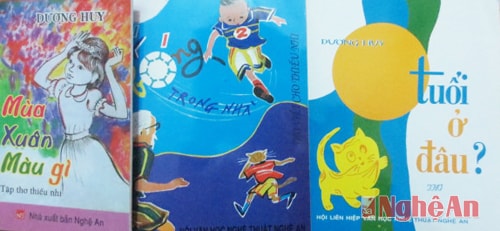 |
| Some poems by the poet Duong Huy. |
Yet, he started with children's poetry later than with his other themes and genres. Duong Huy recounts that he began his literary journey with... folk songs. That was when he was in his hometown, working in the Youth Union at the commune committee office. At 16, Duong Huy composed folk songs to encourage production and motivate people in the cooperative. In 1957, he attended the first National Conference of Young Writers. That was also the time when a genuine country farmer met and stayed with famous names like Nguyen Khai and Che Lan Vien...
He said that it wasn't by chance that he knew how to compose poetry. Duong Huy was born into a family where his father was a scholar who taught and often wrote poetry. His mother was a woman who worked as a weaver; she didn't write poetry herself but knew many poems by heart. In particular, his small hamlet of Diem in Quynh Doi village, Quynh Luu district, was the birthplace of the renowned poet Ho Xuan Huong and many other talented poets, a hamlet with many famous scholars. He recounted that in his house, as in many other houses in the hamlet, the elders would often sit together discussing poetry, literature, and current events, while the children would run in and out, shouting, teasing each other, and imitating each other... writing poetry. It started with mischievous poems, joking around like "this one with a wide mouth, that one with missing teeth."
The playful, satirical nature of his writing also "permeated" him from those days. Later, when he had matured in his creative work and become familiar with many "artistic techniques," he still remembered his very "innocent, simple" folk song written during the anti-American war years: "Uncle Ho taught us / As long as the Americans are still around, we will fight and not spare a single one / We promise Uncle Ho that / As long as the Americans are still around, we will fight and not spare a single one." He also had an unforgettable memory associated with this folk song. It was when he was working at the Nghe Tinh Newspaper, on a trip to a local area in Quynh Luu, his hometown, and encountered a bombing raid. When the bombing stopped, on a collapsed wall, he saw his "poem" still intact, meticulously drawn. At that moment, he was deeply moved...
Later, people mentioned Duong Huy's folk songs, saying that he was only "second to Tran Huu Thung." From folk songs to satirical poetry, to "Talking to Each Other"—a special column on "criticism and self-criticism" in the Nghe An newspaper at that time—it wasn't until 1977 that Duong Huy entered the realm of children's poetry. At that time, he was sent to Ho Chi Minh City to study at the Central Propaganda School No. 3. Missing his children in the North, coupled with his love for children, and having free time while seeing the bustling atmosphere of journalism in the South, Duong Huy began writing for children to submit to newspapers. After graduating, he went to the North to participate in a children's writing competition organized by the Vietnam Writers Association in collaboration with the Central Youth Union, winning a prize. Duong Huy's name then became known in the field of children's poetry.
He said that his connection to the world of children began with a longing for his own children and a longing for his own childhood. Throughout their early years, his children rarely lived with him, rarely received his care and attention because they evacuated with their mothers, while he remained at work, then went to school, and traveled for work… He wrote for his children, but also for himself. For the nostalgia of the village of Điếm, which witnessed his difficult yet mischievous, innocent yet fierce childhood. There, a hungry boy, whose father was away teaching, would run across the fields near and far searching for fish and shrimp, gleaning rice and potatoes to help his mother. There, a mother would light a peanut oil lamp night after night to weave cloth while her child studied.
His mother would sit weaving all night, reciting poetry and singing to ward off sleepiness, and also to remind herself to remain steadfast in her principles. Later, Duong Huy was startled to realize that his mother had been reading Ho Chi Minh's poems and revolutionary verses since those days. Perhaps that's why she survived two years of torture and beatings by the enemy (the poet Duong Huy's mother was the first woman from Quynh Luu to be imprisoned by the French, a veteran revolutionary of the 1930s and 1931). Her songs and recitations remain etched in his memory. Every time they resound, he sees himself as the young boy he once was, sitting by the oil lamp…
When Duong Huy was over 10 years old, his mother passed away. He became an orphan, living in such hardship that he had to work as a servant to survive. Yet, he always cherished that difficult childhood. How could the sorrow and pain of childhood remain so pure to him? He and his five siblings grew up together, and now, some are gone, some are still alive, and some have become martyrs (but live on in his poetry). He says that the poem chosen for his third-grade textbook, written about his family's circumstances and about his younger brother, a martyr whose grave has yet to be found, is a prime example: "Where are you, where are you?/ The long, endless Truong Son Mountains/ Truong Sa islands rising and falling/ Or Kon Tum, Dak Lak?/ Mother's eyes reddened with tears/ Father looks up at the altar/ The country is no longer at war/ You are with Uncle Ho."
Duong Huy said that writing poetry for children wasn't difficult for him. But he didn't want to make it difficult for them. He wanted them to express their most innocent feelings, not to worry about having to preach or incorporate "lessons." From writing poetry for children, he became passionate about observing their world. Try reading one of his poems, "The Boat Sleeping on the Beach," selected for a first-grade textbook: "The boat sleeps strangely / It refuses to climb onto its bed / It buries its face in the golden sand / Tilting its ear towards the sea." Passionate observation isn't enough; it must be full of subtlety, full of love, full of playfulness, and it must be the children themselves to truly understand "the boat." That's precisely the unique quality of his work and his poetry.
For Duong Huy, life around us, seen through the eyes of a child, is always new, fascinating, and intriguing. That's why children often ask: "Where is age?" (The goat plucks the leaves / Age hangs on the chin / The pig lies down / Age is held in front of the belly). "What color is spring?" (Spring wears green / When going to the field to check on the rice / Spring is red like fire / When lighting up the peach blossoms). And Duong Huy, the "old man walking" that people in Vinh often see every day, has opened up that innocent world for us to see, for us to reflect on ourselves, through his collections of poems for children: "Sweet Longan Cluster" (published jointly with poet Le Duy Phuong), "Naughty Zero", "Where is age?", "Playing soccer indoors", "Three mice", "What color is spring?"...
I keep thinking that if there weren't such a quirky Duong Huy in poetry, then poetry for children would be so lacking, just as without the "old man walking" on the sidewalks of Vinh, those picky eaters would be so sad...
Text and photos:Thuy Vinh