
Concrete paving of village roads in My Ly
(Baonghean) - Concrete paving of rural roads, which is difficult in the lowlands, is even more challenging in mountainous areas like Ky Son. However, with government support, some localities in the district have made great efforts, contributing labor and money to pave village and hamlet roads with concrete, making them sturdy and well-maintained.
(Baonghean) - Concrete paving of rural roads, which is difficult in the lowlands, is even more challenging in mountainous areas like Ky Son. However, with government support, some localities in the district have made great efforts, contributing labor and money to pave village and hamlet roads with concrete, making them sturdy and well-maintained.
When discussing the construction of concrete roads in villages, Mr. Mua No Xu, Vice Chairman of the Ky Son District People's Committee, frequently mentioned My Ly commune, a remote border area with over 75% of households living in poverty. Although not designated as a pilot commune for the New Rural Development program, the people there chose to prioritize the construction of concrete roads. According to Mr. Xu, this is a "miracle in the village," and deserves timely encouragement and support for the local people.
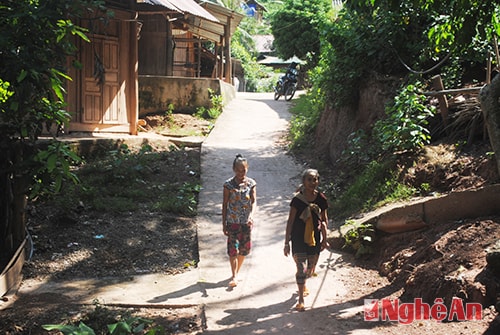 |
| Many roads leading into the villages in My Ly commune have been paved with clean, beautiful concrete. |
Beginning the story of building concrete roads in the villages, Mr. Kha Ngoc Minh – Chairman of the People's Committee of My Ly commune, proudly stated: When the plan to build concrete roads in the villages was announced, knowing that the people were still poor, the Party Committee and local government were determined to mobilize the entire population to build roads and develop new rural areas. We are pleased that most people agreed and supported it. Villages closer to the commune center, with more favorable terrain, immediately registered to receive cement for road construction. However, the commune chose Xop Tu village, a village far from the commune's "gateway," as a pilot project. From there, we learned from experience and implemented the project in other villages. In addition to the cement provided by the State, the villagers also discussed and agreed on contributing sand and gravel. My Ly commune has the Nam Non River flowing through it, so there is plenty of sand and gravel. Therefore, the people of Xop Tu village unanimously agreed that each person would contribute 0.5 cubic meters of sand and gravel, while the concrete mixer and shovels were provided by the district. In just 15 days, 1 km of the village's main road was completed like a dream! Following the example of Xop Tu village, other villages rushed to register to receive cement for their projects. The district provided the commune with two concrete mixers, but when faced with long waiting times, some villages started mixing concrete manually... The atmosphere of concreting the village roads was truly vibrant.
Next came the villages of Xieng Tam, Hoa Ly, Yen Hoa, and Xang Tren, each with its own approach. We arrived at Xieng Tam village, where the internal roads had been paved with concrete, making it easy for motorbikes and pedestrians to travel. Mr. Lo Bu Xa, a villager, confided: “Seeing on TV how many localities invested in road construction, we were very impressed. Therefore, when the government provided cement for concrete road construction in our village, everyone was excited. The village held a meeting and agreed to assign each person to contribute 0.7 cubic meters of sand and gravel.” Mr. Xa's family of six contributed 4.2 cubic meters of sand and gravel. The road from the village down to the Nam Non River was narrow and difficult to navigate, so the villagers used baskets to carry the sand up. Once they had enough sand, the village organized the concrete pouring along each section. Young people were assigned to mix the concrete, while those skilled in construction handled the technical aspects. Village head Vi Van Luan said: "For narrow, winding sections of the road, the village mobilized families to donate garden land to widen the road, and everyone voluntarily donated land. When pouring concrete, everyone enthusiastically participated, making it like a road-building festival for the village. Everyone did their part, and in just June 2013, the villagers poured more than 1,200 meters of concrete road, with a width of 1.5 to 3.5 meters (depending on the section) and a thickness of 13 cm. Now, the people of Xieng Tam village walk on wide, clean concrete roads every day, and everyone is very happy and proud."
In 2013, My Ly commune received 700 tons of cement and organized the concreting of village roads and several other projects such as: the playground of the boarding secondary school, primary school, kindergarten, volleyball court, and the foundation of the village cultural house… In 2014, the local plan registered with the district to concrete 4 km of roads in two villages: Pieng Pen and Xop Duong, and to provide additional funding for 5 villages that had already started construction in 2013. My Ly commune has 12 villages with 1,160 households, including 8 Thai villages, 3 Mong villages, and 1 Khmu village. According to the Chairman of the People's Committee of the commune, the 4 villages inhabited by the Mong and Khmu ethnic groups along the Vietnam-Laos border are the most difficult in the new rural development program, with the criterion of concrete road construction being particularly challenging. Because these villages lack roads and access is primarily via river, transporting materials is very difficult and complicated.
Text and photos:Xuan Hoang