

"Meeting point" when the South China Sea is turbulent.
During his trip to North America (USA and Canada), Australian Prime Minister Tony Abbott visited the United States at a sensitive time.
The US-Australia summit took place on June 12 amidst rising tensions in Asia, with Japan, the Philippines, and Vietnam all condemning China's increasingly aggressive actions in the East China Sea and the South China Sea.
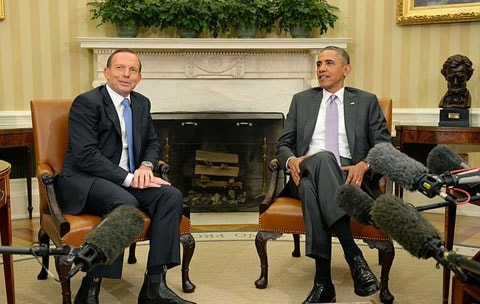 |
| Australian Prime Minister Tony Abbott (left) and President Barack Obama at the White House in Washington, D.C., on June 12. |
At the summit, Prime Minister T. Abbott affirmed that Australia is an "indispensable ally" of the United States; and expressed support for the efforts of President Barack Obama's administration in its pivot to the Asia-Pacific policy. Meanwhile, President B. Obama appreciated Australia's increase in defense spending amidst economic difficulties; and emphasized that Washington and Canberra need to strengthen defense cooperation to "work together to help maintain world order and security." Both leaders agreed that adherence to international law is key to resolving territorial disputes in the South China Sea.
Earlier, at the 2014 Shangri-La Dialogue security forum in Singapore in early May, both US Secretary of Defense Chuck Hagel and Australian Defense Minister David Johnson criticized China's unilateral actions that destabilize the region. And, during Prime Minister T. Abbott's first visit to the US since taking office in September 2013, there was considerable public interest in how Australia would respond to China. Australia's stance is understandable: Mr. Abbott wants the US to continue its leadership role in Asia, a role it has held for decades. Like most people on both sides of the Pacific, he hopes China will cease its provocative actions and competition with the US. It is easy to see that the South China Sea issue significantly impacts Australia's national interests. The latest developments in the South China Sea are, to some extent, a test for Australia – a middle power that has long aspired to be a member of Asia. Despite its strategically important location in Oceania, Australia appears relatively isolated, surrounded only by small island nations with populations ranging from a few hundred to a few tens of thousands. Therefore, a focus on Asia has become a priority in Australia's foreign policy in recent years. The current situation is particularly favorable for Australia as its traditional ally, the United States, is implementing its pivot towards the Asia-Pacific region.
With the US's return to the Asia-Pacific, Canberra has reaffirmed its role as a strategic ally with Washington, while Beijing remains merely a trade partner, even though this relationship is now worth over $100 billion. Just recently (March 28), the US and Australia signed a new defense cooperation strategy involving the deployment of reconnaissance aircraft in Asian waters from the Cocos Islands in the Indian Ocean. Prior to this, under an agreement signed between the US and Australia (November 2011), the US deployed 2,500 troops to Darwin to protect US interests in the Asia-Pacific. Besides its strategic location on the Pacific Rim, Australia is asserting and strengthening its position as a leading force and a reliable partner in the region.
For the United States, Australia is currently a cornerstone of the global power's pivot strategy, aiming to build a defense alliance among allies in Asia to maintain its leading role in regional security. Within that alliance, Japan and Australia are two crucial links. Japan appears ready to shoulder responsibility for a prosperous Asia, and Canberra needs a clear affirmation of Washington's commitment in Asia. Therefore, Australian Prime Minister T. Abbott's visit to the US is an opportunity for Washington to make commitments to a traditional ally in order to address a China that is engaging in increasingly aggressive actions not only against countries in the region but also against the United Nations system, of which it is a member.
Australia's core interests in the region are further strengthened by Canberra being a reliable ally of the US; conversely, the US will gain more influence in the Asia-Pacific if the US-Australia relationship is affirmed and maintained. This is precisely the key to success in the Australian leader's North American tour amidst the turbulent South China Sea.
According to Hanoi Moi Online