

Highlights of the Hang Bua Festival
(Baonghean) - The Hang Bua Festival is a traditional festival of the ethnic minorities in Quy Chau district in particular and the Northwest region of Nghe An province in general, commemorating the contributions of those who founded the villages and settlements. It is held from the 21st to the 23rd of January every year. The festival is deeply rooted in the cultural identity of the Thai people, featuring many traditional folk cultural activities of the mountain dwellers. Before the opening of the 2014 Hang Bua Festival, a reporter from Nghe An Newspaper had an interview with Mr. Vi Van Tien - Vice Chairman of the District People's Committee and Head of the Festival Organizing Committee.
(Baonghean) - The Hang Bua Festival is a traditional festival of the ethnic minorities in Quy Chau district in particular and the Northwest region of Nghe An province in general, commemorating the contributions of those who founded the villages and settlements. It is held from the 21st to the 23rd of January every year. The festival is deeply rooted in the cultural identity of the Thai people, featuring many traditional folk cultural activities of the mountain dwellers. Before the opening of the 2014 Hang Bua Festival, a reporter from Nghe An Newspaper had an interview with Mr. Vi Van Tien - Vice Chairman of the District People's Committee and Head of the Festival Organizing Committee.
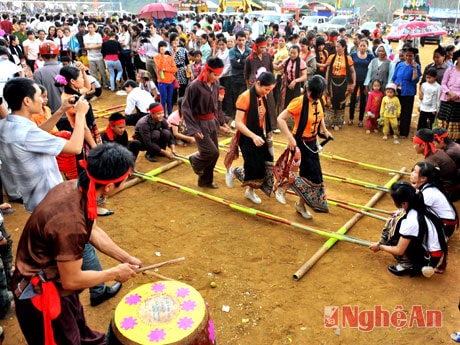 |
| Bamboo pole dancing competition at the Hang Bua Festival. Photo: Sy Minh |
PV: We understand that the Hang Bua Festival is a long-standing festival in Quy Chau district. Could you please tell us more about the history and significance of this festival?
Mr. Vi Van Tien:Hang Bua is located in the Pha En mountain range, in Hong Tien 2 village, Chau Tien commune, Quy Chau district. This is a historical site with a long history, closely associated with the formation of the Thai ethnic minority villages in the Chieng Ngam region; it is linked to the legend of the battle between the mountain god and the water god, with the mountain god emerging victorious and protecting the people. To commemorate the mountain god's benevolence, every spring, people from the surrounding area gather here to hold ceremonies and organize recreational activities such as throwing the "con" (a traditional game), bamboo dancing, archery, stilt walking, and singing "nhoon xuoi" (a traditional folk song), as well as cooking and enjoying traditional dishes of the Phu Quy region. Visiting Hang Bua, tourists not only enjoy the picturesque scenery but also truly experience the customs and unique cultural values of the people who have lived and continue to live in this land.
For a considerable period, the Hang Bua Festival was not held. In 1996, the Hang Bua Festival was restored. In 1997, Hang Bua was recognized by the Ministry of Culture and Information as a "National-level Scenic Monument". Since then, the Hang Bua Festival has been held annually on a regional scale, encompassing the districts of Quy Chau, Que Phong, Nghia Dan, Quy Hop, and Tan Ky. In 2006, according to the state management hierarchy, the Hang Bua Festival was organized on a district-level scale.
The annual Hang Bua Festival aims to promote the traditional cultural values of the ethnic groups in the Northwest region of Nghe An province in general and the ethnic groups in Quy Chau district in particular; at the same time, it satisfies the people's need for cultural exchange and enjoyment between different regions; creates recreational activities for people to participate in, and meets the needs of tourists. The festival is organized according to the customs of the Thai people, ensuring solemnity, safety, and economy; mobilizing a large number of people from all walks of life to participate and contribute according to the principle of socialization. Therefore, in recent years, Hang Bua has received investment and upgrades in many items both inside and outside, such as: improving the ground, building a temple, stage, lighting system, clean water, toilets and other auxiliary facilities serving the festival...
PV: Could you please tell us about the main activities and new features of this year's festival?
Mr. Vi Van Tien:The 2014 Hang Bua Festival was directed and organized by the People's Committee of Quy Chau District, with professional guidance from the Department of Culture, Sports and Tourism, the Provincial Cultural Center, and the Provincial Management Board of Relics and Scenic Spots. The festival took place from February 19-21, 2014 (corresponding to the 20th and 22nd days of the first lunar month). The festival consisted of two parts (ceremonial and festive). The ceremonial part included the opening ceremony, the announcement ceremony, the grand sacrifice ceremony, and the thanksgiving ceremony. The festive part included a welcoming cultural program, the opening ceremony, and various performance activities. The festival activities include competitions in bamboo pole dancing, furrow carving, culinary culture, camping, Thai script writing, rice wine making, Thai cultural club activities, silk spinning and weaving, incense making, Ta Nang Xoong performance (Thai people's moon-setting custom), cultural performances and Hang Bua beauty contest, along with sports such as men's and women's volleyball, crossbow shooting, stick pushing, stilt walking, tug-of-war, and throwing the ball.
 |
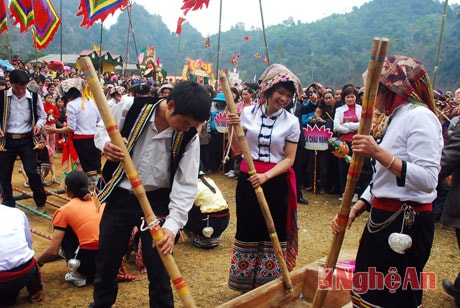 |
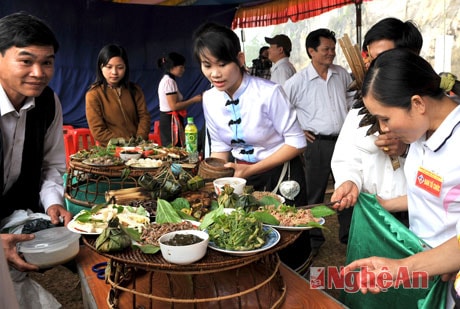
| Competitions in furrow carving and culinary arts at the festival. Photo: M - C |
A new feature of this year's festival is that the district has invested in many essential supporting facilities and planted more trees in the festival area to create a beautiful landscape and provide shade. The organizing committee has also added a Ta Nang Xoong performance competition and a traditional folk game competition to the program.
PV: Festivals are opportunities for us to preserve, protect, promote, and publicize the unique cultural values of the ethnic groups in our region. So, how will the district implement this in the future?
Mr. Vi Van Tien:The Hang Bua Festival has become a traditional annual event, encompassing many unique spiritual and cultural activities. The district recognizes the festival as an opportunity to preserve, promote, and publicize tangible and intangible cultural values, thereby fostering patriotism among the younger generation, creating a joyful and enthusiastic atmosphere to maintain national security and defense, and successfully achieving the goals and tasks of local economic and social development. Therefore, in its organization, the district always prioritizes incorporating the distinctive traditional cultural features of the Thai ethnic group, such as folk songs, folk music, folk dances, and traditional sports and games, into the cultural and sporting activities of the festival program.
To promote the preservation, protection, and development of the cultural values of the ethnic groups and regions, in the coming time, Quy Chau district will organize more cultural and artistic activities, sports, and folk games; at the same time, it will continue to research, collect, and disseminate more folk music, folk dances, and games that are distinctly characteristic of the Thai ethnic group.
PV: Besides the Hang Bua festival, Quy Chau also has many historical sites and scenic spots, with great potential for tourism development. So, what is the district's direction for the future, sir?
Mr. Vi Van Tien:Over the years, Quy Chau district has made many efforts in developing tourism, but certain limitations still remain. Therefore, in the coming time, the district hopes to receive more attention from the central government and the province. To achieve a breakthrough in tourism, the district has issued a tourism development program for the period 2011-2015, focusing on key tasks and solutions such as: Enhancing the leadership role of the Party committee and government; coordinating with the Department of Culture, Sports and Tourism in planning, demarcation, and zoning; diversifying forms of propaganda and promotion of tourism potential; investing in infrastructure in the Hang Bua area, scenic spots, and other historical and cultural relics; focusing on developing Thai culture clubs, folk song and dance clubs, folk games, developing traditional craft villages and characteristic cuisine; collecting and enriching artifacts for the Quy Chau Ethnic Museum; Encourage businesses, organizations, and individuals to invest in infrastructure, restaurants, and hotels to ensure good service for tourists; train human resources to increasingly meet the requirements of tourism companies and tour operators...
Interviewer: Thank you, sir!
Thanh Chung(perform)