

Agricultural product consumption: Don't leave farmers to fend for themselves.
(Baonghean) - Currently, in some localities, cooperative groups and cooperatives have been established to link production with farmers. In addition to introducing science, technology, and mechanization, they also apply VietGAP standards to production to bring many benefits to farmers.
"Bridge" for cooperatives
Before the establishment of the Dong Tien Dairy Farming Service Cooperative in Quynh Thang commune (Quynh Luu district), dairy farming in Quynh Thang was struggling. Although the province provided interest rate subsidies for three years to purchase imported Holstein Friesian (HF) cows, the lack of experience and knowledge in farming, coupled with poor awareness among the people (the milk contained cold water and was not guaranteed to be pasteurized), and the poor quality of the product, resulting in factories refusing to purchase it, led to a decline from 22 households with 59 cows in 2005 to only 15 households with 36 cows in 2008.
Since December 2009, the People's Committee of the commune established the Dong Tien Dairy Cattle Breeding Service Cooperative, gradually resolving the difficulties faced by farmers. The Cooperative's management board negotiated with CP Animal Feed Joint Stock Company to supply products directly to farmers (currently, the price of "Con Co" brand feed is 327,000 VND/40 kg bag, while the market price is 350,000 - 360,000 VND/40 kg bag); the Cooperative also supplies corn kernels at 6,000 VND/kg (market price is 6,700 VND/kg), and brewers' spent grain at 5,800 VND/kg (market price is currently 6,500 VND/kg). At the same time, the Cooperative's management board invested over 450 million VND to purchase automated refrigerated tanks with a capacity of 2,000 kg so that the factory's transport vehicles can pick up goods directly from the commune.
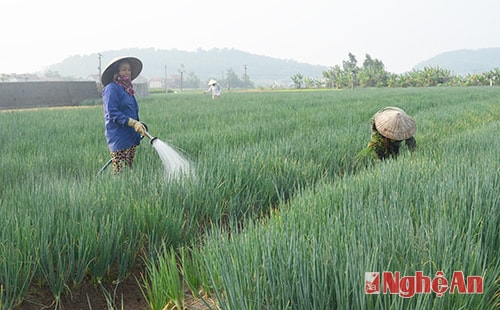 |
| Farmers in Quynh Luong commune (Quynh Luu district) are tending to their vegetables. |
The establishment of the Dong Tien Dairy Farming Service Cooperative has truly empowered many dairy farmers to make a living from their profession. Mr. Tran Trung Huong's family in Hamlet 6, Quynh Thang Commune (Quynh Luu District) is raising 8 cows, 6 of which are milk-producing, yielding an average of 60-65 kg of milk per day. With the current purchase price of 12,500 VND/kg, Mr. Huong earns approximately 800,000 VND per day. He said: “When I participated in the dairy farming project under Decision 47 of the Provincial People's Committee in 2005, I invested over 100 million VND to build barns and buy 3 dairy cows. But at that time, the price of fresh milk was only over 3,000 VND/kg, and the market was unstable, so I constantly suffered losses. I just tried to hold on and didn't want to invest further. By mid-2009, the price of milk started to increase to over 10,000 VND/kg, and there was a stable purchasing cooperative in the commune, so we were very excited and confident in investing in the cows and building barns.”
To date, 33 households in Quynh Thang raising dairy cows have achieved a considerable income. Of the 130 dairy cows they raise, 70 are producing milk, supplying Vinamilk's factory with an average of over 600 kg of milk per day. According to the cooperative's summary for the first six months of 2014, total milk production reached over 154,600 kg, generating nearly 2 billion VND in revenue. Currently, the farmers have collaborated with Vinamilk's factory to develop a well-established raw material supply area. Continued support in technical advice, provision of bull semen, and assistance in purchasing has fostered a stronger and more effective relationship between the enterprise and the farmers. Mr. Bui Van Vinh, Chairman of the Dong Tien Dairy Farming Service Cooperative, stated: "At the beginning of 2013, with the advice and support of the Nghe An Provincial Department of Agricultural, Forestry, and Fisheries Quality Management, the farmers invested in upgrading their barns and equipment to meet VietGAP standards in dairy farming." Currently, dairy farmers have been assessed and certified by the Conformity Certification Center (QUACERT) for good livestock farming practices (VietGAP).
The Van Nam Salt Cooperative in Dien Van commune (Dien Chau district) manages 4 teams with 278 salt-producing households on an area of 50.7 hectares; the average annual output is approximately 4,000 - 4,500 tons. The main market for Dien Van salt farmers is in the mountainous districts of the province, where individual households or groups of households exchange salt for corn, peanuts, and rice to sell to agricultural traders in the district. However, this consumption is often disrupted, especially from April to May (lunar calendar) when salt often accumulates because people are busy harvesting their crops and therefore cannot trade goods.
To prevent salt farmers from being exploited by traders who manipulate prices and hoard salt during peak seasons, then resell it to the farmers for resale, since 2006, the Management Board of Van Nam Cooperative has mortgaged land titles to borrow capital from banks to purchase salt from farmers at a price 150-200 VND/kg higher than the market price; they also contact businesses in Thanh Hoa, Ha Tinh, Hai Phong provinces, etc., to import goods; on average, the cooperative invests about 800,000,000 - 1,000,000,000 VND per year to purchase 600-800 tons of salt from farmers. Even in 2013, when the price of salt dropped from 1,600 VND/kg at the beginning of the season to 1,100 VND/kg during the peak season, the cooperative still purchased it from farmers at 1,250 VND/kg. In 2014, Mr. Tran Hai Thanh (in Team 2), who cultivated 2,500m2, supplied the cooperative with 15 tons of salt, and Mr. Vo Que (in Team 1), who cultivated 2,000m2, supplied the cooperative with 10 tons of salt… at a price of 1,700 VND/kg (150 VND/kg higher than the price private traders were paying in May of the lunar calendar).
According to Mr. Vu Hong Tuyen, Deputy Chairman of Van Nam Salt Cooperative, in the past, salt farmers produced salt using the traditional sand-drying method, resulting in low yields and high labor costs. With the support of the National Agricultural Extension Center, the Provincial Agricultural Extension Center implemented the project "Building a cooperative model and applying advanced techniques for clean salt production" over two years (2011-2012) at Van Nam Salt Cooperative. The model was implemented on a scale of 1 hectare, including a 1,000 m2 salt crystallization yard and 50 salt pans covered with 1,000 m2 of HDPE tarpaulin. Salt farmers producing salt using this method do not need to renovate the yard after each harvest, and the cost of building a tarpaulin-covered yard is lower than building a traditional salt pan. The benefits of building this model have led to the conversion of 100% of the salt fields of the Van Nam Salt Production Cooperative to clean salt production by 2014, increasing the total number of salt pans covered with tarpaulin to 300, covering an area of 19,500 m2. Salt farmers easily adopted the new methods, improving productivity and product quality, reducing input costs, and decreasing labor. Salt production on tarpaulin-covered crystallization ponds achieved an average yield of 80 tons/ha, an increase of 30-40%, and reduced impurities in the salt by over 95% compared to traditional production. Due to the improved salt quality, it is easier to sell, helping salt farmers increase their income…
Improving the quality of agricultural products
Currently, many models of agricultural production and consumption linkages have emerged in our province, demonstrating effectiveness and promising future development. However, in reality, in many localities, despite large-scale production, the market remains unstable, especially during peak harvest seasons, causing losses for farmers. A prime example is the 2013 winter crop in Quynh Luong commune (Quynh Luu district), the "vegetable capital." All types of vegetables, including kohlrabi, cabbage, leafy greens, onions, and coriander, suffered drastic price drops; green onions sold for only 200 VND/kg, kohlrabi and cabbage for less than 1000 VND each. Quynh Luong had to destroy approximately 170 hectares out of 200 hectares of various vegetables due to unsold produce. Annually, out of the commune's total 200 hectares of vegetables, only over 10 hectares are certified VietGAP-certified, yielding about 50 tons of clean vegetables that are stably sold in hotels and supermarkets in Hanoi. The remaining more than 9,000 tons are mainly sold to private traders who then distribute them to wholesale markets. The situation of bumper harvests leading to price drops, and high prices causing shortages, has occurred many times in this region, one of the largest vegetable producing areas in the province.
Discussing the direction of stable output for vegetables and fruits produced in the area, Mr. Nguyen Xuan Dinh - Head of the Agriculture Department of Quynh Luu district, said: First of all, it is necessary to continue expanding the area of safe vegetable cultivation according to VietGAP standards, because in reality, the district only has over 10 hectares of clean vegetables certified VietGAP in Quynh Luong commune. It is necessary to plan concentrated, large-scale production areas to facilitate intensive farming for farmers; actively call on businesses to invest in the production and consumption of clean vegetables. At the same time, promote the role of collective economic models such as cooperatives to absorb, invest in, and disseminate scientific and technical knowledge to farmers, and these also serve as key channels connecting farmers and the market. According to Mr. Nguyen Van Lap - Deputy Director of the Department of Agriculture and Rural Development: To have a more stable agricultural product market, many measures must be implemented simultaneously, including identifying agricultural product quality as a vital issue for the production of agricultural commodities; Improving the quality of agricultural products is essential for enhancing competitiveness. The government needs clear mechanisms, effective measures, and a clear role in helping farmers find markets, including leveraging the role of businesses in the consumption of agricultural products.
Text and photos:Ngoc Anh