

Japan is not afraid of a 'saturation attack' from Chinese cruise missiles.
Japan had anticipated and prepared to counter China's use of a "saturation strike" with cruise missiles.
Japan circumvented regulations to build up its marine corps.
The Western Region Mechanized Infantry Regiment (WAiR), part of the Japan Self-Defense Forces of the Western Region, publicly demonstrated its combat training using small landing craft for the first time at Camp Ainoura, Sasebo City, Nagasaki Prefecture, on June 24th.
According to Kyodo News, in response to China's maritime activities, the Japanese Ministry of Defense is working to enhance its ability to defend remote islands. The "Western Regiment" will become the core force of the "Aquatic-Army Mobile Regiment," which is expected to be established by the end of 2018 with approximately 3,000 personnel.
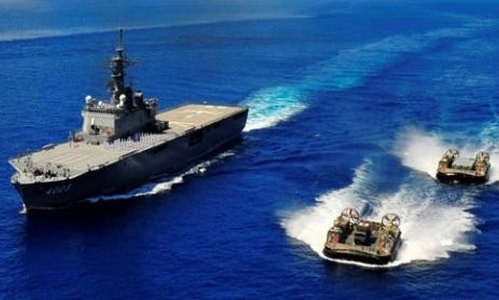 |
| Japanese landing ships conduct training at sea. |
According to Japan's Asahi Shimbun, the Japanese government has included the establishment of mobile regiments in its "Defense Plan Outline," aiming to ensure the ability to quickly land and retake occupied islands. The Ministry of Defense will emulate the US military's approach in Iraq and Afghanistan, using the Marine Corps as a model to build these mobile regiments.
The public training session on June 24th was also part of the preparations for establishing the mobile regiment. The plan for the "Western Regiment" is to conduct two such training sessions annually to train new soldiers.
During that time, approximately 80 soldiers will be instructed on the characteristics of small landing craft and trained in swimming skills. According to the description, this training is officially called the "basic amphibious warfare training course".
During the approximately five weeks of training, the ultimate goal for the soldiers is to master and practice the skills of descending from helicopters and landing ashore from ships and landing craft.
This systematic training course has been conducted since 2013, and this is its third practical session to date. During this time, soldiers not only improve their swimming skills and learn how to operate boats and canoes, but also receive training in jumping from naval defense warships onto smaller vessels for landing ashore and rescue methods in case of boat capsizing.
During the training, the WAiR's newly established soldier education unit, formed in March of this year, will serve as instructors. Regiment commander Matsushi Kunii stated to the soldiers and instructors: "This is a basic course to become a full member of WAiR. The instructors will guide and teach relevant skills to key members of the amphibious mobile regiment."
The Japanese plan for seizing the islands was as follows: a Murasame-class destroyer of the Maritime Self-Defense Force would advance to the waters 10km from the Senkaku Islands for patrol and reconnaissance; several dozen elite WAiR soldiers on the landing ship would board rubber boats to conduct reconnaissance of the Senkaku Islands under cover of darkness; and then 200 soldiers would follow to land on the island for combat.
News-Postseven reports that the WAiR is an elite force tasked with reclaiming islands for Japan should Chinese troops land and occupy the Senkaku Islands. However, maritime warfare is only a small part of a future all-out Sino-Japanese war.
Beyond maritime conflicts, modern warfare presents many different scenarios, such as which location China would attack first and how Japan could withstand a preemptive strike?
The Shukan Gendai newspaper predicted that the People's Liberation Army (PLA) would prioritize attacking Kobe, home to Japan's largest submarine manufacturing facility.
Meanwhile, News-Postseven reported on June 25th that Tokyo would be the first place to be engulfed in flames. According to the report, if the localized conflict between Japan and China were to escalate into a full-scale war, what would the outcome be? The news site stated: "With its superior equipment and supply routes, China is indeed a formidable opponent."
Many Japanese people believe that although the PLA is large with a total force of 2.3 million troops, its equipment is outdated, morale is low, and the country's elite Self-Defense Forces are capable of handling the situation. But that's in the case of small skirmishes at the beginning; once the war between the two countries enters a large-scale, prolonged conflict, will the Self-Defense Forces be able to cope?
Japan counters China's "saturation attack" with cruise missiles.
Japanese military experts all confirm this. Atsushi Kitamura, a military advisor to the US Navy, analyzed that if China attacked Japanese territory, the first thing it would think of is a precision strike with ballistic missiles and long-range cruise missiles fitted with conventional warheads, paralyzing Japan without causing casualties to its own troops.
The cost of producing long-range cruise missiles is very low, so China will employ a "saturation strike" strategy, firing a large number of missiles in rapid succession at Japanese territory. China currently possesses 600 to 700 long-range land-attack cruise missiles such as the "DH-10" and "CJ-10," over 100 "DF-21" ballistic missile systems, and plans to deploy supersonic land-attack missiles in the future.
In Japan's defense plan, when attacked by missiles, Aegis destroyers of the Self-Defense Forces would intercept them with SM-3 missiles, while any missiles that evaded would be dealt with by the ground-based Patriot-3 missile defense system. However, the hit rate of the missile defense system is not high, and its range and number are limited. Under a "saturation attack," Japan would ultimately be unable to cope.
Mr. Kitamura also suggested that the PLA would first fire over 100 long-range missiles to destroy iconic Japanese architectural landmarks, aiming directly at the Japanese people's psyche.
At the same time, critical infrastructure such as the Prime Minister's office, radio and television stations, power plants, especially nuclear power plants and oil reserves, would become primary targets of Chinese missiles. "Once a full-scale military conflict breaks out between Japan and China, the central area of Tokyo will be the first to be engulfed in flames."
However, Tokyo is not overly concerned because, in reality, they possess very strong early warning capabilities. Moreover, Beijing would not dare use nuclear weapons in a war stemming from a sovereignty dispute.
Ballistic missiles and cruise missiles without nuclear warheads, aside from their precision strike capabilities, are not much more dangerous than a bomb. Furthermore, in reality, cruise missiles only demonstrated their greatest destructive power during the 1991 Iarq War.
Since then, many tactics, methods, and weapons have been devised to counter cruise missiles, such as enhancing early warning capabilities, interception capabilities, or deploying decoy and reserve bases…
In recent times, Japan has planned to deploy fixed-type missile defense radars on several islands and deploy E-767 and E-2C early warning aircraft to eliminate unexpected threats from Chinese missiles and stealth aircraft. Japan has spent 8.9 billion yen to replace two FPS-7 surveillance radar stations (an improved version of the FPS-5 maritime surveillance radar) located in Takada, Miyazaki, and on Miyako Island (Miyakojima).
This is a type of Chinese ballistic missile defense radar, a wide-area antenna radar designed to maximize flexibility, surveillance range, and antenna sensitivity. Meanwhile, starting this past April, the Japanese Ministry of Defense has allocated 3.7 billion yen (approximately $37.7 million) for research and development of a mobile anti-stealth radar capable of detecting both stealth fighter jets and ballistic missiles with the most unpredictable trajectories.
Regarding interceptor capabilities, Japan has decided to increase its Aegis-equipped warships to eight, all of which utilize the most powerful versions of the SM-2 and SM-3 interceptor missiles. Simultaneously, they already have PAC-3 interceptor missiles purchased from the United States on land.
Furthermore, Japan is also planning to develop a new type of anti-aircraft missile capable of intercepting cruise missiles. These are just some of the main measures Japan is taking to counter the threat from Chinese missiles. In addition, Japan has significant support from the US in terms of intelligence, early warning systems, missile interception, and other equipment and weapons. It can be confidently stated that Tokyo is prepared to face a worst-case scenario of a Sino-Japanese war.
According to VOV