

Nguyen Duy Trinh Street - A street steeped in revolutionary spirit.
(Baonghean) - This century-old street is now being continuously developed by the local government and both former and current residents, creating a vibrant new streetscape while preserving the essence of a Vinh city center road, deeply connected to the history of revolutionary struggle. That is Nguyen Duy Trinh Street…
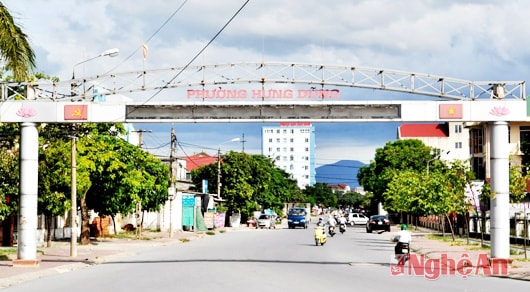 |
| Nguyen Duy Trinh Street. |
Nguyen Duy Trinh Street is about one and a half kilometers long and runs entirely within Hung Dung Ward (Vinh City). When Vinh was still Yen Truong district during the Trinh-Nguyen conflict, this road already existed, serving both as a small access route to the Lam River boat landing (Ben Thuy) and as a road for farmers to go to their fields. During the French colonial period, the population gradually increased, but the road remained a quiet path amidst dense orchards. The road is a transportation route marked by the footsteps of many revolutionary pioneers who came here to build patriotic bases and mobilize farmers in the Yen Dung area (now Hung Dung), creating the spirit of the Red Village during the Nghe An-Tinh Gia Soviet Uprising (1930-1931). Gradually, the road came to be considered the gateway from the Upper Yen Dung area to the Vinh city center.
If, during the dawn of the revolution, the road was bustling with the persistent and heroic footsteps of peasants carrying out the worker-peasant revolution until the General Uprising to seize power in August (1945), then during the fight against the American war of destruction, the road was busy again with air defense units coordinating with the Red Village militia to shoot down American planes, contributing to the title of Hero of the People's Armed Forces for Dung Dung ward.
When Hung Dung was still a commune, the residents maintained their village customs, with straw and stubble covering the roads during harvest season. People's gardens were filled with bamboo groves and banana trees, and the houses were mostly low-rise buildings. More than a decade ago, the commune became a ward, and many residents bought land and settled along the roads. Many multi-story houses were built in the neighborhoods, and while the streets were numbered, sometimes long, winding alleys led to just one house. Even now, the entire Nguyen Duy Trinh street only has one high-rise building: the newly constructed 9-story Sao Dem Hotel.
Despite the ongoing construction of residential buildings and a few offices along both sides of the street, Nguyen Duy Trinh Street has yet to truly develop a vibrant urban atmosphere, except for the first 600 meters, starting from the intersection with Nguyen Phong Sac Street and ending at the intersection with Nguyen Gia Thieu Street. This section has been widened and upgraded in recent years, with a smooth asphalt surface, but essentially still lacks sidewalks. Nevertheless, services have sprung up as bustlingly as any other major street in the city. While not large-scale or specialized in any particular product, the service stalls range from high-end electrical and electronic goods to elegant embroidery shops, interspersed with fashion boutiques, beauty salons, and cafes with fresh, youthful decor. The buying and selling activity isn't yet frenetic, but it has created a lively street atmosphere. In this area, the sidewalk trees haven't yet had time to spread their mature foliage, but after the road was widened, many residents have styled and trimmed their ornamental plants, adding to the charm of the new streetscape.
To this day, Nguyen Duy Trinh Street remains an important route in Hung Dung ward, connecting to the city center. It's also a popular destination because right next to it is the Trung communal house, a historical and cultural relic that has been restored, providing a historical account of the heroic revolutionary movement of the people of Lang Do village. Historical records state: Under the direct guidance of the Central Vietnam Regional Party Committee and the Vinh Provincial Party Committee, in September 1930, Yen Dung Thuong commune organized a large rally at Trung communal house, demanding that the village headman and local leaders hand over their seals, books, and documents. Faced with the strong fighting spirit of the people, the feudal government here collapsed, and a Soviet government was established, called the "Incense Burner Roof," comprising representatives of the Farmers' Association in eight villages. Trung communal house became the headquarters of the "Incense Burner Roof." Now, Trung communal house has become a place for educating the younger generation of the heroic Red City about its revolutionary traditions.
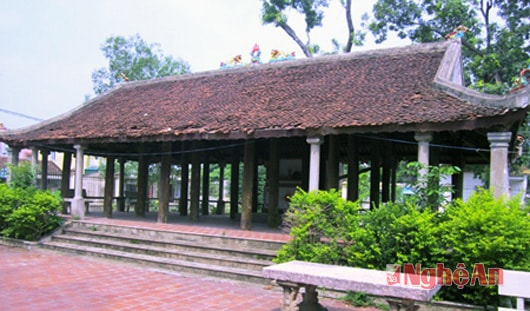 |
| Dinh Trung is located on Nguyen Duy Trinh Street. |
At the end of the road, the stretch from the Lang Do Martyrs' Cemetery to the point where it intersects with Nguyen Viet Xuan Street, quickly becomes bustling thanks to its former access to Vinh University of Technology and Education (the main gate of the university has now moved to Nguyen Viet Xuan Street). Residents in this area compete to build student dormitories and open kiosks selling all sorts of goods. If we talk about the food scene on Nguyen Duy Trinh Street, it's also in this section, although it's mostly about simple snacks, porridge, and desserts; the more upscale options are beer stalls, grilled meat skewers, or dog meat vendors. Most of the villas are hidden away in alleys, leaving rows of kiosks constantly being built along the road, possibly due to the slow pace of road widening and upgrading according to the plan. Before the gate of Vinh University of Technology Education was relocated, Nguyen Duy Trinh Street was also the entrance to the revolutionary historical site "Nia Pagoda Banyan Tree," which was classified by the State and preserved within the university grounds as a traditional gathering place for students. Following Nguyen Duy Trinh Street to visit the Trung communal house complex, visitors are led to houses that still retain many old traces of places where the Central Committee of the Vietnam People's Army once chose to print revolutionary documents and shelter key figures of the Party. For example, Mr. Nguyen Sy Huyen's house still retains a four-pillar wooden house, and Mr. Nguyen Huu Dien's house still has a perennial chay tree where documents were buried.
The streets may still be somewhat hesitant in their pace, but Nguyen Duy Trinh Street is a thoroughfare preserving many traces of revolutionary struggles. Every step along this street and alleyway reminds us of the heroic struggles of a vibrant period in the history of the nation in general and Nghe An province in particular. Therefore, the street is a major attraction, not only contributing to its daily growth and prosperity, but also fostering a sense of appreciation and preservation of the street's essence within the heart of the once-heroic Red Village.
Nguyen Duy Trinh was born on July 15, 1910, in Nghi Tho commune, Nghi Loc district. He joined the patriotic movement in 1927. In 1928, he joined the Tan Viet Party – one of the precursor organizations of the Communist Party of Vietnam – and worked in Saigon-Gia Dinh. He was arrested by the French colonial authorities and sentenced to 18 months in prison, then deported back to his hometown. In 1930, Nguyen Duy Trinh was one of the first members of the Communist Party of Vietnam. Following the revolutionary upsurge of 1930-1931 until May 1945, Nguyen Duy Trinh was captured by the enemy and imprisoned in various prisons. In 1945, after his release, he participated in organizing the uprising in Vinh and Hue; from then on, he held many important positions and made significant contributions to the revolution. In 1976, at the 4th National Congress of the Party, Nguyen Duy Trinh was elected to the Politburo and the Central Secretariat of the Party, serving as Deputy Prime Minister and Minister of Foreign Affairs until 1980. In 1982, he was assigned to the Standing Committee of the Central Party and Government's Socio-Economic Strategy Research Board. Nguyen Duy Trinh passed away on April 20, 1985, in Hanoi at the age of 75. Streets in many cities across the country are named after him. |
Dinh Sam