

Removing live leeches parasitizing the larynx.
(Baonghean.vn) - On October 1st, the Ear, Nose, and Throat Department of Nghe An Obstetrics and Pediatrics Hospital successfully removed a leech that had been living for several days in the larynx (sublaryngeal region) of 11-year-old patient Xong Y Song from Muong Hoi village, Tri Le commune, Que Phong district.
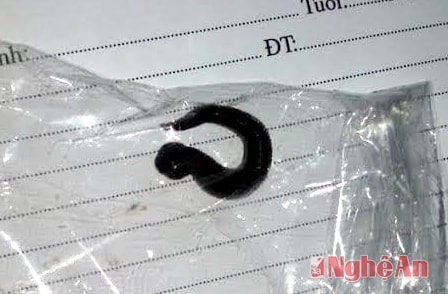 |
| Leeches were removed from the patient's larynx. |
The child was admitted to the hospital with pale skin, fatigue, occasional prolonged shortness of breath, and coughing up blood. Upon examination, doctors performed internal medicine and laryngoscopy and discovered a living foreign object in the child's lower vocal cords.
According to the family of Xong, they don't know when the leech infestation started, only that the child frequently bathed and drank from the stream. About a week ago, the child showed signs of fatigue, poor appetite, persistent coughing, and bleeding, so they took him to the Obstetrics and Pediatrics Hospital for examination, where they discovered a leech parasitizing his larynx.
Dr. Dinh Xuan Huong, Head of the Ear, Nose, and Throat Department, said: "In Xong's case, the team immediately removed a foreign object – a leech almost the size of a finger and over 6cm long – from the patient's larynx. The Ear, Nose, and Throat Department has received many pediatric patients with leeches parasitizing their bodies. In particular, there are quite a few cases where leeches enter the larynx due to drinking stream or creek water; in some cases, leeches even enter both nostrils. When leeches enter the body, people are often unaware because they are small at first. After living parasitically in the body for many days, feeding on blood, they grow very quickly and cause the bite wound to bleed continuously, thus negatively impacting the patient's health."
At the same time, Doctor Dinh Xuan Huong advised people, especially those in mountainous, remote, and isolated areas, not to bathe or drink stream water, as it is very easy for leeches to enter and live as parasites in their bodies.
Text and photos:Business Page
(Provincial Center for Information and Health Education)