
Strength in Hongcheng
(Baonghean) - In mid-July, we visited Hong Thanh commune, Yen Thanh district. This is a time of "agricultural inactivity," usually when laborers disperse to other regions to find extra work, but this year, most people stayed in the village, working together to pour concrete for village roads. Along many roads, the sound of concrete mixers filled the villages.
(Baonghean) - In mid-July, we visited Hong Thanh commune, Yen Thanh district. This is a time of "agricultural inactivity," usually when laborers disperse to other regions to find extra work, but this year, most people stayed in the village, working together to pour concrete for village roads. Along many roads, the sound of concrete mixers filled the villages.
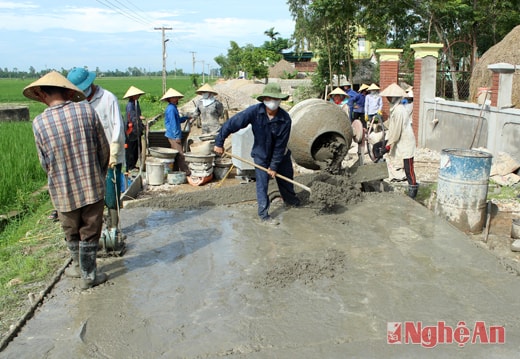 |
| The people of Da Canh hamlet are pouring concrete for the village road. |
When we arrived, the entire Dong Ngo hamlet was busy completing the final sections of the road with concrete. Hamlet head Nguyen Van Ba, sweating profusely, ran back and forth with the supervisory board, meticulously inspecting each batch of concrete and every meter of road that had just been laid. Occasionally, he would remind the group of workers (called workers, but they were actually residents of the hamlet) to "make sure the work is done properly." Mr. Ba excitedly shared: "Initially, when they learned about the plan to build wide, beautiful concrete roads, a few affected households hesitated to move their fences and trees. At that time, the comrades in the Party branch, the hamlet management board, and the people's mobilization team actively persuaded them, and the families realized that building the road would make it easier for themselves and their children to travel and live. Therefore, the households were highly supportive. Many households even voluntarily donated land to open the road. Now, all the village roads and alleys are wide, straight, and beautiful, with the narrowest being 3 meters and the widest 7 meters…" Meanwhile, Mr. Le Van Thuan, now 75 years old but still energetic, braves the sun every day to fulfill his role as a "supervisor." He shared: "In the neighborhood, from the elderly to the children, everyone is happy because the road has been upgraded and paved with concrete, making things much more convenient."
Dong Ngo is one of two predominantly Catholic hamlets in Hong Thanh commune, with nearly 600 inhabitants and 139 households. Previously, the hamlet faced many difficulties regarding transportation, slow economic development, a high poverty rate, and unstable security and order. Over the past three years, after the commune Party Committee assigned commune officials to serve as branch secretaries, the hamlet has made significant progress. During this process, the "neighborhood group" model was formed. With the active participation of various organizations, the self-governance activities of these residential groups have been highly promoted, contributing to resolving disagreements and conflicts among residents, thereby focusing on economic development and building a peaceful life. In particular, in the road construction movement, 42 households voluntarily donated over 1,400 m2 of land to open roads, demolished 9 houses and outbuildings; 25 gates were built and 1,113 m of fences were relocated. In addition, each household contributed 1 million VND to pave the village road with concrete. Mr. Tran Van Dien, Head of the Parish Council, was the first to voluntarily remove all fences and outbuildings without demanding any conditions. Comrade Hoang Thanh Toan, Secretary of the Dong Ngo hamlet Party branch, said: “The road construction movement in the hamlet has become a model for the whole commune. The success here stems from promoting democracy among the people. The policy was suggested by the Party committee and the government, but the key decision was that the people knew, discussed, did, and inspected…”
In Da Canh hamlet, too, the paving of village roads was carefully discussed and jointly carried out by both Catholic and non-Catholic residents. The hamlet has 120 households, divided into 4 neighborhood groups, with nearly half being Catholic. Before starting the construction of the roads, the Party branch and the hamlet's leadership committee decided to let the groups discuss and agree on the most suitable plan. During the paving process, the hamlet elected a general inspection and supervision committee, while the construction was directly assigned to the neighborhood groups for each specific road section. Thanks to this, the progress and quality of the project are always ensured. It is expected that by mid-July, the entire road system of the hamlet will be paved with concrete. In recent days, enduring the sun to closely monitor the paving of each section of the hamlet's roads, the female Party branch secretary, Dinh Thi Thanh, has become tanned, but the joy is clearly visible on her face. “The people of both Catholic and non-Catholic faiths in the hamlet have demonstrated a strong spirit of solidarity, discussing and agreeing on actions together. As a result, the hamlet's roads were completed early, facilitating production and daily life. Through this road construction movement, the bonds between households in the neighborhood group, as well as the entire hamlet, have become even stronger…,” she shared.
The bustling atmosphere of road construction in Hong Thanh stems from the Party Committee's policy of selecting 2014 as the year to complete "rural transportation" according to the 19 criteria of the New Rural Development program. To achieve this goal, before issuing the thematic resolution, the Party Committee directed mass organizations to closely coordinate with the 13 villages to hold meetings with residents, discussing and reaching a high level of consensus. Immediately after the resolution was passed, the mass mobilization units of the villages and hamlets, in coordination with the commune's land and transportation officials, conducted specific surveys of the road routes and proposed feasible plans. Through these meetings, the hamlets hired bulldozers and rollers to compact the roadbeds and poured concrete in a timely manner. The completed roads not only make the villages and hamlets more beautiful and clean but also serve as evidence of the consensus and contributions of the people.
Initial statistics show that hundreds of families have donated over 12,000 square meters of land.2Land was cleared and many structures worth over 5 billion VND were demolished. The Party Committee and People's Committee of the commune also actively mobilized cement to support the people in the hamlets in concreting village roads and alleys. In 2014, the commune mobilized 1,000 tons of cement for this work. In addition, attention was paid to attracting investment in inter-hamlet road projects, building markets, and cultural houses in the hamlets... to strive to gradually achieve the criteria for building new rural areas. Comrade Nguyen Van Tich - Secretary of the Commune Party Committee shared: “This year, with the completion of the concrete road system in the hamlets, the commune will achieve 15 out of 19 criteria for building a New Rural Area. The lesson learned that the commune emphasizes is mobilizing the entire political system to participate. In areas with Catholic parishioners, there is coordination with religious leaders and officials, especially the participation of priests. The commune's mass mobilization block, hamlet mass mobilization teams, and specialized committees advise on and implement the democratic regulations well, so that the people truly participate, directly discuss and do, especially promoting the role of each self-governing neighborhood group in mobilizing manpower, contributing funds, and directly inspecting and supervising the quality of the projects. During this process, commune, hamlet, and village officials must be truly proficient, persistent, and do a good job of ideological work and propaganda. The core team of Party members and officials should set an example for the people to trust and follow. With the results achieved, the commune's officials and people are determined to achieve the New Rural Area criteria in a sustainable manner, linked to the development of the New Rural Area program. "Mobilizing all citizens to unite in building a cultured way of life in residential areas…".
Nguyen Son