

Prioritizing sustainable poverty reduction.
(Baonghean) - The districts under Program 30a in the western region of Nghe An province, including Ky Son, Que Phong, Tuong Duong, and Quy Chau, are considered strategically important areas in terms of politics, economics, culture, and especially national defense, security, and foreign relations for the province and the North Central region. However, how to help farmers develop a sense of commodity production, alleviate poverty, and gradually build new rural areas is a concern for all levels of government and local authorities.
(Baonghean) - The districts under Program 30a in the western region of Nghe An province, including Ky Son, Que Phong, Tuong Duong, and Quy Chau, are considered strategically important areas in terms of politics, economics, culture, and especially national defense, security, and foreign relations for the province and the North Central region. However, how to help farmers develop a sense of commodity production, alleviate poverty, and gradually build new rural areas is a concern for all levels of government and local authorities.
Current situation
Western Nghe An province possesses significant potential in terms of land reserves, forest resources, mineral resources, and advantages in hydropower, aquaculture development, and nature tourism. This allows for the development and expansion of agricultural, forestry, and fisheries production, as well as the development of medicinal plants linked to large-scale processing industries. From 2003 to 2012, 23 research projects were implemented in the four districts of the 30a program in Western Nghe An, with a total investment of over 8.5 billion VND. In addition, 34 models applying scientific and technological advancements were implemented using funds from the Agricultural Extension program, and 22 models applying scientific and technological advancements were implemented using funds from the 30a program, with a total investment of over 2 billion VND. The application of scientific and technological advancements here has contributed to a new look for many villages and hamlets, initially helping farmers develop a sense of commodity production, enriching the people, helping to alleviate poverty, and gradually building new rural areas.
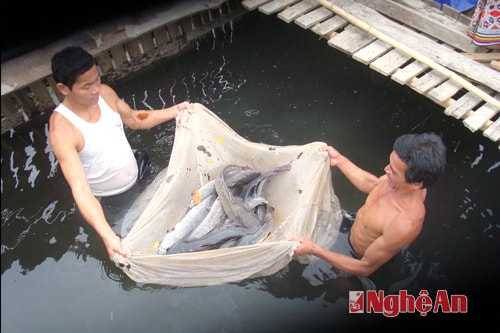 |
| The model of raising catfish in cages on the river by the family of Mr. Vi Văn Tuyên, Chào village, Châu Bính commune (Quỳ Châu). Photo: Trần Ngọc Lan |
However, the economic growth of the four districts remains unstable, the economic restructuring process is slow, the poverty rate is high, and the commodity economy is still in its nascent, self-sufficient stage. A significant number of new crops/animals have been introduced into science and technology programs, agricultural extension, and poverty reduction initiatives, but only a limited number have become marketable products. Investment remains scattered, with little focus on traditional products that have the potential to become marketable goods suitable to the local natural conditions and farming practices. Necessary directions have not yet been established to focus on developing key commodity products that would effectively and sustainably alleviate poverty in the localities.
To date, apart from a few species that have proven effective and produced considerable quantities, other new plant/animal varieties introduced have only reached the model stage; research has been approached only from a technical and technological perspective, without focusing on the product value chain, organization, and the comprehensive development of markets. Most models and projects are successful in the experimental research phase, but the number that are scaled up after completion is small. In reality, there is still a lack of consistency and coordination between the direction of research and application of science and technology and the actual production and business activities in the area, and between the agricultural sector and other sectors in the locality.
The units directly implementing research and application of scientific and technological advancements in the area are lacking and weak. Other organizations involved in implementation currently focus only on transferring knowledge to the people, without paying attention to post-project support, leading to research results and production models often not being sustainably maintained and effectively utilized in the long term. In addition, there is a lack of sufficiently strong partners in the area capable of receiving investment, and the role of businesses in organizing research and application of scientific and technological advancements to develop them into marketable products is not yet recognized. On the other hand, theoretically, scientific research results create new factors, so initial support from the State is essential. However, in reality, there is still a situation where policies and management and support documents are not issued in a timely and coordinated manner, thus failing to encourage people in the area to actively and proactively participate in applying science and technology to production and daily life.
The above situation stems from several objective and subjective reasons, such as: a lack of thorough guidance and surveying when applying science and technology to specific products to achieve the dual goals of economic and social effectiveness and long-term sustainability; insufficient attention to applied research on solutions for building, establishing, managing, and developing brands and markets for certain strong product lines; and an inadequate workforce in science and technology management in the area, both in terms of quantity and quality. In particular, experience and understanding of local customs and traditions, as well as the pursuit of initial project objectives, are quite limited. Management and statistical work in the districts is also limited, and the summarization and lessons learned from projects have not been implemented uniformly or systematically. Therefore, after completion, managers have not been able to identify suitable products and future directions in a meaningful way for each locality. The coordination between programs/projects and related units is still not synchronized, and local leaders have not been truly attentive or concerned about strengthening the overall role of science and technology in socio-economic life in general, and the transfer of scientific and technological advancements in their localities in particular.
Some solutions
Local authorities need to effectively disseminate information and raise awareness among management levels and residents about the importance of applying scientific and technological advancements in the socio-economic and cultural development of their localities through various means such as radio, television, leaflets, training courses, and workshops. Each locality should proactively propose and organize research and application of scientific and technological advancements, focusing on developing native plants and animals; traditional local products; and testing and introducing new crops and livestock with commercial potential. This aims to create high-volume, high-quality products with strong brands, thus establishing key products for the locality and providing momentum for sustainable socio-economic development.
During implementation, on the one hand, priority should be given to selecting leading units for carrying out tasks that are strong companies, enterprises, or cooperatives with sufficient management capacity and the ability to effectively adopt advanced technologies, minimizing scattered investment among the population. On the other hand, it is necessary to integrate many programs and projects, and promote the mobilization of resources from the central to local levels to ensure the effective implementation of research and application programs, topics, and projects. Training and workshops should be organized to raise awareness and improve the skills of the people regarding the organization and application of scientific and technological advancements; opportunities for cooperation with foreign countries should be continuously sought to organize research and application of scientific and technological advancements to serve the socio-economic development of the districts. Develop appropriate support policies to encourage localities to organize research and application of scientific and technological advancements in livestock farming and crop cultivation, linked with processing, in order to create highly competitive products in the market.
Nguyen Quy Hieu(Department of Science and Technology)