
High-yielding rice varieties
(Baonghean) - In the spring of 2014, Phu Hau Agricultural Cooperative - Dien Tan commune, Dien Chau district imported ZZD 001 rice seeds from the Northern Seed Company for local farmers to cultivate. This is a high-yield, three-line hybrid rice variety originating from China that has been tested in northern provinces from the spring of 2010 to 2012 with good results, high yield, and resistance to some pests and diseases such as blast, bacterial leaf blight, mild infestation of planthoppers, brown spot, stem borer, and leaf roller. This rice variety has been officially recognized as a new agricultural crop variety by the Department of Crop Production. Currently, the growth, development, yield, and pest and disease incidence of ZZD 001 rice are being monitored, and the economic efficiency per unit area is being calculated at the end of the season. The results are as follows:
(Baonghean) - In the spring of 2014, Phu Hau Agricultural Cooperative - Dien Tan commune, Dien Chau district imported ZZD 001 rice seeds from the Northern Seed Company for local farmers to cultivate. This is a high-yield, three-line hybrid rice variety originating from China that has been tested in northern provinces from the spring of 2010 to 2012 with good results, high yield, and resistance to some pests and diseases such as blast, bacterial leaf blight, mild infestation of planthoppers, brown spot, stem borer, and leaf roller. This rice variety has been officially recognized as a new agricultural crop variety by the Department of Crop Production. Currently, the growth, development, yield, and pest and disease incidence of ZZD 001 rice are being monitored, and the economic efficiency per unit area is being calculated at the end of the season. The results are as follows:
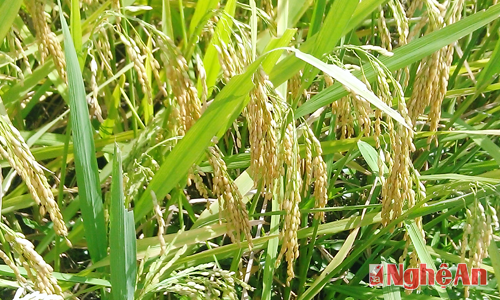 |
| ZZD 001 high-yield 3-line hybrid rice variety |
* Intensive rice cultivation investment for 1 sao (500m2): Base fertilization: 200 kg of manure + 30 kg of NPK 5:10:3 fertilizer. Tillering fertilization: 1 kg of microbial fertilizer + 4 kg of nitrogen. Panicle fertilization: 1 kg of microbial fertilizer + 3 kg of potassium + 1 kg of nitrogen. Water is regulated appropriately during the rice plant's growth process.
* Growth and development: In the spring crop, the ZZD 001 rice variety has a growth period from sowing to harvest of 130 days, including 20 days for the seedling stage and 110 days from transplanting to harvest. The rice grows well, has strong tillering, large and bright green leaves, thrives in low-lying areas, and has large panicles with overlapping grains.
* Pest and disease resistance: Despite complex spring weather conditions, with humid weather, drizzle, and cold spells in January, February, and March, no leaf blast disease was observed (score 0), while other varieties such as BC 15, glutinous rice, Khang Dan, GS9, etc., were infected with leaf blast. In April and May, hot weather with showers and thunderstorms did not show bacterial blight or neck blast, while other pests such as brown planthopper, white-backed planthopper, bacterial blight, stem borer, and small leaf roller were only mildly infected (scores 1-3). During the season, no pesticides were needed; some farmers used selective pre-emergence herbicides after transplanting.
* Yield components: Measurement results show a minimum of 6 panicles per clump and a maximum of 11 panicles per rice clump. The number of panicles per square meter ranges from 300 to 320 panicles. The number of filled grains per panicle is a minimum of 152 and a maximum of 246, with some panicles having 306 filled grains. The percentage of empty grains is 8.6%. The weight of 1,000 grains is 32-33 grams. The actual yield is 82 quintals/hectare (4.1 quintals/500m2 plot).
* Economic analysis: With the current market price of 650,000 VND/quintal, equivalent to 53,300,000 VND/hectare. Meanwhile, the costs incurred by farmers, including herbicides, fertilizers, seeds, and plowing/hectare rental, amount to 13,248,000 VND/hectare (excluding labor costs). Thus, 1 hectare of ZZD 001 rice yields a profit of 40,052,000 VND (equivalent to 2,000,000 VND/sao). The rice grains are white, long, and the cooked rice is soft, fragrant, and sticky. This rice variety has high yield potential, is easy to cultivate intensively, is less susceptible to pests and diseases, and is particularly resistant to blast and bacterial leaf blight, thus ensuring ecological balance, human health, and creating favorable conditions for the rice field ecosystem to establish a population of natural enemies to control pests. However, further evaluation of the ZZD 001 rice variety is needed during the summer-autumn rice crop season and on various soil types and ecological zones to draw more objective and accurate conclusions, in order to recommend its use to farmers for higher economic efficiency per unit area.
Nguyen Huy Khanh
(Regional Plant Protection Center 4)