

Beware of the tactic of "using the wind to break the bamboo."
(Baonghean) - The campaign against oversized and overloaded vehicles across the country has been underway for several months now. However, on major and minor roads, whether national or provincial highways, there are still many heavily loaded trucks that are clearly exceeding the permitted weight limit.
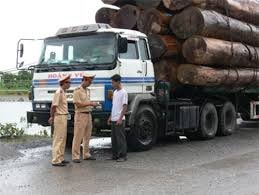 |
| Inspecting oversized and overloaded vehicles. (Illustrative image) |
This is a question with many answers. And the answers have become increasingly different over time. Initially, when authorities cracked down, drivers tried to circumvent the rules by taking detours to avoid weigh stations. Later, they resorted to the tactic of overwhelming force by parking in long lines in front of weigh stations and then rushing past en masse. More reckless and audacious tactics included attacking inter-agency forces at checkpoints, crashing through barriers to escape. More discreetly, they used connections and bribery to bypass the checkpoints. These tricks were prevalent in the beginning and have now evolved into new methods.This involves taking advantage of moments when law enforcement is lax during the day to "bypass" the weigh station.
For example, on June 29th, the press reported that numerous oversized and overloaded vehicles took advantage of the shift change at Weighing Station No. 15 in Dien An commune (Dien Chau district) to speed through the checkpoint right in front of the authorities as if no one was watching. However, witnessing this firsthand, many people couldn't help but suspect that Weighing Station No. 15 was being exploited by drivers taking advantage of the momentary lapse in security to escape, or that the authorities intentionally allowed drivers to "exploit" the situation to legitimize the passage of overloaded vehicles. After all, the shift change only lasted a short time, and the officers on duty were still present at the scene. Yet the incident lasted for nearly two hours, with numerous trucks passing through the checkpoint, and the only thing they managed to stop and inspect was... one truck, the smallest and lightest among those that had successfully passed.
Looking at this scene, some people commented that it's not necessarily true that the authorities lacked the capacity to prevent it at that time, but rather that they seemed to have no intention of stopping overloaded trucks from bypassing the checkpoint. As for why they "didn't intend to prevent it," only after investigation and examination by the relevant authorities can an accurate answer be provided.
This incident brings to mind a recent conference summarizing the inspection and control of vehicle load limits in the province. Mr. Huynh Thanh Dien, Vice Chairman of the Provincial People's Committee, assessed that the inspection and enforcement results did not accurately reflect the reality. Overloaded and oversized vehicles are still frequently seen on National Highway 1A. He questioned, "Have the weighing station personnel done their best? Have they been able to monitor the situation 24/7?" This incident once again forces the public to reconsider this question. If they have done their best, the reasons for this situation must be investigated. If they haven't, the specific causes must be clarified to implement timely corrective measures. Other possibilities should also be considered, such as accepting bribes to allow overloaded and oversized vehicles to pass through the checkpoints, then blaming it on drivers colluding and taking advantage of shift changes to illegally cross the checkpoints. The most worrying thing is the possibility of such "using the situation for one's own gain."
Therefore, to ensure that the inspection and control of oversized and overloaded vehicles achieve the desired effectiveness, it is crucial to be extremely vigilant in promptly detecting and severely punishing acts of exploiting loopholes and colluding with violating vehicles for illicit gain.
Duy Huong