
"When you eat, even mountains crumble!"
(Baonghean) - The national economy is still struggling. Everyone knows and feels that. But not everyone understands the true state of the economy. Therefore, when the Chairman of the National Assembly warned during the Standing Committee meeting on October 9th that every penny earned is spent; current expenditures are constantly increasing, bonds are being issued, and borrowing is being used to refinance debt... many people were alarmed.
(Baonghean) - The national economy is still struggling. Everyone knows and feels that. But not everyone understands the true state of the economy. Therefore, when the Chairman of the National Assembly warned during the Standing Committee meeting on October 9th that every penny earned is spent; current expenditures are constantly increasing, bonds are being issued, and borrowing is being used to refinance debt... many people were alarmed.
It's understandable to be alarmed! For a long time, we thought the national economy was struggling, but we never imagined it would be this dire. We thought it was just a minor shortage because the media occasionally reported on the economy "showing signs of improvement," "growing well," etc.; and that the number of new jobs had increased to 1.6 million, with the lowest unemployment rate in the world at only 1.84%... Hearing that made us feel relieved. We thought economic growth was necessary to create so many jobs. But... it turns out those assessments and figures were just "psychological therapy." In reality, we're barely making ends meet, as evidenced by the increase in current expenditures, from 60% in 2011-2012 to 67-70% in 2014, reflecting the situation where borrowing is the primary means of survival. But "borrowing mainly for consumption" means allocating very little to investment for development, so how can there be any profit to repay the debt? If the debt cannot be repaid, then more borrowing is needed to refinance. This creates a vicious cycle with no way out. The root cause of this situation lies in the very statement of the Chairman of the National Assembly: "You spend every penny you collect. You hold back on investment, and then you borrow recklessly. How can the country develop like that? If you can't repay the debt, you'll collapse. This is a lesson learned.""We need to address this immediately in 2016." Clearly, the reality is that we have always spent without a plan. We spend recklessly.
This reality has been reflected upon by public opinion many times, and there have been numerous calls to tighten public spending, but it seems few people pay attention to implementing them. Perhaps the borrowed money is public money, not belonging to anyone in particular. The debt is also public debt, not belonging to anyone in particular. So people just spend recklessly, regardless of the consequences. Because spending and expenditure lead to what people call "kickbacks" and "rewards"... Just recently, there was news that Hai Duong province requested government approval to build a centralized administrative center with an estimated investment of over 2,000 billion VND. Of course, the majority of this capital will be spent from the budget, at least 1,000 billion VND or more; the rest will be mobilized from various sources, including selling land and old headquarters. Basically, it will come from public assets.
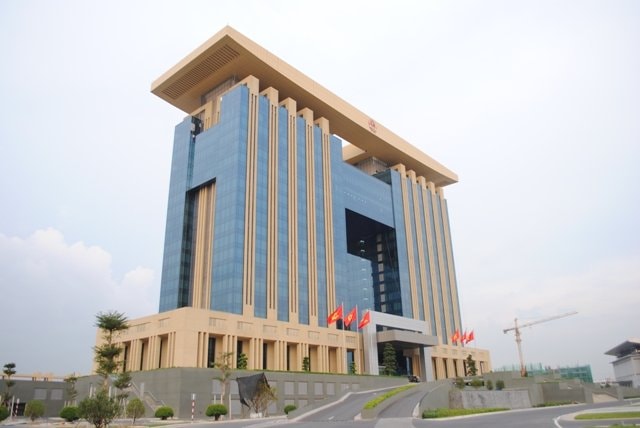 |
| Prior to Hai Duong, many provinces across the country had also spent thousands of billions of dong to build and put into operation administrative centers, such as Binh Duong, Ba Ria - Vung Tau, and Da Nang. Photo: TBKTSG |
Previously, the administrative centers built in other provinces and cities such as Binh Duong and Da Nang... also cost "trillions of dong"; in particular, Khanh Hoa has an estimated investment of 5,000 - 7,000 billion dong. With such projects, how can the budget not be depleted? How can it possibly cover all expenses? And public debt this year has increased to 60.3% of GDP, although still within safe limits, the situation is truly alarming. This is because public debt does not fully reflect "hidden" items such as tax refund debts and social insurance debts... Meanwhile, direct debt repayment obligations compared to total annual state budget revenue have exceeded the safe limit of 25%, reaching 25.9% in 2014 and are expected to continue increasing to 31% in 2015.That's why the Speaker of the National Assembly bluntly warned: "We must balance revenue and expenditure; we must use what we earn to cover our expenses. If we keep issuing bonds and borrowing excessively just to spend, we'll be ruined." In reality, many have already "failed."
According to the report of the National Assembly's Economic Committee, the situation in 2014 remained difficult, with no positive changes in sight. In particular, the number of businesses going bankrupt, dissolving, or ceasing operations remained high. In the past nine months, 52,525 new businesses were established, but 51,244 businesses dissolved or went bankrupt, and 18,873 businesses temporarily suspended operations. Some medium and large-sized businesses, despite having managed to survive in the past few years, have now had to cease operations, dissolve, or go bankrupt. Furthermore, 213,000 businesses declared losses, resulting in no corporate income tax liability, accounting for 68.6% of the total number of businesses that filed tax returns. The inventory index increased by 13.34%, higher than in 2013. As a result, the plan to increase salaries this year had to be postponed due to a lack of funds, and the government is now proposing not to increase salaries next year either, also due to a lack of money.
That alone is enough to show us the true state of our national economy at the present time. Not knowing the truth causes anxiety and worry. Knowing the truth brings sadness, but also alleviates some of the anxiety. The reality of the serious illness is clear, and the causes of this illness have also been clearly stated. The remedy has also been indicated: stop reckless spending and wasteful spending. We must tighten our belts and cut back on our spending.
That's absolutely necessary. Borrowing for investment and development, for profit, is highly advisable, but borrowing solely for spending, for the sake of "eating," must be strictly prohibited. Because, as the saying goes: "When the mouth eats, the mountain crumbles." And once the "mountain crumbles," many other things will crumble with it.
Duy Huong