

GPMB National Highway 1A Upgrade and Expansion Project: Don't try to be different.
(Baonghean) - Over 4,000 households along the entire National Highway 1A route from Hoang Mai town to Vinh city have, for the benefit of the nation, handed over their land, creating favorable conditions for contractors to accelerate the construction progress of the National Highway 1A upgrade and expansion project - a key national project. However, as of July 20, 2014, 22 households in Hamlet 11, Quynh Giang commune, have still re-encroached on the land and have not yet handed it over to the construction unit...
(Baonghean) - Over 4,000 households along the entire National Highway 1A route from Hoang Mai town to Vinh city have, for the benefit of the nation, handed over their land, creating favorable conditions for contractors to accelerate the construction progress of the National Highway 1A upgrade and expansion project - a key national project. However, as of July 20, 2014, 22 households in Hamlet 11, Quynh Giang commune, have still re-encroached on the land and have not yet handed it over to the construction unit...
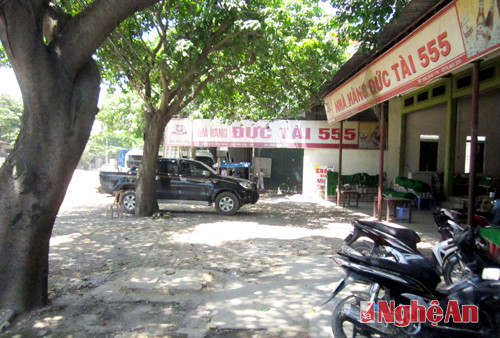 |
| Duc Tai Restaurant is one of 22 households in Hamlet 11, Quynh Giang Commune (Quynh Luu District) that have not yet handed over the land to the construction unit. |
The land clearance process for the expansion and upgrading of National Highway 1A in Nghe An province faced obstacles and challenges. However, with the involvement of the entire political system and a strategy of simultaneously carrying out construction and mobilizing and educating each household along the route, affected households understood the situation thoroughly and prioritized national interests, creating favorable conditions for contractors to proceed with the project. During that period, in Quynh Giang commune, Quynh Luu district, 172 households with land use rights certificates within the PMU1 traffic safety corridor were required to pay compensation within a 13.5m radius. After explanation and persuasion from various organizations, they understood and actively cooperated with the authorities to hand over the land. By April 7, 2014, the People's Committee of Quynh Giang commune announced that 204 affected households in the commune had agreed to hand over 100% of the land.
However, during the construction process, by May 30, 2014, 22 households in Quynh Giang commune had re-encroached on the land and refused to hand it over. Authorities and organizations continued to disseminate information about the State's compensation and land clearance policies through various means, but the households remained stubborn and insisted that the State compensate them for land within a 13.5m radius before construction could begin. Some households agreed, but others prevented them from doing so.
Lawyer Nguyen Trong Hai - Head of Trong Hai and Associates Law Office, said: Complaints are the right of every citizen. However, abusing this right to make false accusations or fabricate things that did not happen before competent authorities, affecting the honor and dignity of the accused, or even causing conflict and disruption to normal social activities or unpredictable consequences, is an unacceptable act and, depending on the severity, may be prosecuted according to the law. If fabricating or making false accusations that affect others in order to insult their honor or cause damage to their legitimate rights and interests, or fabricating that someone has committed a crime and reporting them to competent authorities, may be prosecuted for defamation. One of the guiding principles of the Criminal Code is that "All offenders are equal before the law, regardless of gender, ethnicity, beliefs, religion, social class, or social status" (Clause 2, Article 3 of the Criminal Code). Article 122 of the Penal Code stipulates the crime of defamation: 1.Anyone who fabricates and disseminates information that they know to be false in order to insult the honor or cause harm to the legitimate rights and interests of others, or fabricates that another person has committed a crime and denounces them to competent authorities, shall be punished with a warning, non-custodial rehabilitation for up to 2 years, or imprisonment from 3 months to 2 years. 2.Committing an offense falling under one of the following circumstances shall be punishable by imprisonment from 1 to 7 years: Organized crime; abuse of position and authority; against multiple people; against grandparents, parents, teachers, caregivers, educators, or those who provided medical treatment; against public officials; falsely accusing others of committing very serious or exceptionally serious crimes. Offenders may also be fined from 1 million to 10 million dong, prohibited from holding office, or prohibited from practicing a certain profession or doing a certain job for 1 to 5 years. Article 40 of Decree 45/2010/ND-CP on the organization, operation, and management of associations stipulates: “Anyone who violates the right to form associations or abuses the name of an association to engage in illegal activities shall, depending on the nature and severity of the violation, be subject to disciplinary action, administrative penalties, or criminal prosecution in accordance with the law; in cases causing material damage, compensation must be paid as prescribed.” Article 245 of the Penal Code stipulates the crime of disturbing public order: 1.Anyone who disrupts public order causing serious consequences, or who has been administratively penalized for this act, or who has been convicted of this crime and whose criminal record has not been expunged and who commits the offense again, shall be fined from 1 million dong to 10 million dong, sentenced to non-custodial rehabilitation for up to 2 years, or imprisoned from 3 months to 2 years. 2.The following offenses shall be punishable by imprisonment from 2 to 7 years: a) Using weapons or engaging in acts of vandalism; b) Being organized; c) Causing serious traffic obstruction or disrupting public activities; d) Inciting others to cause disturbances; e) Assaulting a person who intervenes to protect public order; f) Dangerous recidivism. |
We have learned that the cause of this situation is due to some households being incited and instigated to make demands that are inconsistent with the State's policies on compensation, support, and resettlement for land clearance, thereby organizing to prevent the contractor from carrying out the construction. Among those who propagated, incited, and opposed this is Mr. Nguyen Trong Thuan (from Quynh Giang, Quynh Luu, with permanent residence in Dong Da district, Hanoi) who wrote a letter of complaint distorting the truth about the process of directing land clearance for National Highway 1A. Nguyen Trong Thuan's inflammatory arguments, such as: "Document No. 147/TB-UBND-GT dated April 3, 2014, of the People's Committee of Nghe An province regarding land clearance for the project to upgrade and expand National Highway 1A through Nghe An province, contains content completely contrary to the law, especially the land clearance section through Quynh Van and Quynh Giang communes," "leaving resentment in the hearts of the people," "a sign of incompetence and weakness in both virtue and talent,"... have been propagated by some individuals to incite households in Quynh Giang to "keep the land that belongs to you" in order to obstruct construction units.
In whose name, and for what purpose? Why, while residing in Hanoi, did Mr. Thuan write a complaint demanding "equality before the law" for the households in Quynh Giang (Quynh Luu)? In his complaint, he presented himself as someone knowledgeable about the law, yet he used arrogant and personally insulting language that we will not mention here!
Furthermore, on April 21, 2014, Father Nguyen Van Dinh, parish priest of Thuan Nghia, a person responsible for religious affairs and guiding the souls of his parishioners, eagerly wrote a petition to the People's Committee of Quynh Luu District, stating: “Recently, many households in Cau Giat Town and other communes in Quynh Luu District have informed me that their legally owned land has been encroached upon for the expansion of National Highway 1A, but they have not received compensation. The expansion of National Highway 1A is the desire of the entire population because it facilitates travel, reduces accidents and traffic congestion... However, when clearing land related to the people's legally owned land (with land titles and legitimate origins), the government needs to provide reasonable compensation. By doing so, the government respects itself (because the land was issued by the government); this is fairness, creates trust and stability among the people. Because of the desire for stability in the area and for the legitimate rights of the people...” "The people hereby submit this petition to the District People's Committee for consideration and protection of the legitimate rights and interests of the people."
On May 14, 2014, the People's Committee of Quynh Luu District issued Official Letter No. 731/UBND.TNMT in response to Father Nguyen Van Dinh. The letter clearly explained that cases involving land within the 13.5m road corridor that had been cleared during the previous PMU1 Project were not eligible for compensation. Cases involving land outside the 13.5m road corridor would be considered for compensation and support based on land use history, in accordance with regulations. The letter also requested the priest to disseminate information and encourage residents to hand over the land to the construction unit to ensure timely progress in accordance with the Government's policy.
After receiving Official Letter No. 731 from the People's Committee of Quynh Luu District, Father Nguyen Van Dinh "discussed with the households whose land is in dispute" and stated: "The government's solution is unsatisfactory; the people disagree because their legitimate rights have not been resolved." He then reiterated his stance, claiming it was "for the practical interests of the people and the prestige of the State government," and declared that "the People's Committee of Nghe An Province, the People's Committee of Quynh Luu District, and especially the Land Clearance Board for the expansion of National Highway 1A through Nghe An Province, need to understand that the previous Government regulations on traffic safety corridors are not land expropriation decisions. Even if it is a traffic safety corridor, the land still belongs to the people, so when the State needs to expropriate it, it must issue an expropriation decision and provide adequate compensation according to the law at the time of expropriation."
This is a subjective opinion of Father Dinh and lacks legal basis, because a traffic safety corridor cannot be under the exclusive use of any single individual.
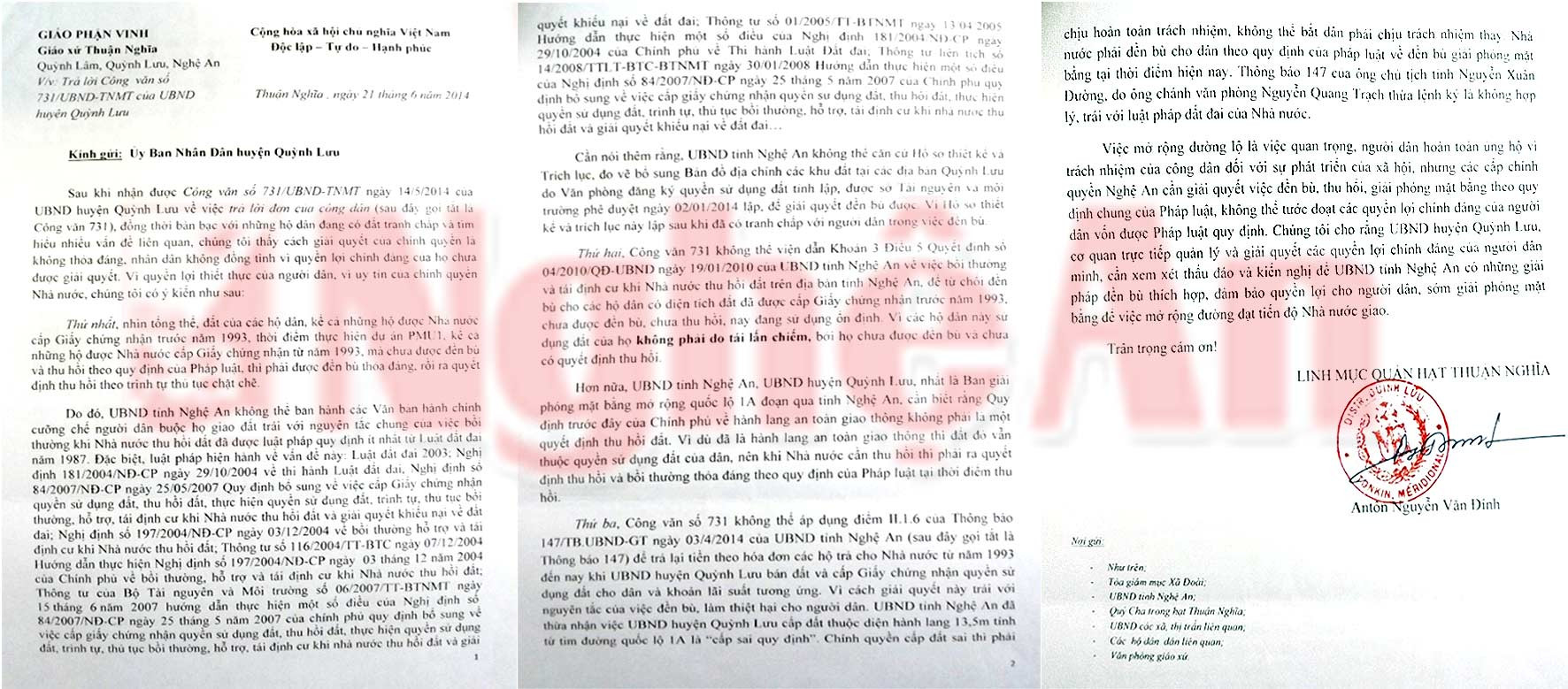 |
| Letter from Father Nguyen Van Dinh to the People's Committee of Quynh Luu District. |
And I would like to clarify to Mr. Thuan and Father Dinh that the regulations on traffic safety corridors were issued in 1982, in Decision No. 6-CT dated January 3, 1990, of the Council of Ministers on the implementation of Decree 203-HĐBT dated December 21, 1982, on the Regulations for Road Protection for National Highways, which clearly states: “1. According to the Road Regulations issued with Decree No. 203-HĐBT dated December 21, 1982, of the Council of Ministers, the scope of the road and the road protection corridor are the open space, belonging to the road to protect, ensure traffic safety, and provide for future expansion. Land within the road protection corridor may only be used for growing food crops, flowers, and green trees as directed by the Ministry of Transport; 2. On national highways, especially National Highway 1, since the date of issuance of the Road Protection Regulations, all works already completed in traffic by the relevant authorities are subject to these regulations.” Granting land or constructing structures without authorization by local authorities at the ward, commune, district, or provincial/city level constitutes a violation of the law. Within six months from the date of signing this Decision, the violating agencies and individuals must remove the aforementioned structures from the public space corridor (20 meters from the base of the embankment or the top of the excavation on each side). The State will waive fines and provide no compensation.”
In 1993, during the implementation of the National Highway 1A upgrade and expansion project, with the PMU1 Management Board of the Ministry of Transport as the investor, the unit marked the traffic safety corridor along the entire route, extending 7 meters from the edge of the road to each side, equivalent to 13.5 meters from the centerline of the road to each side. In Official Letter No. 1268/PMU1-QLDA2 from Project Management Unit 1 - Ministry of Transport dated July 28, 2010, sent to the Steering Committee for Compensation, Support and Resettlement of the National Highway 1A Upgrade and Expansion Projects through Nghe An Province, it was confirmed: “After reviewing and checking the archived documents at Project Management Unit 1 regarding the land clearance work for National Highway 1A of the WB1 Project from km 212+000 - km 463+000 (Cau Gie - Vinh City) in Nghe An Province, managed and implemented by Project Management Unit 1 in the years 1993-1998, Project Management Unit 1 would like to offer the following opinions: 1. Area where transportation infrastructure under the WB1 project has been constructed: Procedures for permanent land acquisition up to the construction site have been completed; 2. Area from the construction site to the land clearance markers of the WB1 project: The sections of the route passing through the area In urban areas, the land clearance boundary is 3m from the outer edge of the roadside ditch on each side. In rural areas, the boundary boundary is 7m from the base of the embankment slope to the top of the excavated embankment slope on each side. In sections with adjacent railway lines, only land clearance markers are placed on one side. Within this area, the project has fully compensated for all structures, buildings on the land, and trees and crops.”
Since the Road Protection Regulations for National Highways came into effect, almost no one has built permanent houses within the 13.5-meter radius along National Highway 1A! Later, some households bought, sold, or transferred land use rights, and when re-issued land certificates, the authorities deducted the area within the traffic safety corridor. This is clearly shown in the land certificates of households in Quynh Giang whose land adjacent to National Highway 1A was re-issued since 1993.
Therefore, if, as Father Dinh perceives, "The expansion of National Highway 1A is the desire of the entire population because it facilitates travel and reduces traffic accidents..." or "The road expansion is important, and the people fully support it because of their civic responsibility towards the development of society," then the priest should "give sermons about the sacrifice of Jesus, the parables of the Pharisees..., or stories about God's acceptance of suffering and willingness to give glory to others, as left in the Gospels" and "convey the wonder and joy of faith and the profound love between God and His creation," in order to work with the authorities to persuade the households still obstructing the construction of the National Highway 1A upgrade and expansion project in Quynh Giang commune; "For the sake of the nation" and to "reduce traffic accidents," facilitate travel and business, please hand over the land and create conditions to expedite the construction of this key national project. Because, through our interactions with the Catholic residents of Hamlet 11, Quynh Giang Commune, Quynh Luu District, they said that "everything now depends on the priest's decision," and they are also waiting for his opinion!
For those households in Quynh Giang who still have doubts and concerns about handing over their land, they should look at the example of the 4,462 households along the entire National Highway 1A from Hoang Mai town to Vinh City, who, for the benefit of the nation, handed over their land, creating favorable conditions for contractors to accelerate construction progress. To date, in the localities of Hoang Mai town, Dien Chau, Nghi Loc, and Vinh City, the shape of this modern and well-maintained national highway is becoming increasingly clear. Surely, along the entire route, only a few households in Hamlet 11, Quynh Giang commune, shouldn't stubbornly cling to their land, creating an unusual difference on this wide and spacious road?!
Obstructing or delaying the handover of land is not only contrary to the policies and guidelines of the Party and the State, but also violates the law, as some extremists have engaged in acts of "obstructing public officials," "disturbing public order," and "establishing illegal associations"... These actions will certainly be dealt with by the authorities according to the law. Therefore, the 22 households in Hamlet 11, Quynh Giang Commune (Quynh Luu District) also need to "learn from others and reflect on themselves" to understand and comply with the State's policies, because no one has the right to obstruct or infringe upon the interests of the nation...
Reporters