

Kudzu root, a plant that's easy to grow but yields real profit.
(Baonghean) - Being a highly drought-tolerant plant, kudzu root is rarely lost due to drought and is mainly grown on hillside land, foothills, cultivated land, farmland, and land utilized within fields and gardens. The localities in Nam Dan district that currently cultivate a lot of kudzu root include the communes of Nam Thanh, Nam Nghia, Nam Xuan, Nam Anh, Nam Loc, and Van Dien… Among them, Nam Anh commune has the longest tradition and experience in kudzu root cultivation in Nam Dan.
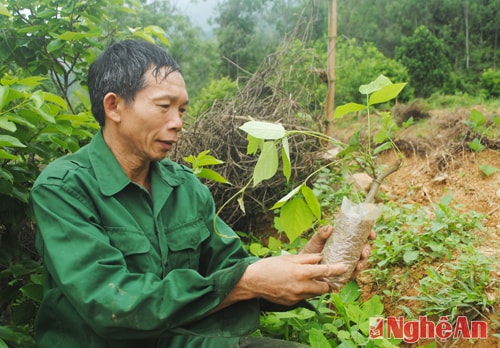 |
| Cultivating kudzu seedlings at the family farm of Mr. Ho Viet Tu, Hamlet 9, Nam Anh Commune (Nam Dan District). |
The family of Mr. Ho Viet Tu, in Hamlet 9, Nam Anh, has the largest area of kudzu cultivation in the commune. Mr. Tu said: His family has a farm at the foot of Dai Hue mountain, mainly growing kudzu. His cultivation method is very simple: After harvesting a kudzu vine, he takes the root, plants it in a mound of soil, and waits until the root sprouts and produces new branches. At this point, Mr. Tu adds 3 to 4 mounds of soil around the old mound, selects 3 to 4 of the strongest branches, and plants each branch in a new mound. After a while, he checks if the kudzu branches in the new mounds have rooted, then cuts the stem of the kudzu vine from the old mound and connects it to the new mound. This method is essentially a form of asexual propagation, similar to sweet potato cultivation. In addition to propagation by mounding, Mr. Tu has successfully applied propagation by cuttings. This method is also simple: select round, thick, healthy cassava vines that are free from pests and diseases, cut them into short segments, each segment having two buds. The soil is taken from rice paddies or home gardens, crushed into a fine powder, dried, mixed with well-rotted manure, and watered sufficiently before being placed in the soil. After cutting the cassava vines short, insert one end into the soil in the pot and wait until the upper bud sprouts new leaves before planting them.
The land used for growing kudzu is mostly hilly land at the foot of mountains. Due to its economic benefits, many localities have switched to growing it on fertile land, forming specialized kudzu cultivation fields. The method of growing kudzu in Nam Dan differs from many other localities: the land is plowed to a depth of 25-30 cm, the soil is broken up into small pieces, and mounded into mounds 40-50 cm high. Before planting, each mound is fertilized with an average of 5-7 kg of manure and 0.2-0.3 kg of NPK fertilizer (8-10-3).
If planted on hillside land, cassava vines don't necessarily need stakes, but if planted in flat land, stakes are necessary. The main material for making stakes is small branches, which are planted together like stakes for gourds, pumpkins, and cucumbers.
The cassava planting season runs from February to early March each year, with harvesting in November and December. The cassava harvest season in Nam Dan is quite bustling with buyers and sellers. Mr. Ho Si Lan's family in Hamlet 9, Nam Anh Commune, has specialized in buying and processing cassava starch for many years. Mr. Lan said that his family buys about 40-50 tons of cassava tubers annually and processes 8-10 tons of dried cassava starch. Besides him, many other farmers also participate in processing cassava starch at home, but on a smaller scale. According to Mr. Lan, processing cassava starch is not difficult, but it's not simple either. To obtain high-quality, fragrant, delicious, clean, and smooth starch, a very strict process must be followed: Fresh cassava tubers are bought, peeled, soaked, and washed thoroughly before being put into a grinding machine and ground carefully. Then, the liquid is squeezed out using a cloth, and the pulp is squeezed three times to extract all the sticky starch. The liquid extracted from the cassava pulp is continuously soaked and settled in tanks for 7-8 days and nights. The water used for soaking and settling the cassava starch should be taken from mountain streams; the water should be clear, clean, and pure. This ensures that the cassava starch, when removed and dried, will be pure white and, when dry, will solidify into small granules like corn or bean kernels – this is considered good quality starch. Ms. Pham Thi Hai, a farmer with over 1,300 square meters of land who previously grew peanuts but has now switched to growing cassava, said: "Cassava is a crop that yields good results even with little effort." Many locals agree with Ms. Hai's opinion, stating that cassava is drought-resistant, doesn't suffer from pests or diseases, and can be grown in any type of soil (including rocky and sandy soil) with good yields.
Currently, the average yield of fresh cassava tubers in Nam Dan is 20-22 tons/ha, with a purchase price of 10-12 thousand VND/kg. This translates to a revenue of 200-240 million VND per hectare per year. If processed into starch, 5 kg of fresh cassava tubers yield 1 kg of dry cassava starch. The current selling price for 1 kg of dry cassava starch is 100,000 VND (wholesale) and 120,000 VND (retail).
Thus, the value chain generated from planting to harvesting, processing, and consumption of 1 hectare of kudzu will yield revenue of 400-440 million VND. After deducting all expenses, which amount to 1/3 of the revenue, a net profit of 260-300 million VND/ha will still be earned.
The demand for kudzu root is very high today, and it is widely used in traditional medicine (kudzu root is used to treat diseases), kudzu starch is used as a refreshing drink in the hot summer and as a fever reducer for colds... Therefore, cultivating kudzu in Vietnam in general, and Nghe An in particular, is necessary, and there is plenty of land available for kudzu cultivation: hillside land, reclaimed land, land intercropped with forestry trees, farmland, high-lying arable land... so gradually forming concentrated cultivation areas into large commodity zones linked to procurement and processing into a closed value chain to bring about higher economic efficiency.
Doan Tri Tue