
Vietnam-India High-Level Meeting
During the meeting between Prime Minister Nguyen Tan Dung and Indian Prime Minister Modi on October 28, both sides reaffirmed their commitment to comprehensively developing the strategic partnership between the two countries.
During the meeting between Prime Minister Nguyen Tan Dung and Indian Prime Minister Modi on October 28, both sides reaffirmed their commitment to comprehensively developing the strategic partnership between the two countries.
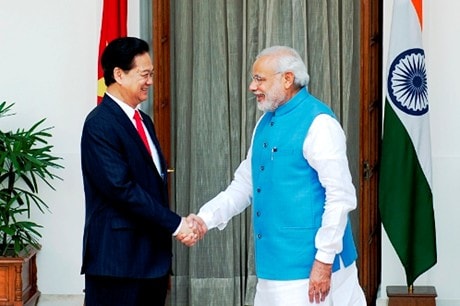 |
| Prime Minister Nguyen Tan Dung and Indian Prime Minister Narendra Modi. |
| RELATED NEWS |
|---|
Strengthening cooperation in politics, economics, defense and security, and science and technology.
Both sides also reached a high degree of consensus on major directions and measures to develop bilateral relations in an increasingly substantive and effective manner, especially in the fields of politics, economics, defense and security, science and technology, and culture and education. Both sides agreed to strengthen exchanges of high-level and other delegations, promote exchanges and cooperation through all channels—Party, Parliament, and people-to-people exchanges; and regularly and periodically organize existing cooperation mechanisms such as the Intergovernmental Committee, the Strategic Dialogue and Political Consultations, the Defense Dialogue, and the Joint Subcommittee on Trade…
Both sides highly appreciated the rapid development of economic relations between the two countries in recent years; agreed to consider strengthening economic cooperation as a strategic goal in bilateral cooperation, emphasizing the need to further enhance the effectiveness of economic cooperation, setting a target of achieving and exceeding bilateral trade turnover of 15 billion USD by 2020. Prime Minister Modi announced that the Indian Government is ready to provide Vietnam with a credit of 300 million USD to import raw materials for several economic sectors, especially the textile, garment, and footwear industries.
Prime Minister Nguyen Tan Dung thanked the Indian Government for its goodwill; welcomed and pledged to create favorable conditions for businesses of both countries to strengthen mutually beneficial economic, trade, and investment cooperation in areas where both sides have strengths such as oil and gas, energy, infrastructure construction, information technology, chemicals, fertilizers, pharmaceuticals, and agricultural processing. Indian leaders and businesses committed to strengthening cooperation and investment in Vietnam, supporting Vietnam in diversifying input materials for industries, especially the textile and garment industry, and participating in large-scale infrastructure projects in Vietnam. The Indian Prime Minister suggested that Vietnamese businesses take advantage of opportunities from India's economic development programs such as "Make in India" to promote mutually beneficial cooperation.
Both sides agreed to continue promoting defense and security cooperation, as well as strengthening substantive cooperation in the fields of science and technology, culture and education. They noted that with the opening of direct flights in November 2014, Vietnam and India have initially achieved air connectivity and expressed interest in promoting efforts to connect maritime routes, boost tourism cooperation and people-to-people exchanges. They also agreed to continue coordinating effectively and closely with each other in regional and international forums such as ASEAN-India cooperation, the East Asia Summit (EAS), the ASEAN Regional Forum (ARF), the Regional Comprehensive Economic Partnership (RCEP), the Non-Aligned Movement, and cooperation within the framework of the United Nations. Vietnam reaffirmed its support for India's membership in the UN Security Council when this mechanism is expanded.
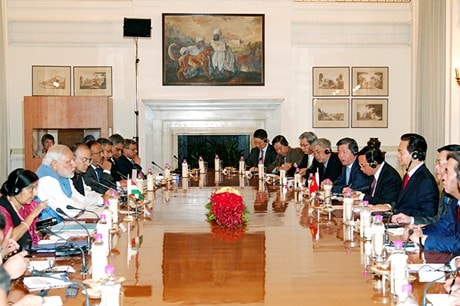 |
| High-level talks between Vietnam and India. |
Ensuring the rights and interests of countries in the South China Sea.
Regarding the South China Sea issue, both sides agreed on the importance of ensuring peace, stability, security, and safety of maritime and air navigation in the South China Sea; India affirmed its support for the legitimate rights and interests of states in the South China Sea being protected; it supported the peaceful resolution of disputes in the South China Sea on the basis of international law, including the 1982 United Nations Convention on the Law of the Sea (UNCLOS-1982), the full and strict implementation of the DOC, and the early development and completion of the Code of Conduct (COC).
Vietnam highly appreciates India's stance on the East Sea issue and India's commitment to continue cooperating with Vietnam in exploring and exploiting oil and gas in Vietnam's exclusive economic zone and continental shelf in the East Sea.
Signed numerous cooperation agreements.
On this occasion, the Prime Ministers of the two countries witnessed the signing of cooperation agreements, including: a Memorandum of Understanding on Nalanda University; a Memorandum of Understanding on the Conservation and Restoration of Cham architectural works at My Son, Quang Nam province; a Memorandum of Understanding on the establishment of an English Language and IT Training Center at Nha Trang University of Information and Communication; a Cultural Exchange Program for the period 2015-2017; a Memorandum of Understanding on radio cooperation between the Voice of Vietnam and All India Radio; a framework agreement on cooperation between OVL and PetroVietnam; and a Memorandum of Understanding on cooperation between ONGC and PetroVietnam.
The State Bank of Vietnam has granted in-principle approval for the Indian bank to open a branch in Vietnam.
The Voice of Vietnam and the public broadcasting company Prasar Bharati have also signed agreements to exchange broadcasting programs in the fields of culture, education, science, entertainment, sports, news, and other areas of mutual interest. They will collaborate on producing broadcasting programs on topics popular with audiences, exchange delegations of leaders, reporters, and technicians, and conduct training courses on broadcasting technology for the Voice of Vietnam. They will also cooperate and participate in organizing important political, cultural, and economic events of both countries.
According to chinhphu.vn