

U Dai Son Market
(Baonghean) - Dai Son commune, Do Luong district, is famous for having the largest buffalo and cattle wholesale market in the country. During market days, thousands of buffalo and cattle are transported from all over, creating a bustling atmosphere and transforming the peaceful appearance of this remote rural village...
Going to the cattle market.
From Provincial Road 34, the section passing through Nghi Phuong and Nghi Kieu communes in Nghi Loc district, everyone knows the way to U Dai Son market. The road is small, winding, and secluded. On both sides are acacia and eucalyptus trees, and lush green fields of peanuts and corn. The Dai Hue mountain range stands to the south like a protective wall for the small villages.
According to Mr. Nguyen Thuc Hai, Vice Chairman of Dai Son Commune: "If it weren't for U Market, hardly anyone would know about Dai Son Commune." The market is located right in the middle of the commune's central intersection. This is a prime location convenient for transportation. From here, one can go to the district center via Khuon-Tru-Dai road, or through Nghi Kieu (of Nghi Loc district) via Provincial Road 34 to Vinh City, or turn towards Yen Thanh to reach National Highway 7A. The market has moved to many locations; initially, it had a full range of goods to serve the local population. The buying and selling of buffalo and cattle took place at these markets. With the advantage of ample land and a thriving livestock industry, the demand for buying and selling buffalo and cattle increased steadily. Not only people in the commune, but also people from the surrounding areas came to U Market whenever they needed to. Word spread, and traders from all over flocked there in increasing numbers. Recognizing this, in 1967, Dai Son Buffalo and Cattle Market was established and began operating. The market is held six times a month on the 1st, 6th, 11th, 16th, 21st, and 26th, with thousands of buffaloes and cows being sold.
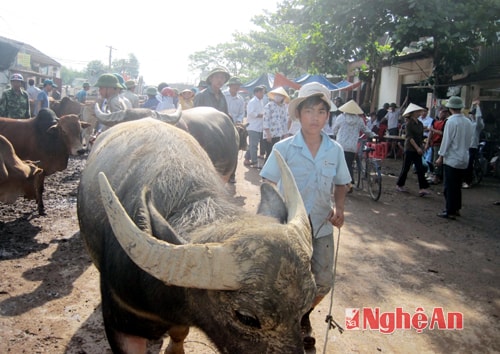 |
| Cattle and buffalo from all over the region gather at Ú Đại Sơn market (Đô Lương). |
It's unclear when exactly, but the folk song "Whoever goes to U Dai Son market/ Buys a magnificent buffalo to establish a large farm" has become familiar. At 5 a.m., groups of people, leading their buffaloes and cows, stream towards the market, their mouths constantly chattering. The buffaloes hurry along, urging on by their owners, and the calves happily run along... For traders from far away, to make it to the market on time, they have to walk their buffaloes and cows to the market the day before. Trucks with out-of-province license plates, laden with buffaloes and cows, honk loudly as they search for a way through. Mr. Nguyen Van Ba eagerly urges his buffaloes forward, looking very excited: "The market only comes once every few days, it would be a shame to miss it. Farmers have little capital, so they only bring a few animals to the market to sell." For many farmers, going to the market is also a habit to... look at buffaloes and cows. They see it as a hobby. In addition, the buffalo and cow market is an opportunity for many people to check market prices and learn about buying, selling, and selecting breeds. The chance encounters, handshakes, bargaining, and haggling amidst the hurried crowds... are a stark contrast to the inherent tranquility of this rural village.
Reading the fortune of… buffaloes
There's an old saying: "The buffalo is the foundation of one's livelihood." Choosing the right breed of buffalo for plowing is crucial for farmers; it can foreshadow good fortune or misfortune for the household. Every farmer who goes to the market knows by heart the saying: "A mourning head, a swirl of hair, a sagging jaw / Of these three things, the house is ruined." Mr. Hue – an elderly farmer who has spent more than half his life at U Market – shared his experience: “The worst kind is the ‘laughing buffalo,’ meaning that when you shine a light on its face at night, it bares its teeth. Secondly, there’s the ‘three-eyed’ buffalo, also known as the buffalo with three eyes – it has a protruding lump in the middle of its forehead like a third eye. In addition, ‘white fever’ or ‘spotted tail’ cattle are the most important to avoid when choosing. The most preferred type of buffalo is: ‘Bear-like mouth, jackfruit leaf ears, and a round rear end,’ a breed that eats anything and is easy to raise. If someone mistakenly buys a mischievous buffalo, they will have to ‘cosmetically’ improve it to deceive people; if that doesn’t work, they will have to sell it at a low price to traders.”
Buying beef cattle is relatively simple, not as complicated as choosing breeding cattle. However, to enter the cattle trading business, the first thing is to have an accurate and discerning eye. All bargaining and pricing are based on visual observation, without any weighing or measuring. Both buyers and sellers know how to accurately estimate the animal's weight. Based on years of experience, Mr. Nguyen Van Sau – an experienced trader in the region – said: “The criteria for selecting animals are those with thick, stiff fur and rough skin because they have more meat but smaller bones. Often, the ‘unconventional’ breeding cattle of farmers are opportunities for profit for traders.”
For traders, losses in buying and selling are normal. But for farmers, who always consider cattle their "foundation of livelihood," buying a "rebellious" animal is considered extremely unlucky. Therefore, when buying a breeding animal, they often ask a dozen people for help, including relatives and elders in the village. After the market day, a warm and friendly meal is prepared at home to thank everyone and welcome the new animal, hoping for good fortune in the future.
Merchants at U Market
Called merchants, they were actually farmers who traded. Initially, due to the low efficiency of agricultural production, they took advantage of the nearby cattle market to focus on raising cattle for sale. As their experience in buying, selling, and valuing cattle increased, they borrowed more money to expand their business. Gradually, they traveled throughout mountainous districts like Tuong Duong and Ky Son, and even to neighboring Laos, to buy cattle to resell.
Those with less capital engage in "sit-down trading." They buy slightly thin buffaloes and cows, fatten them up for a few weeks, and then sell them at the market, earning 400,000 to 600,000 dong. Like many other farmers in Dai Son commune, old farmer Le Van Quyen had to put aside his dream of large-scale farming and turn to trading buffaloes and cows. He can't remember how long he's been in this business, only that his family used to farm and trade buffaloes, and now they only do this. His eldest son is also more interested in herding buffaloes than in studying, and his wife, when she has free time, also works as a buffalo herder at the market. So the whole family earns a living from the buffalo market. Six trading sessions a month provide enough food for four people for 30 days. And it's not just his family; the whole village and commune do the same. It's called trading, but in reality, it's fattening buffaloes and cows to sell. The husband or eldest son goes to find thin, sick buffaloes and cows to bring home, while the wife and children stay home to herd and fatten them. Every few weeks, with their skilled care, the buffaloes and cows are taken to the market. Once there are animals to bring to market, the whole family goes together. While waiting to see if the animals sell, the children take advantage of the opportunity to "earn extra" by herding buffaloes and cows for traders. Many families near the market have utilized available land to build makeshift shelters for their animals while waiting to be loaded onto trucks. Traders, once they have bought enough animals, rent these shelters for 15,000-20,000 dong per animal. Thanks to the buffalo market, many families here have been able to build multi-story houses, acquire expensive equipment, and their economic lives have become more prosperous. In the center of the commune, shops and restaurants have sprung up everywhere. The face of the countryside in Dai Son is undergoing a transformation. Mr. Nguyen Thuc Hai, Vice Chairman of Dai Son commune, said: “The cattle market contributes to increasing the income of the people in the commune, especially during the agricultural off-season. Currently, about 60% of the more than 1,800 households in the commune earn income from the cattle market. Every year, the cattle market contributes more than 90 million VND in taxes to the commune's budget, creating additional capital to solve local difficulties...”
As the market dispersed at midday, the roadside eateries bustled with the laughter and chatter of traders after a successful trading session. Along the road, farmers happily led home their newly selected livestock, drawing admiring glances and pointing fingers from onlookers…
Nguyen Le