

Four national-level rapid response teams have been established to combat Ebola.
To strengthen measures to combat the Ebola epidemic, the health sector will establish four national-level rapid response teams corresponding to the four regions of North, Central, South, and Central Highlands.
On the morning of October 19th, Professor Nguyen Thanh Long, Deputy Minister of Health, inspected the Ebola prevention and control work at the Central Hospital for Tropical Diseases (Hanoi).
Reporting to Deputy Minister Long, the hospital's leadership stated that they had established an outpatient emergency team; regularly trained staff; and had mobile negative pressure isolation rooms to provide maximum protection for patients undergoing treatment.
The hospital has also provided standard personal protective equipment (PPE) to its staff and is preparing to receive 1,000 sets of standard PPE according to World Health Organization (WHO) guidelines to prevent cross-contamination. Notably, it has established a biosafety level 2 laboratory, which will be assessed by the Ministry of Health and WHO next week for Ebola virus testing.
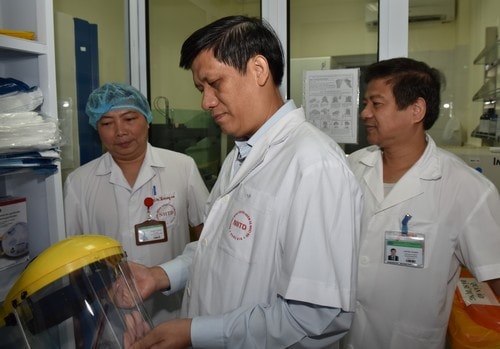 |
| Deputy Minister of Health Nguyen Thanh Long inspects epidemic prevention and control work at the Central Hospital for Tropical Diseases. Photo: NP |
Deputy Minister Long requested that all medical facilities raise their vigilance and response levels even further in response to the Ebola epidemic. In addition to the rapid response teams in each province, city, and district, the health sector will establish four national-level rapid response teams corresponding to the four regions of North, Central, South, and Central Highlands to strengthen epidemic prevention and control.
According to Professor Long, hospitals must prepare isolation areas to receive, isolate, and provide supportive treatment for suspected patients, especially preparing personal protective equipment; at the same time, they must review all procedures for handling medical waste from patients, specimens, and wards; and provide training for medical staff, including administrative staff, security guards, and cleaning staff…
The Department of Medical Examination and Treatment Management is responsible for directing hospitals to review their Ebola virus prevention and control plans and to continue training and updating medical staff with knowledge and experience from around the world. Next week, the Department will organize a large-scale drill at the Central Hospital for Tropical Diseases and other hospitals assigned to the task in Central and Southern Vietnam.
Representatives from the WHO and international organizations stated that the latest studies show that the Ebola virus has not undergone genetic or virulence changes, nor is there clear evidence of a change in its transmission route. The transmission route of the Ebola virus remains direct contact with secretions; however, it should be noted that if an infected person vomits, coughs, or sneezes with secretions containing a high concentration of the virus, and the contact person has abrasions or damaged mucous membranes, the virus can also enter the body.
Currently, Senegal and Nigeria have not reported any new cases. As of October 18th, the world has recorded nearly 9,300 cases, including 4,604 deaths. Notably, 431 cases were healthcare workers, and 247 deaths were reported.
In recent days, the Ebola epidemic has continued to unfold in a complex manner; however, the fact that three nurses from Spain and the United States contracted the virus while caring for patients is a public health incident. This forces all countries to review, examine, and reassess their infection prevention and control measures to learn lessons from this experience.
According to Vnexpress