

Filling the reading skills gap for students.
Reading is one of the most important competencies and skills for university and college students. However, the reality is that many students today actually lack the basic skills to access academic knowledge from books and textbooks.
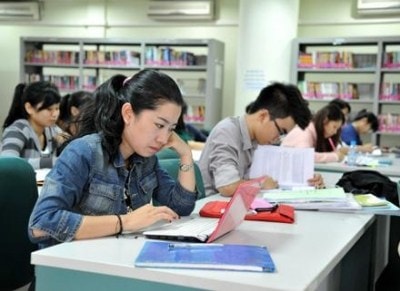 |
| Many students today actually lack the basic skills to access academic knowledge from books and textbooks. (Image is for illustrative purposes only.) |
Dr. Cao Xuan Lieu (Academy of Educational Management) stated that the Academy conducted a survey on reading skills for specialized psychology materials among 120 second-year students.
As a result, over 50% of students regularly read subject-specific materials after lectures in class. Only 22.5% of students read the material beforehand, and 13.3% read the material beforehand and reread it after the lesson ended.
Some students interviewed stated that attending lectures in class provided them with the foundational knowledge needed to easily absorb information when reading materials independently; they also had the knowledge to compare what was taught in class with the content of the materials.
According to the same survey, more than half of the students usually read the table of contents first, then immediately look for the main content in the document to read. Only 7.5% of students read the introduction, and 9.1% of students read the introduction and table of contents before reading the main content of the document.
The way students read documents also raises several points worth discussing, such as: students only read and rarely create outlines afterward. The reason, according to the students themselves, is the influence of their high school study habits; they lack the habit of taking notes while reading, so actions like recording information, making comparisons, contrasting ideas, or noting down main points are rarely used by students.
Furthermore, through discussions with students, it was found that most students, when reading, do not know how to focus on the main points of the material but tend to grasp things superficially; they do not know how to connect with other knowledge; and most students are unable to synthesize and generalize.
In addition to the information above, a number of other issues were raised in the survey, revealing that the survey participants still lacked many other skills, such as: identifying illustrative evidence in documents; supplementing, expanding, and analyzing events, phenomena, and document content; diagramming and modeling document content; and creating an outline of the entire document content...
In response to this situation, Dr. Cao Xuan Lieu stated that he has conducted experiments on methods to improve reading skills in specialized psychology literature.
The experiment was conducted in three steps: providing students with the skills to read specialized literature, providing them with materials on developmental psychology to read while simultaneously providing feedback, evaluation, and suggestions; implementing a system of exercises to practice reading skills; and finally, testing and evaluation.
Reading skills are specifically divided into the following areas: identifying the main content; identifying the basic argument of each paragraph in the document; identifying illustrative evidence in each paragraph; supplementing, expanding, and analyzing events and phenomena; diagramming and modeling the document's content; and outlining the entire document.
According to Dr. Cao Xuan Lieu, after directly implementing the above measures for a period of time, the students' reading skills have improved positively, with students now performing more appropriate reading activities.
According to GD&TĐ