
Projects with delayed final settlements: The need for accelerated handling.
(Baonghean) - Currently, in Nghe An province, there are more than 1000 projects that have not yet submitted final settlement documents to the competent authorities. This situation affects the management of state investment capital and causes prolonged outstanding construction debts...
(Baonghean) - Currently, in Nghe An province, there are more than 1000 projects that have not yet submitted final settlement documents to the competent authorities. This situation affects the management of state investment capital and causes prolonged outstanding construction debts...
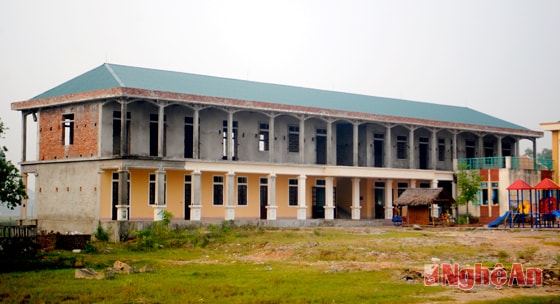 |
| The Long Thanh Commune Kindergarten project (Yen Thanh District), for which the commune is the investor, has been slow to finalize its accounts. |
As of May 18, 2014, in Yen Thanh district, there were 173 projects that had been completed according to the contract schedule but had not yet settled the investment capital. Mr. Phan Van Tuyen - Vice Chairman of Yen Thanh District People's Committee said: Yen Thanh District People's Committee had issued Official Letter No. 864/UBND dated July 11, 2011 on urging the submission of settlement documents for outstanding construction projects. To date, 16 communes have completed the preparation of settlement reports or have settled the outstanding projects such as Cong Thanh, Dai Thanh, Do Thanh...; 16 units have not yet completed the preparation of documents for outstanding projects, including some communes with many outstanding projects such as Bao Thanh commune (6), Tay Thanh (5).
Explaining the reasons for the delay in project settlement, Mr. Phan Van Tuyen stated that the number of outstanding construction projects in the district is large, while the number of staff is limited, leading to prolonged delays. Some projects, where the District People's Committee is the investor, are behind schedule due to a lack of funding (of the 11 projects where the District People's Committee is the investor but has not yet submitted settlement documents, 5 are incomplete due to insufficient funds). Some projects, where the Commune People's Committee is the investor, involve hiring local residents to carry out the work and using the legal status of other contractors, resulting in a lack of coordination between contractors and investors in project settlement. Furthermore, some projects have been largely paid to contractors, leading to contractors' reluctance to prepare settlement documents.
Conversely, some sectors and localities have done well in settling investment capital for projects using state budget funds. For example, the Department of Transport and the People's Committee of Vinh City... At the Department of Transport, although the number of projects is not large, the number of bidding packages is very large. However, this work is handled very effectively. The Deputy Director of the Department of Transport, Mr. Pham Hong Quang, said: "Previously, we also had many shortcomings in the settlement documentation process. Later, to resolve those shortcomings, the department established a specialized team to carry out the settlement work, delegating authority to specialized staff to directly handle difficulties. In the documentation process, there were also some lost or incomplete documents, but we based our work on state regulations, with the Treasury coordinating with the Department of Finance to handle them. Each project has its own unique characteristics, therefore it is necessary to advise on solutions to overcome difficulties and resolve them completely." Experience shows that localities and sectors that receive close attention from leaders at all levels achieve good results in handling outstanding construction investment debts. Conversely, localities and units lacking effective management and guidance, with low settlement rates and numerous outstanding projects, suffer from accumulated debt and inability to finalize investment capital accounts. Furthermore, the assignment of responsibilities for monitoring and implementing the settlement of construction investment capital at various levels remains limited.
In light of this situation, and in implementation of Directive No. 27/CT-TTg dated December 27, 2013, of the Prime Minister on strengthening and promoting the final settlement of investment capital for completed projects using state funds, on April 25, 2014, the Provincial People's Committee issued Decision No. 1738/QD-UBND promulgating the plan for implementing Directive No. 27/CT-TTg at departments, agencies, and districts, cities, and towns. Upon review, the total number of projects not yet finalized (according to the report of the State Treasury) in the province is 3,380, including 160 unfinished and duplicate projects; 1,594 projects with approved final settlements; and 1,626 completed projects not yet finalized (including 624 projects with submitted final settlement documents to competent authorities and 1,002 projects without submitted final settlement documents).
Out of a total of 1,002 projects that have not yet submitted final settlement documents, 685 projects completed in 2011 or earlier have violated the deadline for submitting final settlement reports by more than 24 months. Specifically, there are 619 projects managed by 222 units under the management of districts, cities, and towns. Some of these projects, completed in 2011 or earlier, have not yet submitted final settlement reports, such as the People's Committee of Que Phong District (58 projects), the People's Committee of Hoa Hieu Ward (Thai Hoa Town) (18 projects), the People's Committee of Do Luong District (14 projects), the People's Committee of Nghi Hoa Ward (Cua Lo Town) (10 projects), and the Infrastructure Development Board of Program 135 of Que Phong (10 projects). According to regulations, penalties must be imposed, including temporarily suspending the management of the project owner, and ceasing further capital allocation and project acceptance.
However, the process of identifying and compiling the names, addresses, and contractors of projects violating the settlement deadlines in districts, departments, and sectors has been incomplete, affecting the proposal of appropriate sanctions. In implementing Directive 27/CT-TTg and Decision 1738 of the Provincial People's Committee, projects with missing or incomplete settlement documents have not been implemented, and the process of documenting settlement issues has been inconsistent or problematic. Contractors have not cooperated with the investor in preparing settlement reports. Some investors and project management boards have not effectively reviewed and urged construction and consulting contractors to cooperate in preparing work reports. Reporting difficulties and obstacles in settlement by the People's Committees of districts, cities, and towns, as well as investors and project management boards, has not been timely.
Therefore, to strengthen and expedite the final settlement of investment capital for completed projects using state funds in the province, it is necessary to innovate the verification process for the final settlement of completed projects. Specifically for projects under the investment decision-making authority of the People's Committees of communes, wards, and towns, it is necessary to hire independent auditing organizations to audit the final settlement reports of completed projects. The Department of Finance should, based on the list of investors and contractors with projects that have violated regulations by submitting final settlement reports for more than 24 months, propose to the Provincial People's Committee to direct the Department of Planning and Investment not to advise on investment policies or appraise new investment projects for investors and contractors who have violated regulations by submitting final settlement reports. It should also not advise the Provincial People's Committee to approve bidding plans or award contracts for new projects to investors who have violated regulations by submitting final settlement reports. Investors and project management boards with new projects should not allow contractors who are currently violating regulations by submitting final settlement reports to participate in bidding for new projects. Only with these drastic measures can we hope to address projects with delayed final settlements and definitively resolve outstanding construction debts.
Thu Huyen