

13 Laws effective from January 1, 2015
From January 1, 2015, 13 laws officially came into effect with many important contents such as: Expanding the scope of benefits and coverage of health insurance; allowing surrogacy for humanitarian purposes; exempting corporate income tax on income from processing agricultural and aquatic products by cooperatives; strengthening control and management of construction quality; and addressing scattered, wasteful, and inefficient public investment.
From January 1, 2015, 13 laws officially came into effect with many important contents such as: Expanding the scope of benefits and coverage of health insurance; allowing surrogacy for humanitarian purposes; exempting corporate income tax on income from processing agricultural and aquatic products by cooperatives; strengthening control and management of construction quality; and addressing scattered, wasteful, and inefficient public investment.
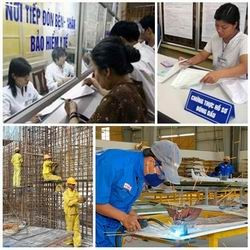 |
| Illustrative image |
The 13 laws include:1. Law amending and supplementing certain articles of the Health Insurance Law; 2. Employment Law; 3. Law amending and supplementing certain articles of tax laws; 4. Marriage and Family Law; 5. Plant Protection and Quarantine Law; 6. Notary Law; 7. Customs Law; 8. Construction Law; 9. Public Investment Law; 10. Law amending and supplementing certain articles of the Inland Waterway Traffic Law; 11. Environmental Protection Law; 12. Law on Entry, Exit, Transit, and Residence of Foreigners in Vietnam; 13. Bankruptcy Law.
Expanding the scope and level of benefits under health insurance.
According to the Health Insurance Law, the health insurance benefits of citizens will be expanded. Accordingly, people living in areas with particularly difficult socio-economic conditions; and people living in island communes and districts will be granted free health insurance cards funded by the State budget.
The law abolishes the 5% co-payment requirement for the poor, those receiving social welfare, ethnic minorities living in areas with difficult socio-economic conditions; those living in areas with particularly difficult socio-economic conditions; and those living in island communes and districts. It also abolishes the 20% co-payment requirement for relatives of those who rendered meritorious service to the revolution, including biological parents, spouses, children of martyrs, and those who cared for martyrs.
The law also reduces the co-payment rate from 20% to 5% for other relatives of war veterans and those belonging to near-poor households.
Notably, the Health Insurance Fund will cover 100% of medical examination and treatment costs when patients have participated in health insurance for 5 consecutive years or more and the amount of co-payment for medical examination and treatment costs in the year is greater than 6 months of the basic salary.
The Employment Law regulates five major groups of issues.
The Employment Law comprises 7 chapters and 62 articles, regulating 5 major groups of issues including: 1- Policies to support job creation; 2- Labor market information; 3- Assessment and certification of national vocational skills; 4- Organization and operation of employment services; 5- Unemployment insurance.
Specifically, the public employment policy is a new policy aimed at providing temporary, paid employment to workers through the implementation of projects or activities using state capital associated with socio-economic development programs at the commune level, including: building infrastructure serving agricultural, forestry, fisheries, and salt production; building public infrastructure; environmental protection; climate change adaptation; and projects and activities serving the local community.
Corporate income tax exemption applies to income from processing agricultural and aquatic products by cooperatives.
The amended Law on Taxation stipulates the exemption of corporate income tax (CIT) for income from agricultural and aquatic product processing activities of cooperatives and enterprises in particularly difficult areas. A tax rate of 10% is applied to income from agricultural and aquatic product processing activities of cooperatives and enterprises in difficult areas. A tax rate of 15% is applied to income of enterprises engaged in cultivation, livestock farming, and processing in the agricultural and aquatic sectors not located in areas with difficult socio-economic conditions or areas with particularly difficult socio-economic conditions.
Regarding value-added tax, the Law adds offshore fishing vessels as an exempted item; and moves three groups of goods previously subject to a 5% tax rate to the tax-exempt category: fertilizers; animal feed for livestock, poultry, and other animals; and specialized machinery and equipment for agricultural production.
Surrogacy for humanitarian purposes
The 2014 Marriage and Family Law includes notable amendments and additions, such as revisions to marriage regulations (marriage age; removal of the prohibition on same-sex marriage, although "the State does not recognize same-sex marriage").
In addition, the Law also includes provisions on surrogacy for humanitarian purposes, aiming to meet the needs of couples who want children but whose wives are unable to conceive.
It is strictly prohibited to bring soil in or import harmful organisms.
The Law on Plant Protection and Quarantine has added several new principles to plant protection and quarantine activities, namely: the principle of pest control based on the principle of prevention being paramount; the application of integrated pest management measures in a sustainable manner, prioritizing biological control, the use of pest-resistant plant varieties, cultivation techniques, and good agricultural practices; and the use of pesticides must adhere to the "four correct principles" to ensure effectiveness, safety for people and food, minimize environmental pollution, and protect the ecosystem.
The law stipulates prohibited acts, emphasizing the prohibition of bringing soil and importing harmful organisms into Vietnam, breeding harmful organisms; and producing, trading, using, storing, transporting, disposing of, collecting, and processing pesticides and pesticide packaging in violation of regulations.
Improving the quality of notary services.
Regarding the Law on Notarization, the basic provisions concerning notaries, notarization organizations, notarization procedures, and state management of notarization have been expanded, and the scope of notarization has been broadened.
The law focuses on regulating notaries and notary practice organizations, aiming to improve the quality of the notary workforce, develop large-scale, stable notary practice organizations, and enhance the quality of notary services.
Fundamental changes to the method of carrying out customs procedures.
The Customs Law clearly stipulates the promotion of customs procedure reform, modernization of customs management, fundamental changes in the method of implementing customs procedures from traditional and semi-electronic methods to fully electronic methods, continued simplification of customs administrative procedures, application of management principles to enhance the effectiveness and efficiency of customs management activities, and strengthening national and economic security protection to prevent smuggling, illegal transportation of goods across borders, and trade fraud.
Strengthening control and management of construction quality.
The fundamental principle and core content of the Construction Law is to innovate the methods and content of project management, especially for projects using state capital, to overcome losses and waste, and to improve the quality of construction works.
The 2014 Construction Law, with its many new provisions, will strengthen control and management of construction quality at all stages of the investment and construction process, ensuring transparency in the construction permit issuance process; overcoming the situation of overlapping and suspended planning, ensuring that construction investment projects meet their objectives, quality, and efficiency, and enhancing the State's management role in construction.
Addressing scattered, wasteful, and inefficient public investment.
The Law on Public Investment has institutionalized the process of deciding on investment policies. This is the most important innovation of the Law on Public Investment, considered the starting point for determining the correctness and effectiveness of programs and projects in accordance with the goals, orientations, plans, and development policies of the Party and the State.
At the same time, it will prevent arbitrariness, subjectivity, and voluntarism in investment policy decisions, enhance the responsibility of those making investment policy decisions, and contribute to overcoming the situation of scattered, wasteful, and inefficient public investment.
The development of inland waterway transport must be in line with the transport development plan.
With the Law on Inland Waterway Traffic, many new points have been amended and supplemented, such as regulations stipulating that the development of inland waterway traffic must be consistent with the transportation development plan and ensure national defense and security, developing infrastructure towards modernity and synchronization in terms of channels, routes, ports, wharves, management technology, etc. People's Committees at all levels organize the registration of inland waterway vessels according to the regulations of the Minister of Transport and manage vessels that are exempt from registration.
Regarding inland waterway vessels, the Law abolishes the registration requirement for small, non-motorized vessels with a tonnage of 5 tons to less than 15 tons. For vessel operators, the amended Law removes the age limit of 55 for women and 60 for men to better reflect current conditions.
Adding regulations on green growth and climate change.
The amended Law on Environmental Protection supplements several provisions on green growth, climate change, and environmental security. At the same time, it harmonizes the provisions of the Law with international environmental commitments as expressed in international environmental treaties that Vietnam has signed and participated in.
The new regulations are also consistent with the characteristics of environmental science, such as prioritizing prevention, recognizing the organic interconnectedness of environmental factors, and not being separated by administrative boundaries.
Businesses are permitted to practice asset management during bankruptcy proceedings.
A new feature in the basic content of the Bankruptcy Law is that an insolvent enterprise or cooperative is one that fails to fulfill its debt payment obligations within 3 months from the due date. Accordingly, the Bankruptcy Law no longer uses the concept of "falling into a state of bankruptcy" but uses the concept of "insolvency".
A particularly important addition to the 2014 Bankruptcy Law is the provision regarding bankruptcy administrators, which stipulates that individuals and businesses are permitted to practice asset management during bankruptcy proceedings, including bankruptcy administrators and asset management and liquidation companies.
Facilitating entry, exit, and residence in Vietnam for foreigners.
The Law on Exit, Entry, Transit, and Residence of Foreigners in Vietnam creates many advantages for foreigners to enter, exit, transit, and reside in Vietnam for sightseeing, tourism, market research, investment cooperation, business, and study… while also meeting the requirements of protecting national security and maintaining social order and safety.
One of the regulations that has drawn attention is the prohibition of visa conversion, aimed at ensuring effective management and addressing the issue of foreigners applying for tourist visas to Vietnam and then subsequently working on construction projects, teaching, or other purposes, as has been the case in the past.
According to Chinhphu.vn