

Yen Phu Peach Village
(Baonghean) - Previously, the lives of the people in Yen Phu village (Minh Thanh commune, Yen Thanh district) mainly depended on agricultural production and small-scale trading. Peach blossom cultivation was introduced to the village about 30 years ago and has seen strong development in recent years. Due to the increasing market demand, some households in the village have boldly invested in improving techniques, care, and expanding the area for peach blossom cultivation, yielding high returns. With suitable soil conditions, long-standing experience, and the diligence and willingness to learn of the people, peach blossom cultivation here has achieved encouraging results, contributing to the shift in economic structure, gradually eradicating poverty, and improving the lives of the people...
We arrived at the Minh Thanh Commune People's Committee after a rather long morning rain. This is the locality with the largest peach blossom cultivation industry in Yen Thanh district – Yen Phu village. We were greeted by the Vice Chairman of the Commune People's Committee, Mr. Tran Khanh Tung. Mr. Tung enthusiastically told us that although it wasn't the end of the year and the peach blossoms weren't yet in full bloom, reporters would be captivated by the peach orchards planted on the hillsides. However, he also expressed some concern because the road to Yen Phu village was muddy after the recent rains. But he said, "Since we're already here, let's just bear with it. Minh Thanh peach blossoms are the best now. For many years, the people have been dedicated to peach blossom cultivation, providing them with high incomes. In 2013, the District People's Committee recognized Yen Phu as a village with a 'flower and ornamental plant cultivation' industry. Although it's called 'flower and ornamental plant cultivation,' the main activity is peach blossom cultivation."
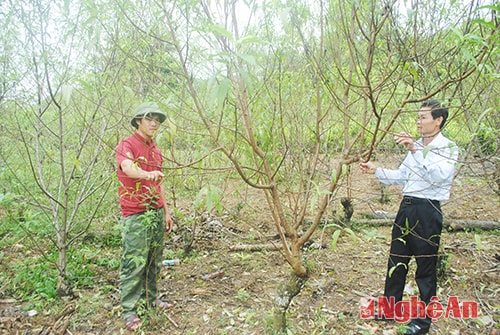 |
| The peach orchard of Mr. Tran Quoc Hoan's family. |
After saying that, Mr. Tung arranged for Mr. Thanh, an official from the commune's People's Committee office, to guide me. Each of us rode a motorbike, navigating slippery, muddy sections of road, clinging deep to the foothills to reach Yen Phu village. In our conversation, Mr. Thanh explained: "This difficult road partly affects the sale of peach blossoms during Tet. Because the weather at the end of the year often has long periods of drizzle, the road surface is muddy, and customers are hesitant to come. The villagers are striving to develop the 'flower and ornamental plant cultivation' profession further in the hope of soon being recognized as a traditional craft village by the province..."
Peach cultivation in Yen Phu is not a distant past, only a few decades ago. Mr. Tran Ngoc Lien, an 82-year-old villager, recalls: "In the late 1980s, life was very difficult for people in this mountainous region; we didn't have enough to eat. Back then, we brought sugarcane to plant in our gardens, and at the end of the year, we carried it to local markets to sell and buy rice. When life became somewhat better, many people bought orange and lemon saplings to plant, replacing the sugarcane. But after three years, the oranges and lemons withered because the soil wasn't suitable. At that time, some families in the village planted large, beautiful native peach trees, and many people immediately thought of growing peaches. Back then, peaches were mainly grown for their fruit; few people sold the branches. Later, gradually, peaches were grown for their flowers to serve the Tet (Lunar New Year) rituals."
As the demand for flowers during Tet (Lunar New Year) increases, peach growers realize the economic value of their crops. According to Ms. Lien, in the last 10 years or so, peach growers in Yen Phu village have focused more on their profession, and peach cultivation has become more clearly commercialized. It is known that nearly 50 households in Yen Phu village now cultivate peaches, accounting for 67% of the total households in the village, with an estimated area of over 20 hectares, mainly on home gardens. Earning a living from this profession is natural, and only through such efforts can it be sustainable. It is estimated that, on average, the total annual income of peach-growing households in Yen Phu village reaches billions of dong. Even the least successful households earn tens of millions of dong per year, while the most successful earn hundreds of millions of dong per year.
We visited the peach orchard of Mr. Tran Van Hai's family. More than 20 years ago, he was the first to graft the Nhat Tan peach variety onto local peach trees in his garden. Now, looking at his orchard, we couldn't help but be surprised by the scale of cultivation. On an area of approximately 1 hectare of land, he dedicated 7 sao (approximately 0.7 hectares) to growing peaches. Mr. Hai happily said: "The orchard has over 1,000 trees, mainly the 'stone peach' variety, grafted onto native peach trees. Previously, we usually grafted the Nhat Tan peach variety, but for about 5 years now, according to customer preferences, it has been replaced with the 'stone peach' variety. The 'stone peach' variety is brought from Ky Son and Que Phong and grafted onto local peach trees. The characteristics of the 'stone peach' are its large, strong trunk, light pink flowers with 5 large petals, and long-lasting blooms. Customers now often seek out this type of peach for Tet (Lunar New Year) offerings, so whatever we have, we sell it all." In total, Mr. Hai has been growing peaches for over 20 years. Initially, he planted them as a hobby, so he didn't take much care of them. Later, it became a real livelihood, requiring daily attention. In Mr. Hai's peach orchard, some trees are worth 4-5 million VND, while the least expensive ones are worth at least 300,000 VND. Mr. Hai affirms that peach cultivation is the main source of income for his family, thanks to which their lives have become much more prosperous and comfortable than before. Now, each peach-growing household has 1-3 main peach trees (master trees), both for eating the fruit and for sowing seeds to grow seedlings. Year after year, the cultivation of this type of peach tree is increasingly widespread, bringing value to both growers and consumers...
As the rain intensified, chatting with peach growers in Yen Phu village revealed the meticulous nature of peach cultivation. The soil and climate in Yen Phu village are considered ideal for peach trees, leading to their healthy growth. At first glance, one might think peach cultivation here is easy – just plant the tree, and it will thrive and bloom at the right time. However, that's not the case. To have a beautiful peach tree or branch to display during Tet (Lunar New Year), it truly requires considerable effort! Mr. Hai explained: "It takes 3-4 years to grow a sapling into a large, beautiful branch. For exceptionally beautiful trees, it can take 5-6 years before they can be harvested and sold. Caring for the trees is also very meticulous and careful throughout the year. For bonsai peach trees, the care requires even greater investment and careful shaping of each branch from a young age. The most difficult part is ensuring that by Tet, the bonsai peach tree has 'four blessings' on its branches: buds, flowers, new shoots, and fruit."
These ornamental peach trees are usually reserved for discerning and wealthy customers. To ensure a tree produces four blossoms at once, growers need years of experience. Mr. Hai shared his secret: Growers must know how to invest at the right time, prune the tree at the right stage, and shape the branches and form appropriately. To have fewer fruits during Tet (Lunar New Year), they must adjust the flowering period to begin in early November. In years with favorable weather, growers are at ease, but in years with unpredictable weather, they are anxious. Therefore, the most important thing is to predict the weather of the year to manage the peach orchard accordingly. If there is prolonged severe cold, they must strip the leaves early to ensure the peach blossoms bloom for Tet. If the weather is warm, the peach blossoms must bloom early and cannot be delayed. In years when the weather is unfavorable and the peach trees don't bloom for Tet, the growers suffer losses.
While cultivating bonsai peach trees requires meticulous care, naturally grown peach trees need very little maintenance. Mr. Tran Quoc Hoan, owner of a 700-tree peach orchard, explains: "Naturally grown peach trees are mainly sold for their branches. After harvesting, clean up the area around the base of the tree, apply well-rotted manure mixed with a little nitrogen fertilizer, and sprinkle it on the ground (peach roots grow shallowly). When the tree sprouts, cut off the small, weak shoots and select the large, healthy ones to care for and allow them to develop naturally, without the need for shaping. When the tree sprouts, stem borers often appear, so proactive spraying with pesticides is necessary. When the tree is growing normally, various pests and diseases such as red spider mites, sap-oozing disease, and stem borers may appear. Therefore, peach growers must pay attention and take immediate action upon detecting any signs of pests or diseases. During the tree's growth, it's important to prune unnecessary branches to encourage the remaining branches to grow quickly and evenly." As Tet (Lunar New Year) approaches, cleaning the peach orchards thoroughly, combined with carefully managing the peach blossoms to ensure they bloom at the right time, creates a positive impression on customers. Therefore, peach cultivation, though a quiet endeavor, holds its own unique joy. This joy not only provides economic benefits for the family but also contributes to the beauty of spring in every home. According to Mr. Hoan, on the sandy soil of the hillside, no other crop yields as high an income as peach cultivation. Utilizing the peach orchard, the family also raises broiler chickens very effectively.
Leaving the lush green peach orchards on the hillsides, we were still reminiscing about the stories the peach growers had told us. There were stories of joy, worry, and apprehension... We knew that there were other places in Yen Thanh that grew peaches commercially, but the peaches from Yen Phu village were the most famous. This fame stemmed from the unique beauty of the peach blossoms and the shape of each tree, meticulously crafted by the local people. Because of this, the "brand" of Yen Phu peaches attracted customers from Con Cuong, Do Luong, Dien Chau, Vinh... who came to buy them to display during the Spring Festival and Tet celebrations. The people of Yen Phu hope that the province will soon recognize their village as a traditional "flower and ornamental plant growing" village, so that their peach products will become even more prosperous!
Text and photos:Xuan Hoang