
Sweet and sour persimmon season in Nam Anh
(Baonghean) - Persimmons from Nam Anh commune (Nam Dan district) have long been famous for their sweetness and delicious taste, and are well-received by the market. But behind that sweetness, there are always hardships and worries…
(Baonghean) - Persimmons from Nam Anh commune (Nam Dan district) have long been famous for their sweetness and delicious taste, and are well-received by the market. But behind that sweetness, there are always hardships and worries…
At this time of year, along National Highway 46 from Muou Bridge to Nam Dan Town, many locals spread out plastic tarpaulins on the roadside to sell persimmons. Occasionally, you'll see a few trucks loaded with sacks of persimmons bearing license plates from Hanoi, Hai Phong, and Thanh Hoa heading north, and many motorbikes carrying a few sacks of persimmons from Xuan Hoa intersection and Dai Hue mountain area lining up on the highway, heading towards Do Luong or down towards Vinh. This scene continues throughout the persimmon season until the end of November in the lunar calendar.
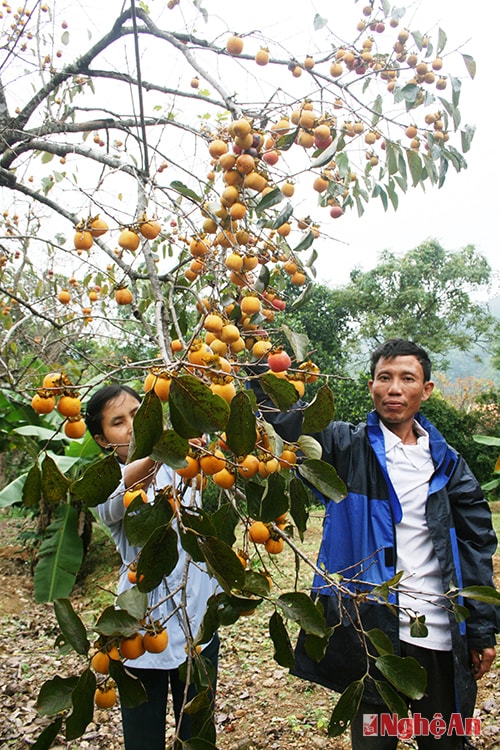 |
| Mr. Nguyen Hoang Duong and his wife, Ms. Ho Thi Hong, stand beside a persimmon tree that yielded 200 kg of fruit. |
Persimmon trees in Nam Anh have been growing for decades. On average, each household has a few trees that yield nearly a ton of fruit. Mr. Nguyen Van Chat, from Team 6, Nam Anh commune, who has been growing persimmons for many years, said: “In my garden, I currently have 6 persimmon trees that are producing fruit. The old persimmon tree planted in 1968 yielded nearly 300 kg this season, while the 5 trees planted in 1993 yielded about 500 kg more. Last year, my family sold them at 12,000 VND/kg, earning 7.4 million VND, but this year it will probably be less. In this hamlet, out of 220 households, 115 households grow persimmons, with Mr. Ho Viet Vinh's family having the most, selling 2 tons of fruit last year. In Hamlet 7, Mr. Nguyen Van Hoi has the largest persimmon tree in the commune, yielding 400 to 500 kg of fruit each year.”
According to Mr. Ho Viet Sy, Vice Chairman in charge of the commune's economy, out of the nine hamlets in Nam Anh, four (from hamlet 5 to hamlet 9) have residents earning income from this traditional crop. Persimmon trees were planted during the war against the US, following the evacuation of four villages – Duc Son, Duc Nghia, Tien Phong, and Thanh Cong – to the foot of the Dai Hue mountain range. Notably, within 10 years (from 1991 to 2000), the commune received support from a project to "restore local persimmon varieties" conducted by the Department of Science and Technology. From then on, along with the VAC (gardening, animal husbandry, and aquaculture) movement of the commune's Farmers' Association, Nam Anh persimmon trees truly became a brand. Depending on the weather, the commune's annual production is estimated at around 500 tons of fruit, generating approximately 6 billion VND in revenue. This is a very significant figure for a hilly area lacking arable land, poor soil, and irrigation water. However, to become wealthy from persimmon cultivation, one must know how to combine planting with finding markets for the product.
In the commune, there are currently 5 households involved in collecting, soaking, and selling large quantities of persimmons. They handle over 70% of the persimmons sold to markets both within and outside the province. Nguyen Hoang Duong and Ho Thi Hong (from Hamlet 6) have been doing this for 4 years. Duong said: “During the peak season, we sell an average of 1 ton of persimmons per day. Besides customers from Vinh, Do Luong, and neighboring communes, we also have customers from Thanh Hoa, Hanoi, and Hai Duong. Each trip they bring in 2 to 4 tons…” Despite the hard work and constant demands, the couple earns an average profit of around 10 million VND per month. Thanks to their persimmon orchard and the persimmon purchasing and selling service, their family's finances have improved significantly, allowing them to support their eldest daughter's studies at the University of Finance and Banking in Ho Chi Minh City. However, this work requires significant capital and sometimes involves accepting losses. Regarding capital, there must be three parts: a deposit to buy the fruit while it's still unripe on the tree, and in years when the "fruit distribution" brings in tens of millions of dong to be sure of success. In addition, there's capital for investing in tools for soaking and ripening, and capital for customers to pay later. "Profit is unpredictable. If things go smoothly and we buy at 8 and sell at 12, we can earn a decent income, but in years when persimmons drop in price, the selling price equals the 'fruit distribution' cost, so we just try to break even. This profession is full of hardships and difficulties," Mr. Duong shared.
That's the situation for sellers, but persimmon growers also face many obstacles and hardships. Even the selection of varieties requires meticulous and elaborate work, and the number of seedlings is small, unlike other species that can be mass-produced through grafting. To create a persimmon seedling, the roots of the host tree must be pruned, and after the roots sprout, they are carefully dug up and planted. Careful cultivation is required for three years before the seedlings can be transplanted elsewhere. On the dry, hard soil of the Nam Anh hills, deep, large holes must be dug, filled with fertile soil mixed with manure or well-rotted waste. Persimmon trees are very finicky; if the soil is waterlogged, they will die, but if there is insufficient water, they will become stunted, the fruit will be small and very astringent. Harvesting is also quite laborious. Both egg-shaped persimmons (large, red fruit) and tree-shaped persimmons (small, yellow fruit) must go through a process of ripening in vinegar or soaking in water.
Ms. Ho Thi Hong (Hamlet 6) said: “Before soaking, you have to wash them thoroughly but be careful not to scratch the skin. In warm weather, soak them for 3 days and 3 nights, but in cold weather, it takes 5 days and 5 nights. Soaking them for too long will make them lose their sweetness, but if you don't soak them enough, the fruit will be astringent. The method of pickling them in vinegar is the same as with bananas, pineapples, and other fruits. Soaking in water or vinegar requires staying up all night, your hands and feet are constantly wet, which can easily lead to rheumatism. The hardship is further compounded by people who, either unknowingly or intentionally, spread rumors about adding harmful chemicals, making buyers hesitant to eat them, fearing poisoning. Producing a kilogram of persimmons, from planting to selling, is already difficult, and these false rumors cause even more harm to the people.” Selling persimmons is also difficult for households that “produce and consume them themselves.” Along the road or at makeshift markets in Nam Anh commune, households earnestly solicit sales, with many people only managing to sell a few tens of kilograms of persimmons and spending an entire day doing so. Some households have to go to National Highway 46, packing their own lunches and eating hastily just to sell a few dozen kilograms of fruit. During the harvest season, while working in the winter crop and harvesting persimmons, households are forced to hire laborers from outside the commune to pick the fruit. They are paid 100-200 thousand dong per day. Therefore, there isn't much profit left.
Like many other crops, the persimmon trees in Nam Anh suffer losses when the harvest fails, and prices plummet when the harvest is good. Growing the fruit is difficult enough, but selling it is even harder. Therefore, persimmon growers in Nam Anh are constantly pleading for businesses and government agencies to cooperate and support the purchase of their produce. Only then can they receive fair compensation and maintain and expand the traditional persimmon cultivation…
Text and photos:Thanh Quynh