

The Ebola virus has mutated into 300 variants.
The death toll from Ebola has reached 4,500 since the outbreak began in West African countries. More than three hundred variants of the virus have been identified. Scientists believe that such mutations allow the disease to spread rapidly.

The Ebola virus has mutated.
The World Health Organization (WHO) announced on October 15th that approximately 4,500 people have died out of a total of 8,997 infected with the Ebola virus since the beginning of this year, and the disease has spread to seven countries.
The WHO has divided the seven countries affected by the Ebola virus into two groups. The first group includes the three most severely affected countries: Guinea, Liberia, and Sierra Leone. The second group, comprising Nigeria, Senegal, Spain, and the United States, has fewer new cases but a high capacity for isolation. Among the three most affected countries, Liberia has the highest number of infections and deaths, with 4,249 and 2,458 respectively, followed by Sierra Leone with 3,252 and 1,183; and finally Guinea with 1,472 and 843 cases.
On October 16, the UN Security Council called on the international community to provide swift and widespread assistance to countries ravaged by the Ebola virus, which is spreading rapidly.
Anthony Banbury, head of the UN's emergency response mission to Ebola, acknowledged that in humanity's battle against Ebola, the epidemic is winning.
The Ebola virus is rapidly evolving. Currently, there are six variants, each of which is rapidly developing into smaller forms. At this point, no one can accurately estimate how many variants have emerged. Virologists say that besides the original virus, discovered in Zaire (now Congo) in 1976, there are now different genotypes derived from it. These are the Ebola-Sudan viruses.
Another strain was discovered in Côte d'Ivoire. There are strains found in Uganda. Furthermore, the Reston virus was isolated in the US and Italy from monkeys in the Philippines. Most recently, the Ebola virus genotype was isolated from bats in Spain. Thus, there is a heterogeneous group of viruses, quite different from the original Ebola virus. This diversity indicates evolution. Therefore, certain mutations occur.
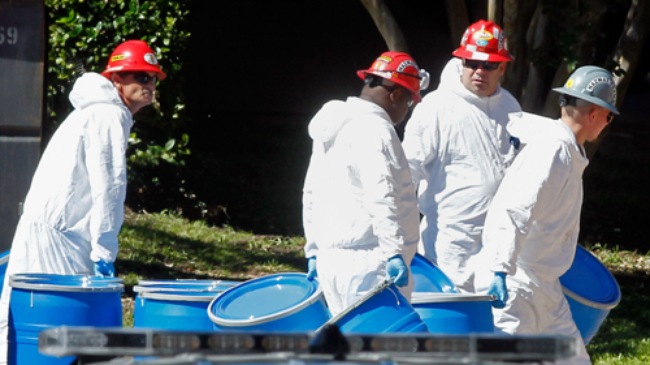
Environmental workers prepare to disinfect the apartment where a second female nurse infected with Ebola lived in Bend East, Dallas, Texas, on October 15.
The worst part is that each strain of the virus requires its own specific vaccine. For example, for a long time there were vaccines against Ebola-Zaire and Ebola-Sudan viruses. But these vaccines were only successful against the strains they created. That is, the Ebola-Zaire vaccine was ineffective against all other cases of Ebola fever.
A combined vaccine is needed. Experts around the world are now working to develop such a vaccine. Progress has been made, but widespread use will likely take another six months or a year.
A few days ago, China decided to send West African nations the experimental JK-05 vaccine, developed at the Chinese Academy of Military Medical Sciences for the Chinese military's emergency needs. And now doctors are preparing to test the vaccine on themselves in case of an Ebola infection threat. However, the vaccine is not yet widely available because it has not been licensed.
The problem is that the initial symptoms of Ebola are similar to those of the flu or a common cold – patients feel weak, have a fever, and a sore throat. And within a few days, vomiting, diarrhea, a rash, and internal and external bleeding develop. When these symptoms appear, the disease is easily diagnosed and the patient isolated, but this early stage is often overlooked.
According to the WHO, if the world fails to contain the Ebola outbreak, approximately 10,000 people could be infected each week.
According to Petrotimes.vn