
The "warriors" in the Battle of Bo Dang
(Baonghean) - The story goes that in the spring of 1424, following the advice of Nguyen Chich - a talented general of Le Loi, the Lam Son rebels organized a march from their base in Lam Son (Thanh Hoa) through the forest into Nghe An to capture the Bo Dang fort, marking the beginning of the campaign to attack Nghe An citadel. From there, they expanded their attack northward, defeating the invading Ming army and liberating the country.
(Baonghean) - The story goes that in the spring of 1424, following the advice of Nguyen Chich - a talented general of Le Loi, the Lam Son rebels organized a march from their base in Lam Son (Thanh Hoa) through the forest into Nghe An to capture the Bo Dang fort, marking the beginning of the campaign to attack Nghe An citadel. From there, they expanded their attack northward, defeating the invading Ming army and liberating the country.
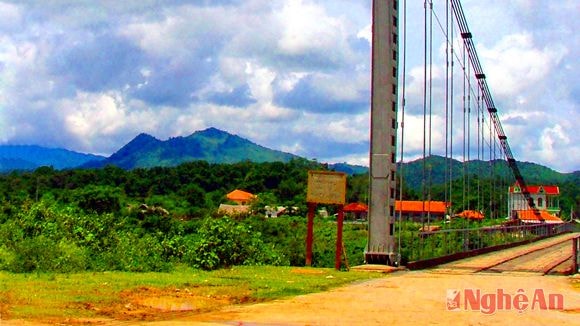 |
| Bo Dang Mountain as seen from Chau Tien - Quy Chau. |
Bo Dang Fort – now located in Chau Hoi commune (Quy Chau district) – was a strategically important base for the Ming army under the command of Tran Trung, a notoriously cunning and arrogant general. The fort was situated on a high mountain with a complex layout, relying on the rugged terrain for support and reinforcement from multiple camps. The steep slopes of the mountain provided ideal conditions for using catapults – a type of device used to launch and propel large rocks – to destroy and hinder the advance of any Ming army attacking the forts.
With the wholehearted support of the people of the ethnic groups in the Chau Nga - Chau Hoi (Quy Chau) region, who accurately provided information on the strategic locations where the Ming invaders had set up defensive stone fortifications, the Lam Son army, under the direct command of Le Loi, received support from the local people in the form of hundreds of goats – animals very skilled at climbing mountains. Thanks to thorough reconnaissance, before entering the battle, the army secretly tied beeswax candles to the horns of the goats. Taking advantage of the darkness and thick fog, the army lit the candles and drove the herd of goats up the mountain amidst a cacophony of shouts and cheers. The Ming invaders on the hill, seeing the flickering lights in the night fog and accompanied by the incessant sounds of trumpets, gongs, and drums, mistook the enemy for an attack on their fort and immediately activated their rock-rolling traps to counterattack. Hundreds of boulders were hurled down to destroy and hinder the advance of the Vietnamese army. One after another, rocks cascaded down like a waterfall, but being clever and agile animals, skilled at climbing and jumping on cliffs, the "goat warriors" carrying fire advanced towards the Ming army's camp, tricking the Ming soldiers. In their panic, they threw all their stored large piles of rocks to stop the goats. However, they could not stop the goats, excitedly acting as "warriors" carrying fire, leaping across the cliffs, creating a fiery encirclement around the Bo Dang fortress.
Upon hearing the sound of the Ming army's stones rolling down, knowing these were the last stones, the Lam Son rebels finally deployed their main force to attack and destroy the Bo Dang fort. At this point, the enemy's stone-throwing weapons were ineffective, and our troops surged forward, swiftly striking the center of the Bo Dang fort, killing General Tran Trung, and annihilating the entire Ming army stationed there… creating a "Thunderous Battle of Bo Dang," followed by the devastating attack on the Ming army in the "Tra Lan region (Con Cuong, Nghe An) where bamboo was shattered and ashes flew," an event that will resonate for generations to come.
Even today in Bo Dang, at the foot of the once-fortified Ming army's encampments, there remain countless rows of boulders that the Ming army used for defense during that battle. These silent, moss-covered boulders stand as a testament to history, marking a strategically important and arrogant high point for the Ming army. With the unwavering support of the ethnic minority people of Nghe An province, the ingenious strategies of the resistance fighters, and the contribution of the docile goats—brought into battle as "warriors"—these powerful defensive weapons of the Ming army were neutralized, leading to a resounding victory that marked the beginning of further triumphs in the Lam Son resistance against the Ming invaders.
Le Ba Duong