
A new document about Duke Doan Bui The Dat
(Baonghean) - Duke Doan Bui The Dat was a renowned military general from Dien Ngoc, Dien Chau, famous in Vietnamese history in the 18th century. Throughout his military career, he was almost undefeated, becoming one of the main pillars of the Le-Trinh feudal state. With his glorious victories, he was one of the three generals whose names were inscribed on the banner of the Royal Court and was considered by historian Phan Huy Chu to be "a famous general of Hoan Chau in recent times."
(Baonghean) - Duke Doan Bui The Dat was a renowned military general from Dien Ngoc, Dien Chau, famous in Vietnamese history in the 18th century. Throughout his military career, he was almost undefeated, becoming one of the main pillars of the Le-Trinh feudal state. With his glorious victories, he was one of the three generals whose names were inscribed on the banner of the Royal Court and was considered by historian Phan Huy Chu to be "a famous general of Hoan Chau in recent times."
Regarding the works of Duke Đoan, Bùi Thế Đạt, to date we only know of the "Giáp Ngọ niên bình Nam đồ" (Map of the Southern Pacification in the Year of the Horse), which contains records about "Bãi Cát Vàng" (Golden Sandbanks), referring to the Hoàng Sa and Trường Sa archipelagos today. No other works or information have been discovered. During a field trip to Phù Bài commune, Phú Vang district, Thừa Thiên Huế province, we were fortunate to access a document related to administrative activities, specifically the issue of taxation in Thuận Hoá - Quảng Nam after this region came under the control of the Lê-Trịnh government, and the country was no longer divided by "Đàng Trong - Đàng Ngoài".
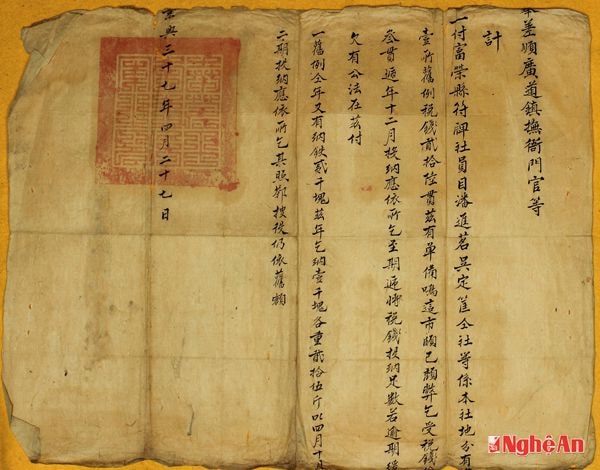 |
| Document granting tax exemptions and reductions to Phu Bai commune. |
The document in question is a document approving a tax reduction for Phu Bai commune, Phu Vang district, Thuan Hoa province. The content is as follows: “To the entire Phu Bai commune, Phu Vang district: In the commune's territory there is a market, and the old tax was 26 quan. Now, a petition has been submitted stating that the market is in a state of disrepair, so we request a tax reduction to 13 quan, to be paid in the twelfth month of each year. This request is hereby approved. According to the old custom, two thousand cubic meters of iron must also be paid annually. This year, we request to pay one thousand cubic meters, with two payment deadlines in April and October. We approve all the requests.” At the end of the document is the date: “April 27th, 37th year of Canh Hung (1776)”. Most notably, the seal stamped on the document reads: “Seal of the Grand General of the Southern Pacification Army”. Based on this, we can conclude that the person who granted tax exemptions to the people of Phù Bài commune at that time was Duke Đoan, Bùi Thế Đạt.
After 1775, upon taking over Phu Xuan, the capital of Dang Trong (Southern Vietnam), Duke Doan Bui The Dat was the first governor there. Notably, in early 1776, following the death of Duke Viep Hoang Ngu Phuc, he was promoted to General of the Southern Army, concurrently serving as governor of Thuan Hoa, and given the authority to make decisions on all matters. Besides ensuring the defense and defeating any invading forces in Phu Xuan, he also had to organize and establish the administrative apparatus. This was a very difficult task because Dang Trong, after more than 200 years of separation from Dai Viet, had become an independent nation. Particularly during the late reign of Lord Nguyen Phuc Khoat, Dang Trong had a cumbersome and burdensome tax system, with officials overcharging and forcing the people to pay more than stipulated.
In 1741, Lord Nguyen Phuc Khoat ordered the collection of taxes from even those who had fled, and in 1765, another order was issued to collect the outstanding taxes from the previous ten years. During the reign of Truong Phuc Loan, the people of Dang Trong suffered even more severe exploitation. Their lives were extremely miserable. Therefore, after taking control of this land, Duke Doan Bui The Dat implemented several economic reforms, especially loosening taxes for the people. The document above clearly records the reduction of taxes and the halving of the tax payment deadline for the people of Phu Bai commune. This demonstrates Duke Doan Bui The Dat's love for his people and his foresight.
Although these documents are not numerous, they are very significant in supplementing information about the life and career of a famous historical figure like Duke Doan Bui The Dat, helping to clarify his background and providing a clearer understanding of the administrative structure of the Dang Ngoai government in Thuan Hoa at that time.
Tu Quang