
7 times the capital city was liberated in the nation's history.
Throughout its thousand-year history, the capital city of Thang Long - Hanoi has been liberated from foreign occupation seven times.
Throughout its thousand-year history, the capital city of Thang Long - Hanoi has been liberated from foreign occupation seven times.
1. The first war against the Yuan-Mongol army (1258)
In late September 1257, after failing to persuade King Tran to surrender, the Mongols invaded Dai Viet. Upon receiving the urgent news, King Tran immediately led his army to fight the invaders.
The first major clash took place at Binh Le Nguyen on December 12th. The enemy was too strong, and realizing the war could not be prolonged, the Tran army proactively retreated to Phu Lo. On January 18th, 1258, the Mongol army attacked Phu Lo. The Tran army once again retreated, simultaneously evacuating residents and property from Thang Long citadel. On January 21st, 1258, 8,000 Mongol troops overran and occupied Thang Long.
What the invaders saw was an empty capital city. Lacking food, the Mongol army resorted to plundering the outskirts, but they found little to no loot and were frequently ambushed.
On the night of January 28, 1258, the Tran army launched a surprise counterattack. The Mongol army, overconfident and unprepared, suffered a crushing defeat at Dong Bo Dau. Outnumbered, the invaders abandoned Thang Long on January 29 and fled straight to Yunnan. The Tran dynasty achieved a great victory.
2. The Second War against the Yuan-Mongol Army (1285)
In 1271, the Mongols established the Yuan Dynasty in Chinese territory. To serve Emperor Kublai Khan's ambitions of territorial expansion, on January 27, 1285, 500,000 Yuan troops launched a massive invasion of Dai Viet (Vietnam).
With overwhelming force, the invaders repeatedly pushed back the Tran army on various battlefields and by mid-February 1285 had approached the capital Thang Long.
On February 17th, the two armies clashed fiercely on the banks of the Red River. The Tran army fought while simultaneously evacuating people from Thang Long. When the capital was empty, the Tran army retreated. The Yuan army captured Thang Long on February 19th.
After fierce battles to hold back the enemy, the Tran army counterattacked from May 1285, with major victories at Ham Tu - Tay Ket and Chuong Duong Do. Building on these successes, the Tran army decided to attack and liberate the capital city of Thang Long.
Faced with the fierce attack of the Vietnamese, the Yuan army had to retreat from Thang Long citadel to the north bank of the Red River. On June 9, 1285, Thang Long citadel was liberated.
On June 10, 1285, 20,000 Đại Việt troops attacked the Yuan army on the north bank of the Red River. The Yuan army suffered a crushing defeat and had to retreat northward.
3. The Third War Against the Yuan-Mongol Army (1288)
After his failed conquest of Dai Viet in 1285, Emperor Kublai Khan did not abandon his plan to conquer Dai Viet. Almost immediately, a plan for a renewed conquest was put into action. In December 1287, under the pretext of bringing Tran Ich Tac back to the country to be established as King of An Nam, hundreds of thousands of Mongol troops advanced into Dai Viet by sea and land.
Following the Battle of Vạn Kiếp and numerous clashes in the Northwest region, the Yuan army approached Thăng Long. On February 2, 1288, the Yuan army, led by Thoát Hoan, began its assault on the citadel. After several days of resistance, the Trần army withdrew from the citadel.
The Yuan army captured the city, but, as before, they could not find food for their troops. Meanwhile, the Dai Viet army counterattacked and controlled the Hai Duong and Hai Phong regions, putting Thoat Hoan in danger of having his route back to Van Kiep cut off. Faced with this situation, Thoat Hoan abandoned Thang Long and returned to Van Kiep.
At Vạn Kiếp, due to dwindling supplies and frequent attacks by the Trần army, Thoát Hoan decided to withdraw his troops from Đại Việt at the end of March 1288. Along with Thoát Hoan's land army, the Yuan navy, commanded by Ô Mã Nhi and Phàn Tiếp, also retreated and was annihilated by the Trần army at Bạch Đằng estuary.
4. The War Against the Ming Army (1428)
In 1406, the Ming Dynasty launched an attack on the Ho Dynasty. Due to unpopularity, the Ho Dynasty collapsed and lost the country to the Northerners. Thang Long Citadel was captured in January 1407 and renamed Dong Quan. Following the defeat of the Ho Dynasty, many rebellions against the Ming took place, but were all brutally suppressed.
By 1418, the Lam Son Uprising, led by Le Loi, had broken out. After a period of activity in the mountainous region of Thanh Hoa (1418-1423) and advancing south (1424-1425), the rebel army grew stronger and began the liberation of Dong Quan from 1426.
The rebel army achieved glorious victories at Tot Dong - Chuc Dong (1426) and Chi Lang - Xuong Giang (1427), forcing the Ming to negotiate peace and withdraw their troops. On January 3, 1428, Dong Quan was liberated. Vietnam was no longer under the control of any invading army.
After the resistance war, Nguyen Trai, a leader of the uprising, wrote the "Proclamation of Victory over the Wu" to announce to the entire population the glorious victory of the Lam Son rebel army.
5. The War Against the Qing Army (1788)
In July 1788, at the plea for help from Le Chieu Thong, Emperor Qianlong of the Qing dynasty seized the opportunity to send Sun Shiyi with over 200,000 troops, divided into three divisions, to advance towards Dai Viet under the pretext of supporting the Le dynasty.
With limited forces in the North, the Tay Son army could not stop the advance of the Qing army. On December 17, 1788, the Qing army captured Thang Long citadel. On December 22, Ton Si Nghi held a ceremony to confer the title of Le Chieu Thong at Kinh Thien Palace.
Also on December 22nd, Nguyen Hue ascended the throne as Emperor in Phu Xuan (Hue), taking the regnal name Quang Trung, and ordered a swift military campaign northward. In just over a month, Quang Trung's army had reached near Thang Long citadel.
On the 30th day of the 12th lunar month (January 25, 1789), Emperor Quang Trung allowed his troops to celebrate Tet (Lunar New Year) before ordering the advance. The general offensive began on the night of the 30th of Tet. In just six days, the Tay Son army captured nearly 10 forts and surrounded Ngoc Hoi fort – the main headquarters of the Qing army. Faced with the overwhelming strength of the Tay Son army, Ngoc Hoi fort quickly fell.
On the afternoon of the 5th day of the Lunar New Year, Emperor Quang Trung entered Thang Long amidst the welcoming cheers of the people, marking the complete collapse of the Qing army on the land of Dai Viet.
6. The August 1945 Revolution
In 1858, the French colonialists launched an invasion of Vietnam, beginning an unequal war with the Nguyen dynasty. During this war, Hanoi was occupied by French forces on November 20, 1873. By 1884, the French had conquered the entire territory of Vietnam and established a colonial administration.
Under French colonial rule, the Vietnamese national liberation movement erupted. Numerous uprisings were launched, but all were brutally suppressed by the French colonialists and ultimately failed.
From the 1930s, with the establishment of the Indochinese Communist Party and the Viet Minh, the Vietnamese national liberation movement took a major turn. Amidst the international upheavals following World War II, the Viet Minh and the Communist Party organized the August Revolution, beginning with the Hanoi Uprising on August 19, 1945, and gradually spreading throughout the three regions and the entire country.
On September 2, 1945, President Ho Chi Minh read the Declaration of Independence at Ba Dinh Square in Hanoi before a large crowd, officially giving birth to the Democratic Republic of Vietnam. Vietnam regained its independence after nearly 100 years of French rule. Hanoi was once again under Vietnamese control.
7. Liberation of the Capital City, October 10, 1954
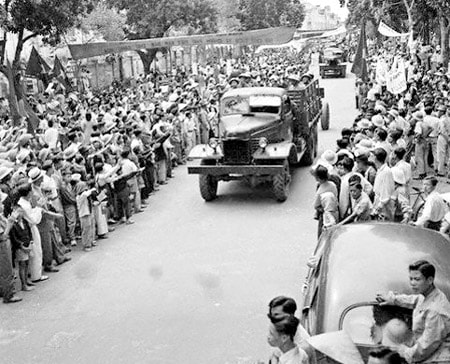 |
| Viet Minh troops took over the capital on October 10, 1954. Archival photo. |
After the revolution, the French colonialists, under the guise of the Allied forces, returned to invade Indochina. Following a series of provocations and armed attacks, on December 19, 1946, the French army recaptured Hanoi. The resistance war against the French by the Vietnamese army and people began.
Over nine years, under the leadership of the Viet Minh, the war ended with the victory at Dien Bien Phu on May 7, 1954. Following this historic victory, the Geneva Accords on a ceasefire in Indochina were signed.
The agreements on the transfer of Hanoi were signed on September 30, 1954, and October 2, 1954, at the Central Joint Armistice Committee. Subsequently, the Viet Minh government dispatched police, security, and administrative teams to Hanoi to prepare for the takeover of the city.
On October 10, 1954, Hanoi was liberated from enemy forces, joyfully welcoming the victorious sons and daughters returning to take over. This event marked a turning point of immense significance, ushering in a new and glorious era in the thousand-year history of the capital city.
Source of Knowledge