

The 2011 Platform of the Communist Party of Vietnam in line with the trends of the times.
Since its founding in 1930, for nearly three-quarters of a century, our Party has successfully led the Vietnamese revolution with three political platforms. Each platform has played a crucial historical role in the destiny of our nation.
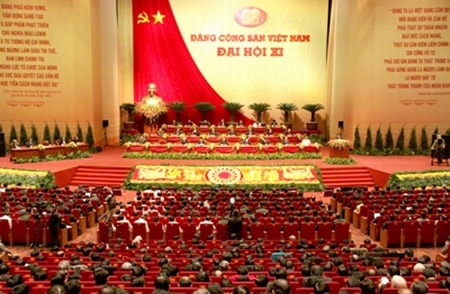 |
| The 11th National Congress of the Communist Party of Vietnam. Photo: Chinhphu.vn |
The Party's first platform, drafted by President Ho Chi Minh, was the "Brief Political Program and Brief Strategy," adopted by the Party's founding conference on February 3, 1930. Subsequently, the first meeting of the Central Executive Committee in Hong Kong inherited these two documents, forming the "Party's Political Thesis" in October 1930.
Implementing the Political Platform and Manifesto of 1930, under the leadership of the Communist Party of Vietnam, our nation successfully carried out the August Revolution of 1945, regaining national independence and sovereignty, establishing the Democratic Republic of Vietnam (now the Socialist Republic of Vietnam), opening a new era for our nation - an era of national independence linked to a political system where the people are the masters of the State and society. Subsequently, under the leadership of the Party, our people defeated the wars of aggression waged by the most brutal imperialist powers of the era, protecting independence, freedom, and national unity.
After the reunification of the country, with the nation united under one banner, the entire nation embarked on the path to socialism. Under the leadership of the Party, our people once again overcame a grave challenge. The old model of building socialism collapsed at the heart of the socialist system. The political regimes in the Soviet Union and the socialist countries of Eastern Europe collapsed (1989-1991). As an underdeveloped nation, having just gone through 30 years of war and facing a US embargo, our Party creatively applied and developed Marxism-Leninism and Ho Chi Minh Thought, implementing the reform process that began at the Sixth Congress in 1986. At the Seventh Congress, for the first time, our Party put forward a program for building the country in peacetime. This was the "Program for Building the Country in the Transition Period to Socialism" in 1991. This was the Party's second program.
In implementing the Second Platform, the Party and the people of Vietnam, on the one hand, steadfastly pursued the goals and principles of socialism, and on the other hand, transformed the model of national construction from the old model with a "proletarian dictatorship" and a "centralized, bureaucratic, and subsidized planned economy" to a new model of socialism. Regarding the political system, it is a system where "the working people are the masters"; regarding the economy, it is a "multi-sector commodity economy"... At the 11th National Congress in 2011, the Party once again adjusted the 1991 Platform. The Platform for National Construction during the Transition Period to Socialism (supplemented and developed in 2011) is the third Platform of the Party. The 2011 Platform of the Communist Party of Vietnam not only continues to affirm the socialist path but also incorporates new content in line with the major trends of the times. The Political Platform outlines the trend of "peace, national independence, democracy, cooperation, and development," while also highlighting the intense challenges currently facing the world and the region. These include "...local wars, armed conflicts,... intervention, subversion, terrorism, territorial disputes, disputes over seas, islands, resources, and fierce competition for economic interests."
Recently, on some social media platforms, individuals, and even groups in various forms, have been using statements from "independent" organizations (organizations not authorized by the government) to write "open letters" to Party and State leaders, criticizing and even distorting the Party's platform and policies. They claim that: "Nearly 30 years of reform... still maintain a totalitarian one-party system that stifles freedom, democracy, and divides the nation." They "propose" "changing the Party's platform, abandoning the erroneous path of building socialism, and completely shifting to a national and democratic path, with the focus on transforming the political system from totalitarianism to democracy..."
So, what are the theoretical and practical implications of these proposals? And if we follow the path proposed by some, what will become of our social system, revolutionary achievements, national independence, national sovereignty, and territorial integrity?
First of all, in theory and practice, the "proposals" put forward by some people are nothing new and are not unfamiliar to the reality of our people's reform efforts over the past 30 years. It cannot be denied that, for many years, our society has faced many unresolved economic and social problems, such as the persistent and unchecked widening gap between rich and poor. The lives of a segment of the population, especially those in remote areas and workers in many industrial zones, remain difficult; the decline in ideology, politics, morality, and lifestyle among some cadres and Party members at all levels has led to a decline in public trust. This has been openly and frankly acknowledged by our Party, which has proposed solutions to address it in Resolution No. 4 of the 11th Central Committee Conference.
However, if someone claims that the current regime is a "one-party totalitarian system that stifles freedom, democracy, and divides the nation" and proposes "changing the Party Platform and abandoning the erroneous path of building socialism," then they are not only distorting history but also making a serious ideological and political mistake. As everyone knows, the reason Vietnam has survived the collapse of the Soviet Union, the US embargo, and the improvement of the lives of the vast majority of the people, and the preservation of national sovereignty, is thanks to the correct political line of our Party.
From an ideological and political standpoint, the calls by some to change the Party Platform mean abandoning the goal of building Vietnam into a society that is "...prosperous, strong, democratic, just, and civilized"; it means abolishing the social system where "the people are the masters" with a "rule of law state of the people, by the people, and for the people" (Partnership Platform 2011). Furthermore, this also means abolishing both human rights and civil rights recognized in the 2011 Platform, especially those stipulated in Chapter II of the 2013 Constitution.
Economically, calling for the abolition of the Party's Platform also means abolishing: "The socialist-oriented market economy with multiple forms of ownership, multiple economic sectors, forms of business organization, and forms of distribution...". According to the general understanding of the international community, Vietnam's current economy is a "market economy," especially since Vietnam became a member of the WTO.
Regarding foreign policy and defense, calling for the abolition of the Party Platform also means abolishing the foreign policy of "Independent, self-reliant, peaceful, cooperative and developmental; multilateralization and diversification of relations, proactive and active international integration..."; and abolishing the defense policy of "Firmly protecting the independence, sovereignty, unity and territorial integrity of the Fatherland" as defined in the 2011 Platform.
Secondly, if we follow the path suggested by some: "Completely shifting to a nationalist and democratic path, with the focus on transforming the political system from totalitarianism to democracy"... what would the scenario and consequences be?
Many models of political institutional transitions from "dictatorship" to "democracy" have been and are taking place in South Asia, the Middle East, and North Africa. However, behind these changes lies a pre-planned "scenario" devised by Western powers with the intention of seizing geopolitical power and non-renewable resources, especially oil. In reality, no transition model has come without a price: violence and seemingly endless instability. The transition from a "socialist" system to a capitalist one, as seen in the Soviet Union and Eastern European socialist countries, also suffered negative consequences.
Objectively speaking, if Vietnam were to change its political system, abolish its "Program," and follow the socialist path, it would undergo a political transformation modeled after the Soviet Union's reforms, with the sweet rhetoric of "reforms to achieve more socialism." Of course, for Vietnam, there are still other potential risks and dangers, which are a historical and topical issue.
Following the collapse of the Soviet Union, the research paper "Lessons from the Collapse of the Communist Party of the Soviet Union" (published in Nhan Dan Newspaper) revealed that one of the causes of the collapse was the moral and lifestyle degradation of the Party's cadres and members, leading to ideological and political decline.
Anyone who believes that only a change in political regime can protect national independence, sovereignty, and territorial integrity is harboring a naive illusion. Since becoming the leading force in building and defending the country, the Communist Party of Vietnam has experienced relations with almost all major powers. To think that the Communist Party of Vietnam remains dogmatic about ideology and naive in the face of diplomatic rhetoric from major powers is a mistake. Vietnam believes that "partnership" and "adversary" relationships are interchangeable. It is necessary to prioritize national interests and consider the political regime to filter fundamental international relations and specific cooperative relationships. Of course, the political thinking of the Communist Party of Vietnam is constantly being refined based on recent political events.
The leaders of our Party have repeatedly affirmed that we will protect national independence, national sovereignty, and territorial integrity by all possible means, in accordance with international law. Vietnam does not rule out any political, economic, or military relations with other countries if they benefit the cause of national construction and defense.
Thus, the Communist Party of Vietnam, with its 2011 Platform, is the only political force that possesses all the necessary ideological and political conditions; the ability to unite the nation and the international community; and the strategic thinking capacity to build and defend the Fatherland, and protect the revolutionary achievements of our Party and people.
According to the People's Army Newspaper