"The more I love folk songs..."
(Baonghean) - During his lifetime, President Ho Chi Minh dedicated his entire life to serving the people and the country. Before his passing, he had only one wish: to hear a folk song or melody carry the essence of folk music into his immortal realm. This simple wish of his left a profound lesson for future generations: "To love one's homeland, one must cherish the folk songs even more."
(Baonghean) - During his lifetime, President Ho Chi Minh dedicated his entire life to serving the people and the country. Before his passing, he had only one wish: to hear a folk song or melody carry the essence of folk music into his immortal realm. This simple wish of his left a profound lesson for future generations: "To love one's homeland, one must cherish the folk songs even more."
folk songs inthe heart of God
Amidst the days when the whole province and the whole country were focusing on Nghe An, on the ceremony honoring the Vi and Giam folk songs as an Intangible Cultural Heritage of Humanity, we sought out artist Song Thao – who was fortunate enough to meet President Ho Chi Minh three times and had the honor of singing for him twice. In her small house in Thanh Vinh on a chilly day, she recounted with deep emotion: In December 1961, the second time President Ho Chi Minh visited his hometown, the Nghe An Performing Arts Troupe was practicing when they received a directive from the Provincial Party Committee; the troupe was honored to perform for him. The whole troupe cheered with joy and excitement.
On the day of the performance, I was very nervous, practicing so much I forgot to eat and sleep, but I still wasn't confident. Around 6 PM, the performing arts troupe arrived at the Provincial Armed Police headquarters to prepare. At exactly 7 PM, a car horn sounded. "Uncle Ho has arrived!" a member of the troupe shouted, and the whole group held their breath backstage, staring intently at the entrance. Unexpectedly, in an instant, President Ho Chi Minh was standing right beside the troupe. He raised his hand in greeting, inquired about each person's health, and instructed them to perform well… His kind gesture calmed the anxieties and nervousness of the entire troupe.
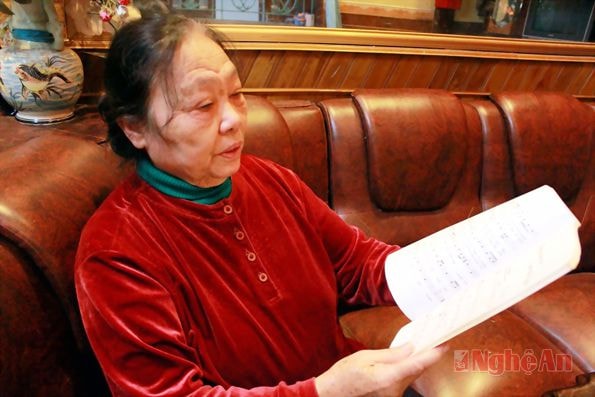 |
| Meritorious Artist Song Thao. |
Throughout the entire program, the folk songs could be considered the "soul" of the performance, placed in the middle to allow time for preparation. Meritorious Artist Song Thao still remembers that performance very clearly: "Stepping onto the stage, I tried to regain my composure and self-control. I looked at Uncle Ho, then at the audience, feeling immense encouragement. I began to sing, seemingly immersed in the melody, and tried to see Uncle Ho more clearly: 'Oh, my dear... a hundred years of shattered stones and fading gold, burning a temple is not a sin as great as breaking a vow/ Oh... oh... when will Hong Linh be without trees/ And when will the Lam River run dry, then this and that will be without love...!'"
The folk song performance by the woman and the other artists deeply moved President Ho Chi Minh. He wiped away tears with his handkerchief as the singing evoked memories of his childhood. He said to Mr. Nguyen Sy Que, then Secretary of the Nghe An Provincial Party Committee: “You should praise these children for singing folk songs, because in the past, people only sang them in their yards, in the fields, or on the river. Now, you have boldly brought them to the stage, and you sing them with emotion and meaning, beautifully and creatively.” He quickly stepped closer to the stage, held up a wicker basket, and smiled: “You performed well, I'll reward you with candy. Do you like candy?” The whole group responded in unison: “Yes, Uncle Ho!” Everyone happily accepted the small but meaningful gift from the beloved father of the nation.
The next two occasions were in 1965, when Meritorious Artist Song Thao participated in the Northern Vietnam Music and Dance Festival, performed for President Ho Chi Minh at the Presidential Palace, and attended an exhibition with him in the Trang Tien area. This time, meeting President Ho Chi Minh right where he lived and worked was incredibly joyful. Meritorious Artist Song Thao always remembered President Ho Chi Minh's advice: "You children sing folk songs with ancient lyrics, you must understand the feelings of our ancestors and grandparents..." Just that alone made many hearts in the troupe flutter, and many tears of joy and gratitude welled up.
In 1969, she and her troupe went to Hanoi to rehearse a program for an overseas cultural exchange when she received news of President Ho Chi Minh's death. At that time, the song "Looking at the Trees, I Remember Him," adapted by composer Do Nhuan from the Nghe Tinh folk song "Anger and Love," was completed and they were looking for someone to sing it. Composer Do Nhuan met Song Thao, and the two had 15 minutes to practice before recording and broadcasting it on the Voice of Vietnam radio station. During those days of sorrow, the song, performed by Song Thao, resonated with the tears of millions of Vietnamese people… "The song may not have been technically perfect, but it resonated with all the longing, respect, and love I felt for President Ho Chi Minh," she said.
Meritorious Artist Song Thao shared: During his lifetime, President Ho Chi Minh not only loved life, freedom, and harmony with nature, but also had a deep affection for folk songs. Folk songs are the soul of the nation, carrying within them the image of the homeland, created by the working people for generations. This simple yet profound wish of his has been partially realized, as the folk songs of Nghe Tinh (Vi and Giam) always hold an important place in contemporary music and have been honored by UNESCO as a representative intangible cultural heritage of humanity.
They met through folk songs and melodies...
What particularly impressed me about this folk music club of the "village artists" was that it was organized like a real "band." There were singers, musicians, lyricists, arrangers… The glue that connected these villagers was their endless passion for folk songs and melodies.
Mr. Nguyen Dinh Ky, Chairman of the Tan Son Folk Song Club (Do Luong), recounted: "Previously, in the 1980s, the cultural and artistic movement in Tan Son was very strong. At that time, young men and women in the village were passionate about the movement. They formed a traveling art troupe, performing everywhere in the village and beyond. Later, the traveling troupe disbanded. Naturally, those who shared a love for folk songs and melodies formed a folk song club. And they became the core members of the folk song club until now."
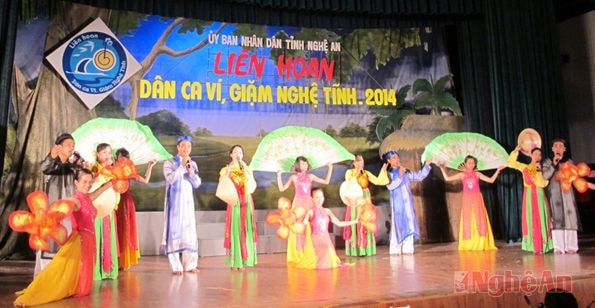 |
| The Tan Son Commune Folk Song Club participated in the Nghe Tinh Folk Song Festival in 2014. |
Starting with just seven members, and to spread the love of folk singing, the Tan Son Folk Song Club proactively collaborated with various organizations to develop performance programs for celebrations, conferences, and schools. Over time, the club has attracted more and more members. Today, the club has over 20 members from diverse professions, including commune officials, teachers, students, and farmers. Each member is assigned a role within this "village band."
Mr. Nguyen Dinh Ky is both the lead male vocalist and lyricist for the club's performances. He is always concerned about how to preserve the traditional beauty of his homeland. For him, "the deeper you delve into understanding, the more you 'discover' and appreciate the beauty and charm of the lyrics and melodies." Therefore, in addition to diligently collecting ancient folk songs, Mr. Ky also devotes much effort to writing new lyrics based on the melodies of the Ví Giặm folk songs. Whether praising his homeland and country, or promoting drug prevention and combating domestic violence, the lyrics he composes are always rich in meaning, contain profound philosophy, and are easy to remember and relatable to the local people.
We saw in the eyes of those simple, honest farmers an extraordinary passion for the folk songs of the Ví and Giặm genres. Only passion could make them cast aside the hardships and fatigue of working in the fields to practice night after night; only passion could motivate them to set aside their family responsibilities and worries to travel with the club to participate in competitions, performances, and festivals at the district and provincial levels…
The club also attracted village teachers to participate. Ms. Nguyen Thi Bich Thuy (a teacher at Tan Son Primary School) is in charge of staging the club's programs and performances. Having a passion for singing and enthusiasm for arts and culture, she was drawn into the movement after hearing and watching the club perform a few times. Always striving to create and innovate the performances, Ms. Thuy has independently collected folk singing and performing arts, transforming them into acts suitable for each event the club participates in. Ms. Thuy also volunteers to handle the costumes and makeup for each member during the performances.
As a shared "spiritual child," each member consciously and voluntarily contributes to equipping the club with musical instruments: from drums, stringed instruments, and flutes to props for performances... Along with a well-organized structure, each member is enthusiastic and passionate about the movement, so the Tan Son Club has won many awards in various festivals: In 2012, it won the A prize at the Provincial Folk Song Festival with the group performance "The Love Song of the Village"; and the B prize at the Provincial Folk Song Festival in 2014 with the performance "Mother's Love, Homeland Love"...
A destined encounterthe artist
Although he is over seventy years old, the charisma and elegance of Meritorious Artist Dinh Bao remain as intact as ever. This is similar to his love for the folk songs of the Ví and Giặm genres, even though he has been away from the stage for over twenty years…
Those who have seen his performances as Cu Phi in "Not Me" or Giao in "Our Homeland's Rice Grain" will surely never forget his simple, natural acting style and emotionally charged singing voice. His love for artist Pham Thi Lan also began on the stage of the Nghe An Folk Song Troupe. The young couple's possessions in the early 1970s were very modest. Their greatest wealth at that time was perhaps their youth, their love, and their burning desire to bring the folk song genre of Vi and Giam from the folk tradition to the stage. That was also when the people of Vinh City and across the country began to know Vi and Giam folk songs through memorable performances such as "Mai Thuc Loan," "The Girl of the Lam River," "The Soul of the Stone," and "The Love Story of the Young King"...
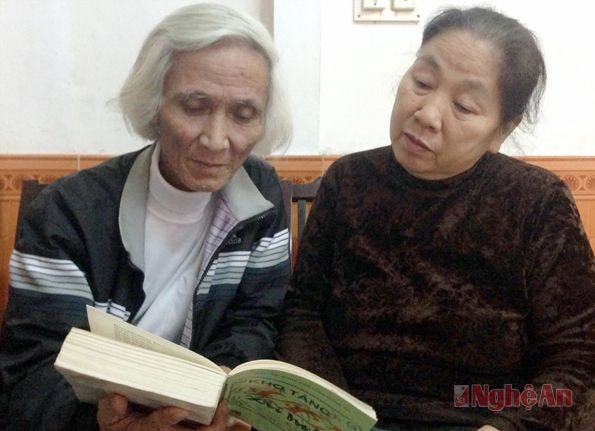 |
| Meritorious Artist Dinh Bao and his wife. |
To create those performances, he himself had to endure many hardships. And what artist Dinh Bao and his colleagues such as Song Thao, Xuan Nam, Thanh Luu, Nam Trung, Linh Quang… can never forget are the days spent traveling throughout the two provinces of Nghe An and Ha Tinh to collect folk songs and melodies. At dawn, he would grab his old bicycle, loaded with all sorts of goods, from green tea to rice… and travel through the countryside to collect folk songs. The period when the group spent the most time collecting was in 1973-1974, with some trips to the countryside lasting for many months.
The greatest achievement from those trips was the recording of most of the folk songs of Nghe An province that were still preserved in folk traditions, which were later published in many valuable books. Artist Dinh Bao affirmed: If the work of collecting and preserving had not been emphasized back then, it would be difficult to have the folk songs of Nghe An recognized as an intangible cultural heritage of humanity today, because folk songs must originate from the people and breathe the life of the people of Nghe An. Simply put, while they are all folk songs, in places where silkworms and weavers are called "folk songs of the weaving quarter," in places where conical hats are made, they are called "folk songs of the hat-making quarter," and in places near rivers and waterways, they are called "clam songs"...
Artist Dinh Bao also has his own source of pride: he successfully composed the Tu Hoa melody, one of the three melodies considered "classics" of Nghe Tinh folk theater (along with the "Grief and Love" melody by director Nguyen Trung Phong and the "Khuyen" melody by composer Thanh Luu)... Thirty years have passed since the Tu Hoa melody was officially composed, and it is still frequently used by directors and has become a highlight that creates the appeal of the plays.
Having spent a lifetime as an artist with dozens of stage performances, artist Dinh Bao still considers retirement the greatest blessing of his life. Occasionally, missing his fellow actors and the stage lights, he would retrace his steps along Le Loi Street to the old folk theater to listen to and pass on his experience to the younger generation. He also traveled to Ky Anh, Nghi Xuan (Ha Tinh), Anh Son, Dien Chau, and Quynh Luu to collaborate with local communities in opening classes to teach folk singing and lyric writing… More simply, he would occasionally perform some old excerpts with his wife, also a former colleague… “Oh, who knows whether the waters of the Lam River are clear or muddy? / Then who knows life, whether it is shameful or glorious? / My boat goes up the rapids and down the waterfalls / The land and water are meaning, love… oh dear!”
Pham Ngan -Dinh Nguyet -Song Hoang
| RELATED NEWS |
|---|