

Ngoc Son village will forever be beautiful.
(Baonghean) - Nestled against the majestic Ngoc Mountain, nurtured and embraced by the Lam and Gang rivers, Ngoc Son village (Ngoc Son commune, Thanh Chuong district) is a place where the spiritual energy of heaven and earth converges, forming the soul of a region famous for its rich cultural heritage forged since ancient times. Located at the foot of Ngoc Mountain (Ngoc Hill), the village is named Ngoc Son…
Here, mountains and rivers blend harmoniously. Midway up Ngoc Mountain, hidden amidst lush ancient forests, lies the temple of Saint Ba. Legend says that he passed away at the foot of the mountain after returning from battle, and the fishermen buried him and erected a temple in his honor. Over time, due to war and destruction, the temple has been restored, and the people diligently offer incense and prayers. The murmuring stream at Cua Den adds to the mystique of the stories passed down through generations. From the temple's entrance, one can take in the surrounding villages, rivers, and undulating fields. To the left and in front is the Ancestral Tomb, the resting place of the founding ancestors of the Nguyen Canh family – a prominent clan of Nghe An province with 18 dukes, 76 titles and marquises, and many great contributions to the nation's defense and people's well-being during the late Le Dynasty. Notable examples include: Phuc Khanh Duke Nguyen Canh Huy, Thai Pho Tan Quoc Duke Nguyen Canh Hoan… Ngoc Son village proudly boasts being the birthplace of a distinguished and influential family; in the middle of the village, there is still a branch of the family's ancestral temple.
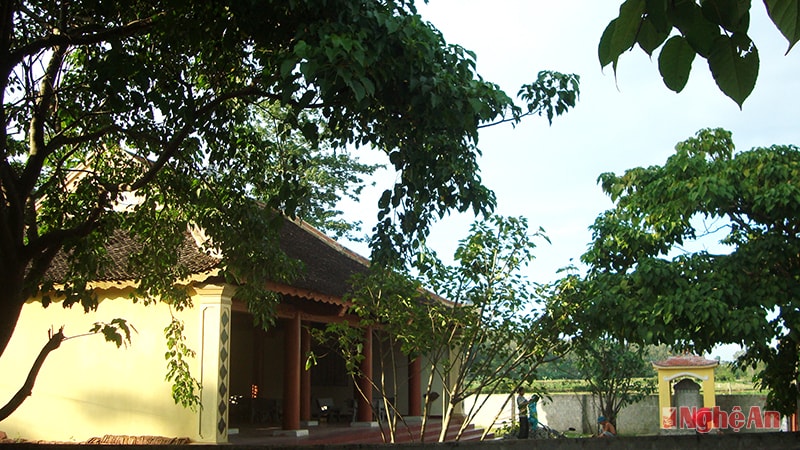 |
| Ngoc Son village communal house (Ngoc Son commune, Thanh Chuong district). |
The old village had three hamlets: Ao, Con, and Nha. Con hamlet was near the riverbank, where two temples once stood close together under the shade of centuries-old banyan and guava trees. The main temple, also known as Ba But Temple, was dedicated to Buddha and stood majestically with its three-tiered platform for offering sacrifices to heaven. The second temple was dedicated to Cao Son and Cao Cac, the supreme kings. During the war, the main temple was dismantled, and the second temple was destroyed by American bombs. The remaining traces of the old temples are a dense garden, the stone bases of the pillars, and a large rock, traditionally believed to be the tomb of a sacred deity. Con hamlet was once called Ban Thach (Stone Table) for this reason.
Next to the Chinese market was the Ngoc Son Inn, consisting of two buildings: upper and lower. The inn was dedicated to Lu Ban – the god of the "craftsman village" – and Fu Xi, the god of agriculture – the god of the farmers. Every year, the "craftsman village" and the "farmer village" held ceremonies to worship the gods, praying for good health, bountiful harvests, and successful careers. Within the inn's grounds, the village erected a stele inscribed with Chinese characters, listing the names of educated people, officials, those with titles, and those who had contributed to the village. During the "popular education" years, children and the elderly flocked here. The inn served as a school for the village. After the war, only the stone stele remained, and the site is now the Ngoc Son commune health station.
Near the market, next to the shops, is Ngoc Son communal house. According to the elders, the communal house was built during the reign of Emperor Tu Duc, dedicated to the village's tutelary deity and serving as a community center. The upper part of the communal house is beautifully carved with intricate patterns by the skilled craftsmen of Ngoc Son. The lower part has three bays and two gables, with "several rows of lim wood columns too large for a person to embrace," all covered with yin-yang tiles. The communal house gate has two majestic pillars, with a mythical creature (Nghê) kneeling at the top. The village communal house has a gong and a large drum, only played during ceremonies. During the revolutionary days, villagers gathered at Ngoc Son communal house to listen to speeches and participate in the seizure of power. During the resistance against the Americans, in 1966-1967, the Le Hong Phong Party School evacuated to the village and used Ngoc Son communal house as its headquarters. The 249th Army Unit also used to be stationed here… After a long period of absence due to bomb damage and the ravages of sun and rain, Ngoc Son Temple was restored to its former glory in early 2013, much to the anticipation of the people. During holidays and festivals, descendants who have left their hometowns can return to light incense in the ancient village temple.
According to 87-year-old Mr. Nguyen Van Xuan, the village used to be prosperous, with many educated and knowledgeable people. The women and girls diligently cultivated rice and corn, and worked hard spinning silkworms and weaving silk. The men and boys were skilled in plowing and plowing, and adept at carpentry; after the harvest season, they would travel far and wide to work. Mr. Xuan's great-grandfather was also one of the craftsmen who contributed to building the village temple. The village's carpentry was not only famous in the region and district, but also spread throughout the province: "The sawsmiths of Nghi Loc, the carpenters of Ngoc Son." During the day, everyone focused on their work. At night, regardless of whether they were young men or women, they would enthusiastically sing folk songs, flirtatious songs, and love songs. The villagers even formed flirtatious song troupes, each usually with a "master of conversation" skilled in classical Chinese or poetry, who would take them to perform in other villages and invite them to sing. On moonlit nights, they would sing all night long, even reaching as far as Nam Dan. The playful banter from years ago, still vividly remembered by the people of Ngoc Son, goes like this: "Girls from Xuan Lieu, going to Lieu market, have faces like flowers and cheeks like willows, as beautiful as fairies / Boys from Ngoc Son, wearing painted hats and painted shoes, look like generals..."
The Lam River has been filled with sediment. The Chinese market has moved further back. The bomb craters on Ngoc Son Mountain have healed thanks to the green of the mountain trees. Despite all the changes, this land still bears the imprint of ancient village traditions, deeply imbued with the spirit of Vietnamese rural life. Visiting Ngoc Son, gazing at the village communal house, listening to folk songs, one feels a deeper love for the land and its people!
Text and photos:Huy Thu