
Minsk Agreement: EU remains vigilant.
(Baonghean) - The Minsk Agreement on the situation in Eastern Ukraine has just been successfully signed, which can be considered good news for the 28 EU member states – a region directly affected by the protracted crisis. However, it seems that Europe is still not very enthusiastic or confident about this agreement.
(Baonghean) - The Minsk Agreement on the situation in Eastern Ukraine has just been successfully signed, which can be considered good news for the 28 EU member states – a region directly affected by the protracted crisis. However, it seems that Europe is still not very enthusiastic or confident about this agreement.
On Thursday, February 12th, European leaders met at an informal summit in Brussels, Belgium. At the summit, French President Francois Hollande and German Chancellor Angela Merkel were seen to be visibly tired, their smiles masking their fatigue, and it seemed they were still quite far from achieving their goals. The meeting took place in a rather subdued atmosphere, even as the Minsk peace agreement initially showed positive signs. Federica Mogherini, the EU's High Representative for Security and Foreign Policy, attempted to reassure the European community by stating, "Good news is always more welcome than bad news."
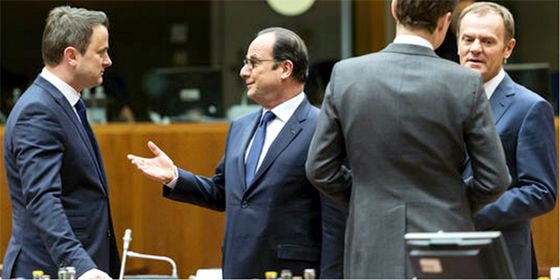 |
| President Francois Hollande (second from left) speaks with Luxembourg Prime Minister Xavier Bettel on Thursday, February 12, in Brussels. Photo: Geert Vanden Wijngaert/AP |
European Council President Donald Tusk stated, "Hope is a good thing, even necessary," but mere hope is not enough. He condemned the "aggression" in eastern Ukraine, calling it "a clear threat to peace," and emphasized the need for coordinated action with the United States. In a recent meeting with US Vice President Joe Biden in Brussels, he didn't even mention the diplomatic efforts of France and Germany. In fact, the European Council President did not rate the achievements of Paris and Berlin alone highly, believing that a collective effort from the whole of Europe is necessary.
On Thursday evening, President Francois Hollande stated: “Despite the risks and shortcomings, at least we have an agreement.” One of the most difficult tasks was convincing Ukrainian President Petro Poroshenko, “but above all, convincing President Putin,” and ensuring that “the contact group with the separatist forces could accept everything we agreed upon.” That was perhaps the main objective of the French and German leaders when they arrived in Brussels with the signatures of the parties involved on the documents prepared in Minsk. A spectacular effort and admirable perseverance, but unfortunately, neither side at the negotiations greeted the two mediators with much enthusiasm.
That didn't seem to discourage France and Germany, with the French President stating: "The agreement is here. That's hope. Even if it's fragile." Before his counterparts and the press, he emphasized the importance of the so-called "Minsk 2" agreement and expressed optimism about the positive impact it would have on the situation in Ukraine. He also alluded to the ongoing debate in Washington about supplying heavy weapons to the Ukrainian army as a spark igniting a desire for increased military force on both sides. For their part, France and Germany disagreed with Washington's position.
However, France's argument is rather fragile. Hollande also had to consider the possibility of violations of the ceasefire: "If that happens, we will have to increase sanctions if the previous measures are insufficient." He also emphasized that France would not supply weapons to Ukraine and affirmed: "Nobody wants war, they only want peace." The German Chancellor, however, adopted a more cautious stance. While after her meeting with President Vladimir Putin on February 6th in Moscow, Merkel stated that an exchange had been "built and formed," after the meeting in Minsk she offered a more careful analysis. The German Chancellor stated: "We have a glimmer of hope. However, it is necessary to ensure that concrete steps are taken."
Merkel added: “We have no illusions. There are still major obstacles ahead…” However, “there is still an opportunity for change that will make things better.” In the Belarusian capital, German Foreign Minister Frank-Walter Steinmeier said that the agreements Russia had broken “are not a comprehensive solution and are little groundbreaking.” In an interview with Le Monde, an influential member of the Christian Democratic Union said: “Putin has succeeded in making the EU more cautious in matters of cooperation with Russia’s neighbors.”
Early next week will put Russia's reaction to the test: the EU will impose new sanctions targeting 19 individuals and 9 Russian companies and separatist forces in Ukraine. A package of measures will be voted on by the 28 EU members following the deadly bombing in Mariupol amidst a major offensive by separatists in January. This is assuming the Minsk ceasefire is respected; otherwise, European sanctions will undoubtedly be even greater, especially as all European eyes are on Ukraine with suspicion. If that happens, France and Germany will likely be implicated to some extent, especially given that their efforts in recent times have not received the consensus of the European community. After what has happened with previous ceasefire agreements, it is feared that history will repeat itself, and ultimately France and Germany will be punished for their excessive intervention in this sensitive issue.
Thuc Anh
(According to Le Monde)
| RELATED NEWS |
|---|